
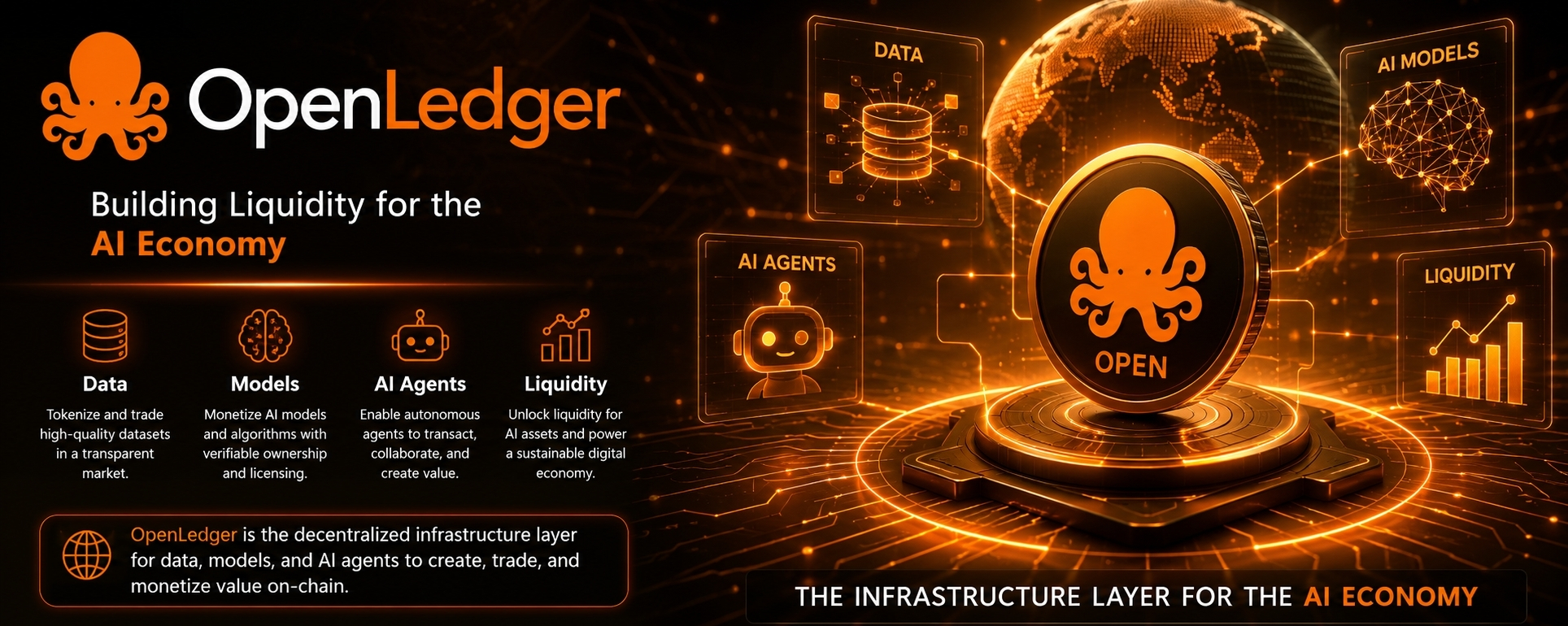
@OpenLedger #OpenLedger $OPEN A lot of people in crypto talk about AI now like it’s inevitable. Like the market already decided where this whole thing is going and we’re all just waiting for price action to catch up. But honestly, most of the time when I hear “AI + blockchain,” it still feels vague to me. Too clean. Too packaged. Everybody says data is valuable, models are valuable, agents are valuable, but very few projects actually explain how any of that value moves between people in a real market.
That’s probably why OpenLedger caught my attention.
Not because it promised some futuristic AI economy overnight. More because it’s trying to deal with something crypto has quietly struggled with for years: liquidity around digital intelligence itself. Not just tokens. Not memes. Actual usable data, models, and autonomous systems.
I remember when DeFi first exploded and suddenly everything became financialized. LP positions, governance rights, yield streams. Even attention became tradable for a while. Then NFTs tried to create ownership around culture and digital identity. AI feels different though. Less visual. Less emotional maybe. The assets are harder to understand.
A dataset isn’t exciting to look at. Neither is a machine learning model. But there’s real value there if the market can actually price it correctly.
That’s where OpenLedger starts getting interesting to me.
The idea of unlocking liquidity around AI infrastructure sounds abstract at first, but when you sit with it for a minute, it actually connects to something pretty familiar in crypto. Markets tend to grow around anything people want access to but can’t efficiently monetize yet. We saw it with compute. We saw it with storage. Maybe now we’re starting to see it with intelligence itself.
It also says something about where this cycle may be heading.
For a while the market was obsessed with pure speculation again. Memecoins everywhere. Attention rotating every few hours. Honestly, part of me understands it because liquidity has been weird this cycle. People got conditioned to chase velocity instead of durability. But underneath that noise, infrastructure quietly kept building. It always does.
Maybe I’m overthinking it, but I feel like the projects surviving long term will probably be the ones solving coordination problems instead of just manufacturing engagement.
OpenLedger seems positioned around that exact tension. How do you let people contribute data, models, or AI agents while still creating a market where those contributions have measurable value? That’s not an easy problem. Most systems either become too centralized or too fragmented to function well.
The data side especially matters more than people realize.
Everyone talks about models, but models are only as useful as the data flowing into them. And right now, a huge amount of valuable data sits trapped inside private systems. Corporations monetize it. Platforms monetize it. Users usually don’t. Crypto has always had this underlying belief that ownership should be more distributed, even if reality doesn’t always cooperate.
So when a blockchain starts focusing on monetizing data itself, I pay attention.
Not because it guarantees success. Far from it. Actually, I think the challenge is enormous. Data markets are messy. Incentives break easily. Quality control becomes difficult fast. There’s also the uncomfortable question of whether decentralization always improves AI systems or just complicates them.
I don’t think the industry fully knows the answer yet.
Still, there’s something compelling about watching blockchain evolve beyond pure finance. A few years ago most conversations revolved around payments or replacing banks. Now we’re talking about machine economies, autonomous agents, distributed intelligence layers. The vocabulary changed without most people even noticing.
And maybe that shift matters more than token prices right now.
One thing I’ve noticed lately is how many builders in crypto are no longer trying to onboard everyone immediately. That frantic energy from earlier cycles feels weaker now. Teams seem more focused on building systems that actually function before worrying about mass adoption narratives.
OpenLedger gives me that feeling a little.
Not flashy. Not screaming for attention every second. More like a project trying to establish rails before traffic arrives. Sometimes those projects disappear quietly. Sometimes they become foundational years later and everyone pretends the outcome was obvious from the start.
Crypto does that a lot.
I also keep thinking about AI agents specifically. People throw the term around casually now, but autonomous systems interacting economically with each other could create entirely new forms of market behavior. Agents purchasing data. Agents licensing models. Agents optimizing execution without human intervention.
That sounds exciting and slightly unsettling at the same time.
Maybe that’s why I find this sector interesting in general. It forces crypto people to think beyond speculation cycles and ask deeper questions about ownership, coordination, and value creation in digital environments. Questions that don’t always have clean answers.
And honestly, I’m still unsure how fast all of this develops.
Part of me thinks the market is early. Another part thinks narratives around AI might already be overheated in some areas. Both can be true simultaneously. Crypto has a habit of discovering real ideas through irrational behavior first.
Still, I can’t ignore how often liquidity becomes the deciding factor in whether technology ecosystems actually grow. Developers need incentives. Contributors need monetization paths. Markets need ways to price assets efficiently. Without that, even strong technology struggles to sustain momentum.
That’s probably the core reason OpenLedger stays on my radar.
Not because it claims AI matters. Everyone claims that now. But because it’s approaching AI through the lens crypto understands best: coordination and liquidity.
And maybe that’s the part people underestimate.
I keep coming back to how strange this whole space feels lately. Half the market is chasing instant narratives while another half is quietly building systems that might take years to fully make sense. Somewhere in between, projects like OpenLedger are trying to define what ownership looks like in an AI-driven internet.
I don’t know yet whether that vision fully works. Maybe nobody does.
But I think the fact we’re even having these conversations now says something important about where crypto is heading next.$OPEN
