

There was a moment around 2 AM last week that genuinely made me sit up straight.
Not because the market suddenly became volatile, but because I had just deployed an OctoClaw agent and configured a simple workflow for it — detect price spreads between two DEXs, automatically bridge through the cheapest chain, execute if the spread moved above a certain threshold. Then I went to sleep. The next morning, I opened my wallet history and saw several trades had already been executed while I didn’t even know what the market had done overnight. There were no notifications. No “would you like to proceed?” prompt. Nothing. Just completed transactions sitting there on-chain, fully verifiable.
The feeling was strange.
Up until now, the relationship between humans and AI in crypto has mostly been trapped inside one model: AI analyzes, AI suggests, AI warns, then humans manually sign the transaction themselves. It is an absurd amount of operational friction that everyone has quietly accepted as part of using crypto tools. But that night at 2 AM, I realized something different about OctoClaw.
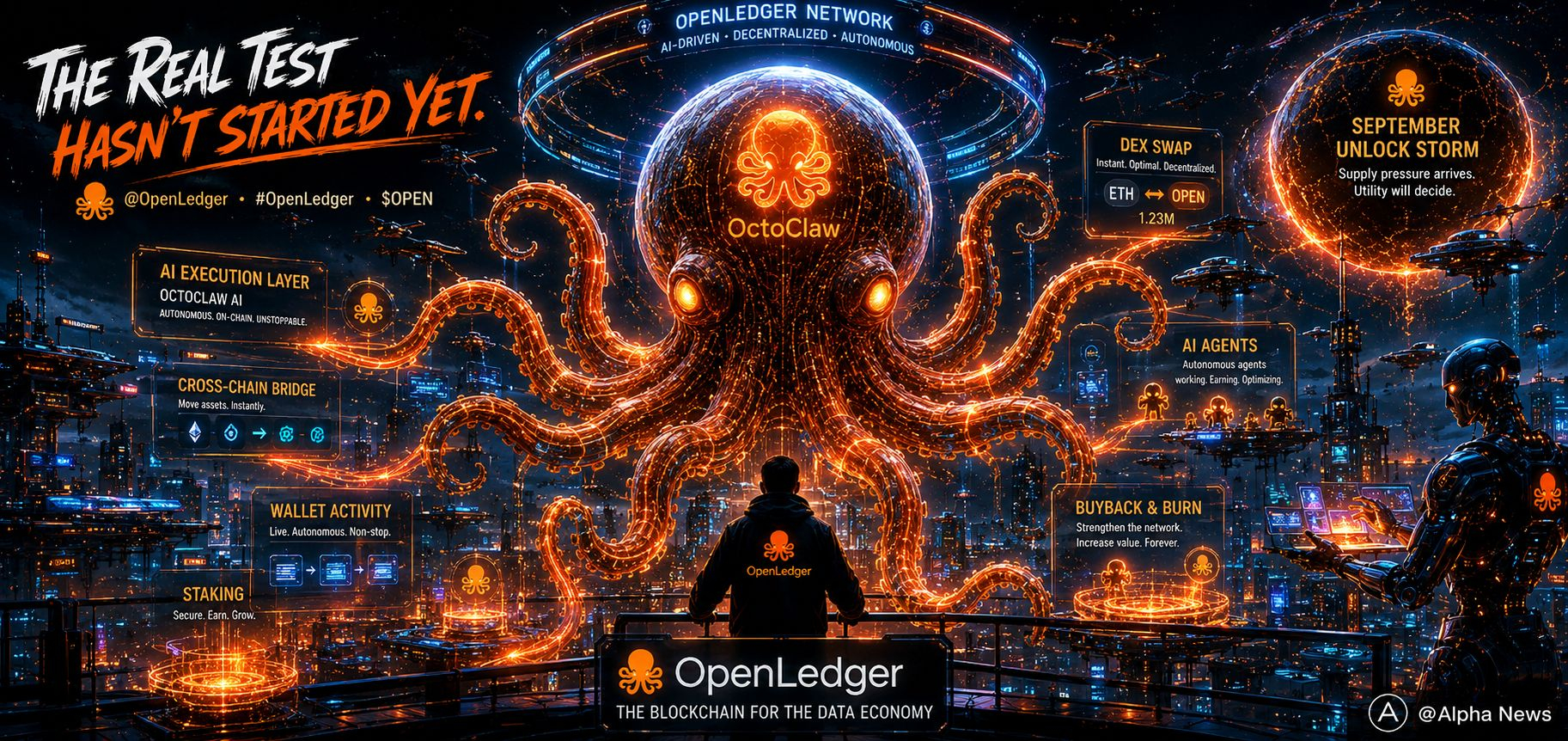
It doesn’t ask, it acts and the difference there is not really about speed or efficiency. It points to a much deeper question.
I spent almost a week afterward rereading OpenLedger’s technical documents, not as a trader evaluating another tool, but as someone who has been through enough market cycles to know that the things which truly change an industry rarely come from improving what already exists. They usually come from asking a question nobody else is asking yet. And the question OctoClaw forced me to think about was this: what happens when AI stops being a passive tool waiting for commands and starts becoming an economic participant capable of acting within boundaries you define?
This is no longer just a technology question. It starts becoming a design question for the entire internet economy.
Take a step back for a second. The internet today runs on an unspoken rule: your data is fuel, but you are not the one getting paid for it. Platforms like Google and Facebook collect data from billions of people, train AI systems on top of it, then generate hundreds of billions of dollars through advertising. You create the value, but you have no place inside the value distribution layer itself. Once AI becomes capable of autonomously executing trades, generating content, and making financial decisions, the question of “who benefits from this AI?” stops being philosophical and becomes a very real economic question.

OctoClaw is not just a trading agent. It feels more like a proof of concept showing that AI can become both intelligent and economically aligned at the same time. While reading OpenLedger’s technical architecture, one concept kept standing out to me: Proof of Attribution. Every dataset, every model, every agent carries a visible lineage recorded on-chain. Outputs can theoretically be traced back to the data sources that helped produce them. More importantly, when those outputs generate value, part of that value can flow back to the people who contributed the underlying data through smart contracts automatically, without intermediaries.
That is not just a technical feature for marketing. It is a statement about how AI economies might eventually operate. And honestly, I’ve seen this pattern before.
When Uniswap first launched in 2018, most people dismissed it as a strange little experiment with terrible UX and almost no liquidity. What they failed to understand was that Uniswap was not trying to build a “better exchange.” It was replacing the entire logic behind exchanges with something fundamentally different: no order book, no registration, no centralized intermediary. It introduced a completely different way of thinking about liquidity itself.
I get a similar feeling when I look at OctoClaw and OpenLedger, except this time the shift may happen one layer deeper. They are not trying to build a smarter AI assistant than Bittensor or Fetch.ai. They seem to be asking a different question entirely: if AI systems can autonomously create economic value, then how should that value flow back to the people who helped create the intelligence behind those systems in the first place?
That is why I think comparing OctoClaw to other AI agents on the market misses the bigger picture. Most agents are designed around the question of how to make AI more capable. OctoClaw feels designed around the question of how to make AI economies more economically fair.
Of course, I’m not saying the model is perfect already. I still have real concerns. If an agent reads incorrect oracle data, who becomes responsible? If a smart contract reverts halfway through a complex workflow, can the agent safely recover from that state? And the question I keep thinking about the most is whether the market is actually ready for this idea of “payable AI” at all when large technology companies have spent the last twenty years extracting data for free.
But I’ve been in this market long enough to know that projects which truly change industries are rarely the ones with the most polished technology at the beginning. Usually they are the ones asking the right question before everyone else realizes the question matters.
And in this case, the important question may not be whether OctoClaw executes trades well. It may be what happens to the internet economy once AI systems can autonomously distribute value back to the people who contributed the data behind them.
I don’t have a certain answer to that yet. But I do know that the people who start thinking about that question early will probably have a very different perspective from those who are still only comparing which AI agent executes a few milliseconds faster than another.
@OpenLedger $OPEN #OpenLedger $ETH

