The next trillion-dollar AI company will not be built the same way Big Tech built the last generation.
That shift is exactly why OpenLedger is starting to attract serious attention across both AI and crypto communities.
For years, artificial intelligence has been controlled by a small group of centralized companies.
They own the models.
They own the data.
They own the distribution.
And most importantly — they own the economic upside.
Meanwhile, the people actually generating the valuable data receive almost nothing.
Every search.
Every conversation.
Every contribution.
Every dataset uploaded online.
Millions of humans continuously feed AI systems for free while corporations monetize the outputs at massive scale.
That model is becoming unsustainable.
AI’s Biggest Problem Is Not Intelligence — It’s Ownership
The market often talks about faster models, larger GPUs, and more powerful inference.
But the real battle of the next decade is data ownership.
AI models are only as valuable as the data powering them.
Without high-quality human-generated data, even the most advanced AI systems lose relevance.
This is where OpenLedger introduces a fundamentally different approach:
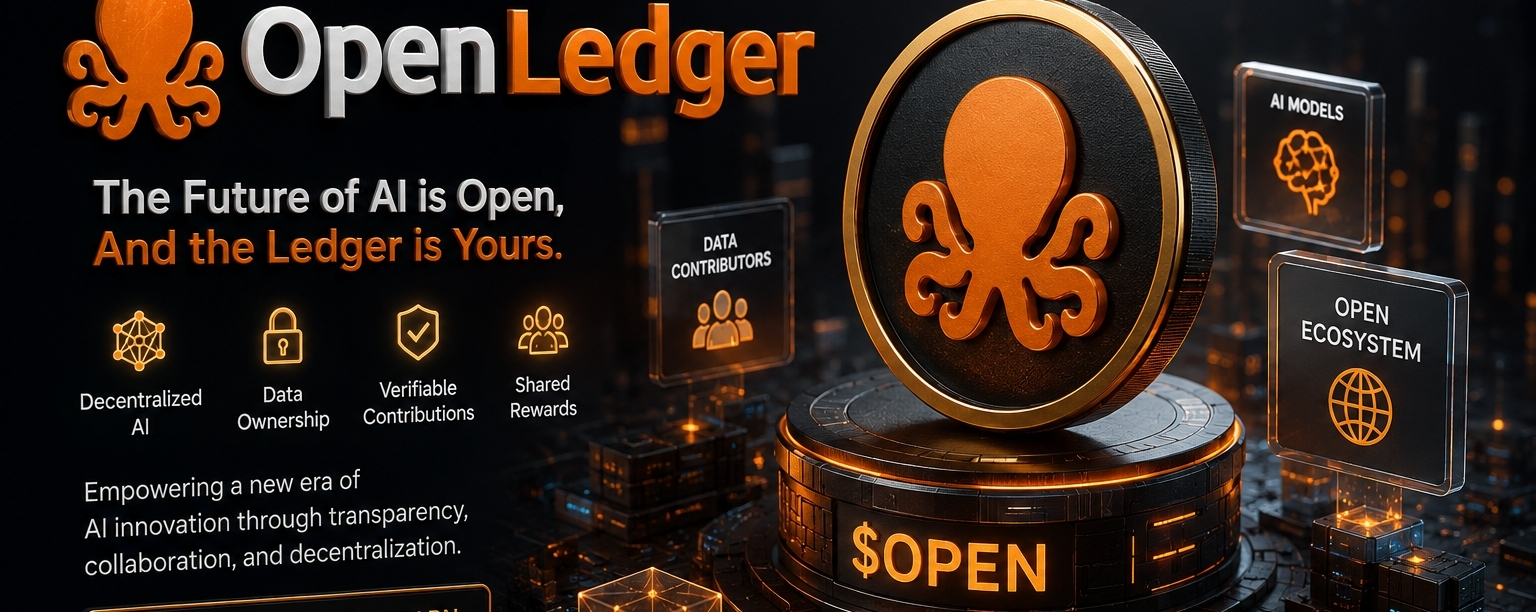
Instead of centralized corporations extracting value from users, OpenLedger aims to create an ecosystem where contributors, developers, and communities can actually own part of the AI economy they help build.
That changes everything.
Why This Narrative Matters Now
Crypto moves in cycles.
2020 was DeFi.
2021 was NFTs.
2024 became infrastructure and real-world assets.
The next major narrative may be decentralized AI economies.
Not speculative AI memes.
Actual AI infrastructure.
The market is beginning to realize something important:
AI without decentralized ownership eventually becomes another version of Web2.
And users are increasingly aware of that risk.
OpenLedger positions itself directly in the middle of this transition by focusing on transparent AI coordination, data contribution systems, and decentralized value distribution.
That combination is powerful because it connects two industries already moving toward convergence:
Artificial Intelligence
Blockchain Infrastructure
Very few projects are building seriously at that intersection.
The Psychological Shift Most Investors Miss
Most people still view AI as a tool.
But over time, AI becomes an economy.
And economies create winners based on who controls the rails.
Google controlled search.
Meta controlled social graphs.
Amazon controlled cloud infrastructure.
The next generation may belong to platforms controlling decentralized AI coordination and data liquidity.
That’s the deeper thesis behind OpenLedger.
It is not simply about launching another token.
It is about creating infrastructure where AI value can flow back toward contributors instead of remaining permanently centralized.
That is a much bigger narrative than short-term price action.
Why Communities Are Paying Attention
Retail interest in AI crypto projects continues growing because people understand the emotional side of this shift.
There is a growing feeling that users helped train modern AI systems without compensation.
Projects like OpenLedger tap directly into that frustration while offering an alternative vision:
Open participation
Shared incentives
Verifiable contribution systems
Decentralized AI coordination
That creates a far stronger long-term story than hype alone.
Narratives become powerful when they connect technology with human emotion.
And “owning the future you help build” is one of the strongest narratives in modern tech.
Final Thoughts
Most people will ignore decentralized AI until it becomes impossible to ignore.
That is usually how major technological transitions happen.
Early skepticism.
Slow infrastructure development.
Then sudden adoption.
Whether OpenLedger ultimately dominates the sector or not, the broader idea behind it is becoming increasingly difficult to dismiss:
The future of AI may not belong entirely to centralized corporations.
It may belong to networks.
And if that future arrives, OpenLedger could become one of the projects people look back on as early infrastructure for the decentralized AI economy.