
For years, crypto moved like a casino with better branding.
New chains every month. Faster throughput. Bigger promises. Everybody screaming about TPS numbers while traders bounced from one narrative to another trying to catch the next vertical candle before it disappeared. We’ve seen this movie already.
Then AI arrived — not quietly either.
Suddenly the internet changed shape almost overnight. Chatbots started writing code. Models started generating images that looked disturbingly human. Entire industries went from “this is impossible” to “this might replace us” in less than two years.
And somewhere inside that chaos, OpenLedger appeared with a very different idea.
Not louder AI.
Not bigger AI.
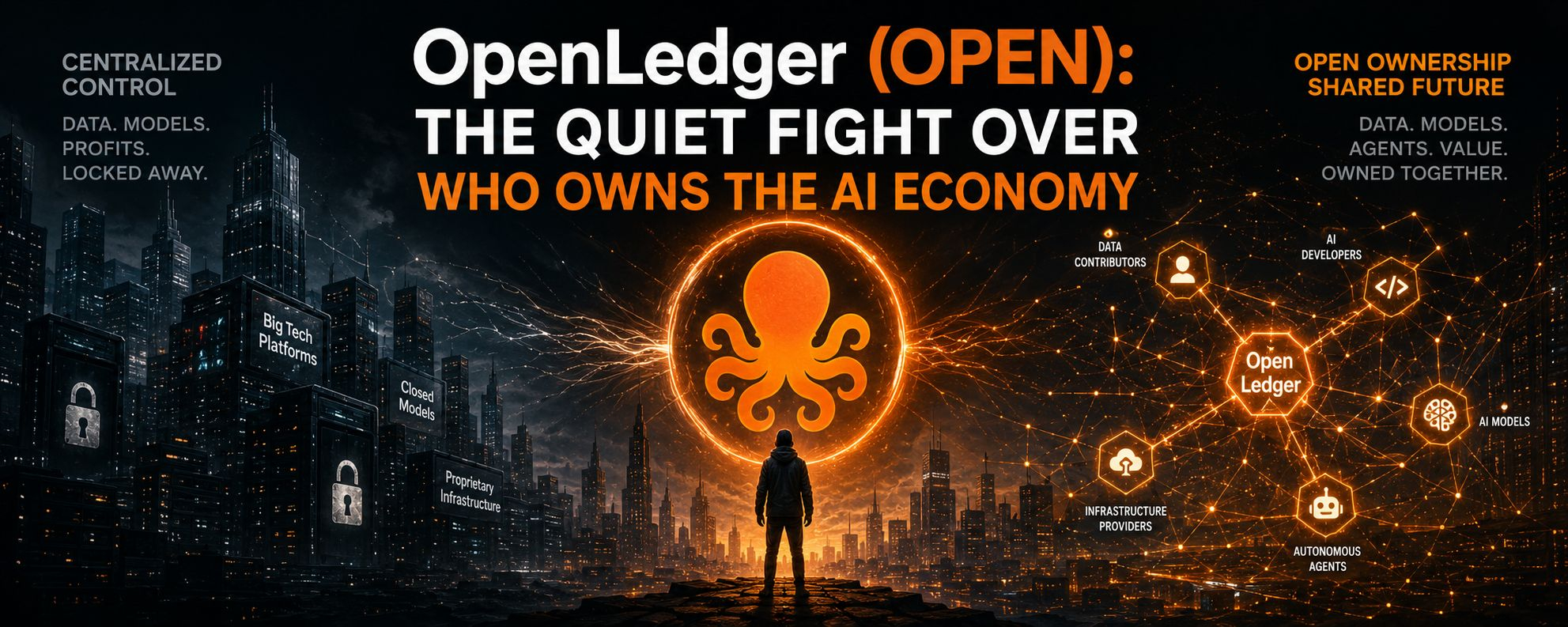
Owned AI.
That changes everything.
Because the truth is, most people still don’t understand what’s actually happening underneath this new AI boom. We keep talking about intelligence, but intelligence isn’t the real power here. Data is. Infrastructure is. Ownership is.
That’s where the money lives.
Think about how the internet evolved for a second. We spent twenty years feeding platforms with our behavior — every post, every click, every search, every stupid argument at 2 a.m., every photo, every preference. All of it became raw material. We were building datasets without realizing it.
The platforms monetized them.
Now AI companies are doing the same thing at a much larger scale. Except this time, the output isn’t just advertising revenue. It’s machine intelligence itself.
Look, that should probably make all of us pause for a minute.
Because the current structure is brutally one-sided. A handful of companies control the compute. They control the training pipelines. They control the infrastructure. They control distribution. And increasingly, they control the intelligence layer being wired into the modern internet.
That concentration is real.
And honestly, it’s accelerating faster than most people expected.
OpenLedger is basically reacting to that reality before it becomes permanent.
I know what you’re thinking—crypto already promised decentralization once before. And yeah, fair point. Most of those promises collapsed under speculation, bad incentives, or technology nobody actually needed. We’ve watched entire sectors pretend to be revolutions while surviving purely on token emissions and hype cycles.
This feels different though.
Subtly different.
Because OpenLedger isn’t really trying to “beat” the biggest AI companies at their own game. That would be absurd. Nobody is casually competing with trillion-dollar infrastructure and near-unlimited compute budgets.
Essentially, the project is attacking the economic layer around AI instead.
That’s smarter.
The core idea is simple enough to explain to anybody outside crypto: if data, models, and autonomous agents are becoming valuable economic assets, then maybe they shouldn’t live inside closed systems forever. Maybe there should be open rails where those assets can move, interact, generate value, and compensate participants directly.
Not just corporations.
Us too.
And the weird thing is — once you frame it that way, the whole concept suddenly sounds less speculative and more inevitable.
Because AI is already becoming modular. One company trains a model. Another fine-tunes it. Another provides inference. Another supplies data pipelines. Another builds autonomous agents on top of everything else. The system is fragmenting in real time.
Fragmented systems create coordination problems.
Coordination creates markets.
Markets need infrastructure.
That’s the opening.
Earlier AI crypto projects mostly failed because they confused attention with utility. Slap “AI” onto a token and suddenly everybody pretended they were investing in the future. But underneath the narrative, there usually wasn’t much substance. No real demand. No durable architecture. No reason the system needed to exist outside speculation.
The market eventually figured that out.
Painfully.
Now we’re entering a colder phase — and honestly, colder markets are where the serious projects start separating themselves from the noise. People stop caring about slogans. They start asking uglier questions.
Who uses this?
Why does it matter?
Does the architecture actually hold together once speculation disappears?
OpenLedger exists inside that more skeptical environment, which might actually help it long term. Weirdly enough, projects built during calmer periods tend to survive longer because they’re forced to solve real problems early.
But here’s the catch: none of this is easy.
Not even close.
Decentralized AI infrastructure sounds exciting until you start looking at the engineering reality behind it. Centralized systems are faster. More efficient. Easier to coordinate. AI already demands absurd computational power, and distributed systems naturally introduce friction into almost every layer of execution.
Latency becomes a problem.
Storage becomes a problem.
Inference becomes a problem.
Scaling becomes a problem.
Everything gets harder.
That’s before we even touch regulation — which is another storm entirely. Governments are already circling AI from every direction while crypto regulation remains inconsistent almost everywhere. Put those two industries together and you create a policy headache nobody fully understands yet.
Still, the pressure underneath this movement keeps growing.
Why?
Because AI is no longer behaving like normal software.
That’s the important shift.
We’re watching AI evolve into infrastructure itself — something closer to electricity or cloud computing than a simple product category. And whenever infrastructure becomes essential, ownership starts becoming political whether we like it or not.
We’ve seen this pattern before.
The internet decentralized publishing, then giant platforms centralized attention.
Cloud computing centralized infrastructure again.
Now AI risks centralizing intelligence itself.
That’s the actual backdrop behind projects like OpenLedger. Not memes. Not speculative token charts. A deeper fight over who participates in the value creation layer of machine intelligence.
And honestly, that fight is only getting started.
The part most people still underestimate is autonomous agents. Right now, AI feels like a tool we interact with manually. You ask questions. It responds. Simple enough.
But that won’t stay static forever.
Agents are gradually becoming capable of independent coordination — interacting with APIs, executing tasks, managing information flows, even making economic decisions in limited environments. Once software starts participating economically on its own, traditional systems start looking outdated very quickly.
I mean, think about that for a second.
Machines transacting with machines.
Agents paying for data access.
Autonomous systems coordinating services in real time.
That’s not science fiction anymore. Pieces of it already exist.
Traditional financial infrastructure was never designed for that world. Blockchain systems actually might be. Not because they’re trendy — because programmable coordination suddenly becomes useful once non-human actors enter the economy at scale.
And no, this doesn’t mean every AI interaction ends up on-chain. People exaggerate that part constantly. Most systems will probably remain hybrid because efficiency still matters.
But some layer of programmable ownership and transparent coordination? That feels increasingly hard to avoid.
Which brings us back to OpenLedger.
The project is essentially making a long-term bet that the future AI economy won’t function properly if ownership remains completely concentrated inside closed ecosystems. Data contributors will want participation. Developers will want portability. Agents will need interoperable economic rails.
The market hasn’t fully priced that possibility in yet.
Maybe it never will.
But if AI really becomes the next foundational layer of the internet — and it probably will — then the systems controlling ownership around it may end up mattering just as much as the intelligence itself.
That’s the uncomfortable thought sitting underneath this entire sector.
Not whether AI becomes powerful.
We already crossed that line.
The real question is who gets to own the machine economy once it arrives.