
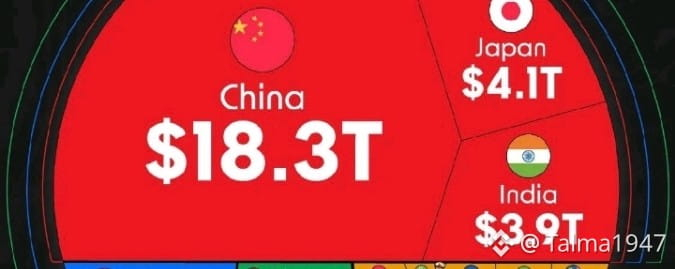
Asia’s economy is now roughly $40 trillion in GDP as of 2024, making it the largest regional economy on the planet. That’s about 40% of global GDP, and it’s driving ∼60% of all global growth.
Here’s how that $40T weight is actually hitting the markets:
1. Where the $40T comes from
- China: ∼$18.3T, 46% of Asia’s GDP. Manufacturing, tech, exports, AI, green energy.
- Japan: ∼$4.1T. Heavy in autos, robotics, advanced tech.
- India: ∼$3.9T and growing fast. Projected to overtake Germany as #3 by 2029.
- South Korea, Indonesia, Türkiye, Saudi Arabia make up most of the rest.
Asia dominates trade in semiconductors, consumer electronics, and accounts for ∼1/3 of global goods trade.
2. Impact on global markets
A. Growth engine the West can’t ignore
Asia is expected to contribute ∼60% of global GDP growth in 2025 and 2026. For investors, that means the “world” ETF isn’t actually the world: MSCI World has only ∼8% exposure to Asia, mostly Japan, and 0% to China, India, Taiwan, Korea. You’re systematically underexposed to the main growth story if you’re just holding US/EU indices.
B. Supply chains and trade flows are shifting east
- Intra-Asia trade is now 52% of all Asian trade. aeba
- More of what China and India produce is consumed domestically. China’s export share of output dropped from 15.5% to 8.3% from 2007-2017. 80e5
- Only 18% of goods trade today is low-wage to high-wage exports, down from the old globalization model.
C. Sector exposure you don’t get elsewhere
Asia is overweight in semiconductors, EVs, green tech, AI hardware, and high-growth consumer markets. Taiwan/Korea dominate AI chips, China leads in EV and green energy, India has a digital/demographic boom. Those are underrepresented in European and US indices.
D. Derivatives and capital markets following the shift
Asia Pacific’s economic weight and developing financial markets are shifting focus in the global derivatives market eastward. More liquidity, hedging, and price discovery is happening in Asia-linked contracts.
E. Valuation and diversification angle
Many Asian markets trade at a discount to US peers. They also run on different economic cycles - domestic consumption in India, export manufacturing in Taiwan, innovation in China - so they’re less synchronized with US/EU cycles. That’s a hedge against euro/dollar volatility.
3. The big picture shift
McKinsey calls it “Asianization”: after Europeanization in the 1800s and Americanization in the 1900s, the world’s center of gravity is moving to Asia. By 2040 Asia could be >50% of world GDP and nearly 40% of global consumption.
Bottom line: The $40T Asian economy isn’t just big, it’s the main driver of global growth right now. Markets that ignore it are missing the sectors and cycles that are actually expanding. That’s why funds and corporates are reallocating more exposure to China, India, Japan, Taiwan, Korea.
Want me to break down which specific markets/sectors in Asia are getting the most capital inflow right now, or how this affects US/EU stocks you might hold?