I was talking to a DeFi builder the other day and they said something that stuck with me.
“We don’t really build finance anymore. We just debug coordination.”
And honestly… that hit harder than it should’ve.
Because when you actually look at DAO treasuries, they’re not struggling with “finance problems” in the classic sense. It’s not yield. It’s not even security most of the time. It’s coordination. Humans sitting between intent and execution, constantly slowing everything down.
And yeah, that’s the real bottleneck now. Not gas. Not smart contract complexity. Coordination.
It’s everywhere once you notice it.
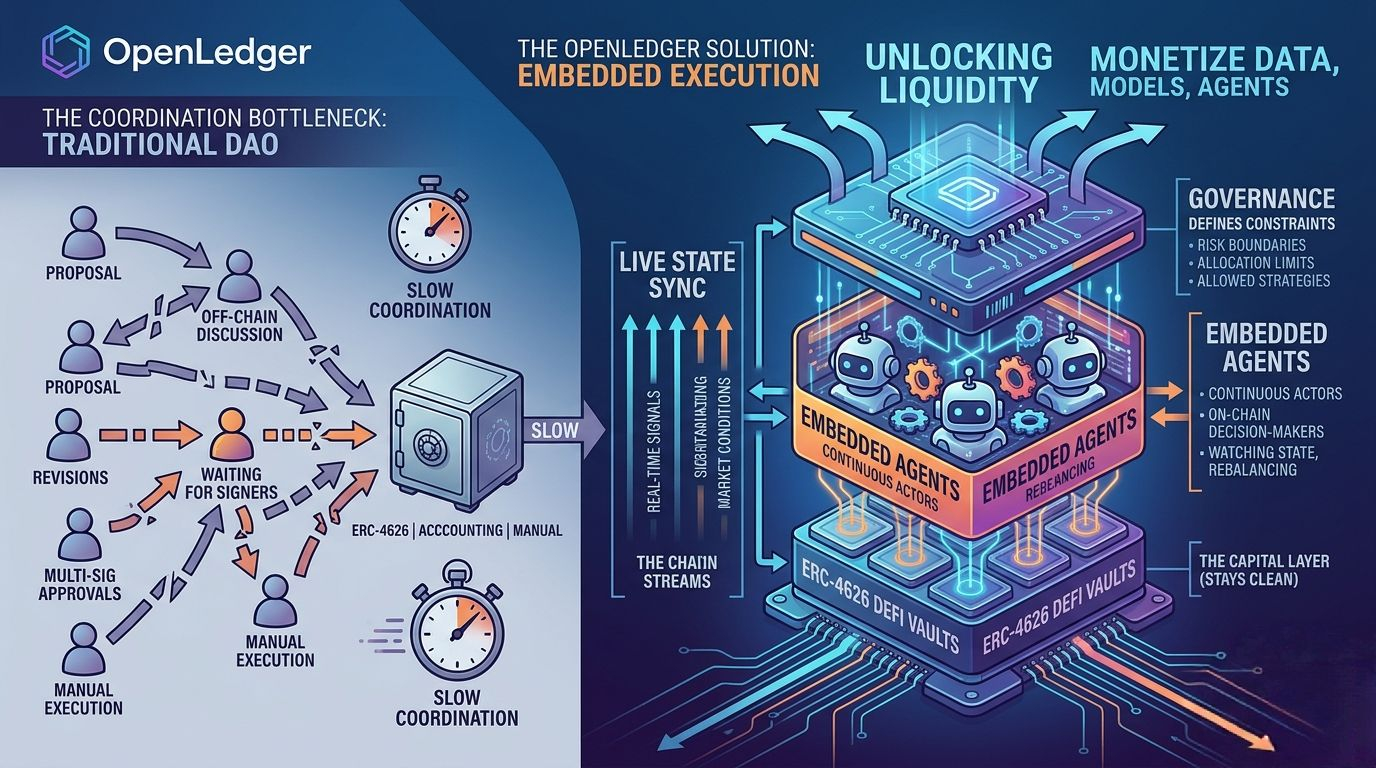
Look at how a DAO moves money today. It starts with a proposal. Then a discussion somewhere off-chain. Then revisions. Then waiting for signers across time zones. Then multi-sig approvals. Then finally execution… if nothing gets stuck.
It feels like watching a system constantly translate itself between layers that don’t really talk to each other properly.
And here’s the uncomfortable truth: capital is already fully digital. We solved that part. Tokens, vaults, shares — all of it works fine.
But moving capital? That still feels manual.
That gap is the problem.
Here’s the thing people don’t say out loud: crypto solved representation, not execution.
We know exactly what capital is. We can model it cleanly. We can track it, split it, bundle it.
But what it does over time? That part still depends on humans or external bots glued on top.
And that’s where things start breaking in subtle ways.
Now take something like ERC-4626 — the vault standard.
It does its job well. No doubt about that.
Deposits. Withdrawals. Shares. Accounting. Clean interface. Everything neatly structured.
ERC-4626 basically gives DeFi a common language for vaults.
But here’s the limitation that matters: it doesn’t actually run anything.
It tracks state. It doesn’t evolve state on its own.
So what you end up with is a vault that understands balances perfectly… but has no idea how to act when conditions change unless something external pushes it.
That’s the missing piece.
Now this is where OpenLedger steps in, and I’ll be honest, this is the part I find most interesting.
Because instead of treating execution as something outside the system, it tries to pull execution inside the system itself.
Not “automation on top.”
More like: execution as a native layer of the vault.
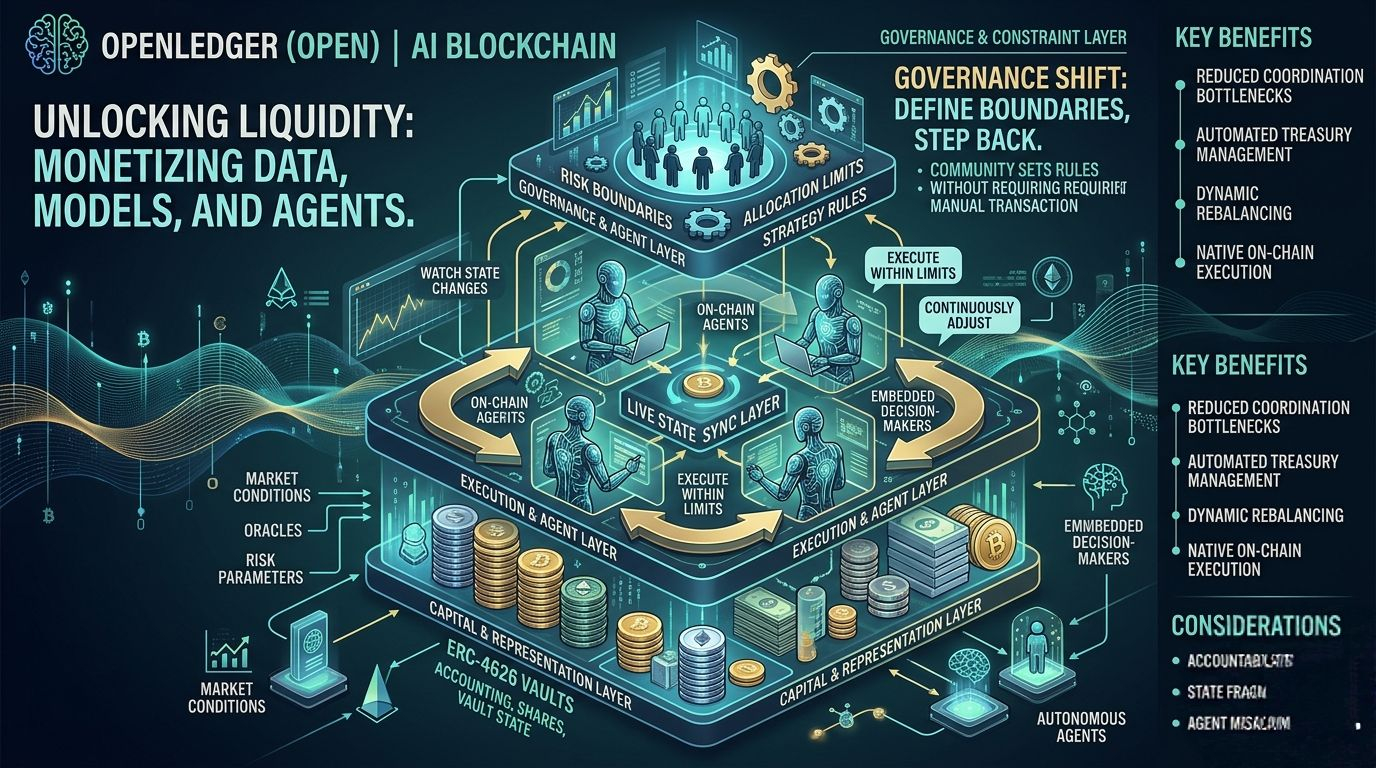
Think of it like this stack:
At the bottom, you still have ERC-4626 vaults handling accounting. That part doesn’t change.
On top of that, you get agents — real on-chain actors, not just off-chain bots — making decisions based on vault state, market conditions, and risk parameters.
Then you’ve got a live state sync layer feeding everything real-time signals.
And finally, governance sitting at the top, not approving every move, but setting boundaries.
That last part is important. I’ll come back to it.
Because this shifts everything.
Vaults stop acting like passive containers. They start behaving like systems that continuously adjust themselves.
Capital doesn’t just sit there anymore. It reacts.
Slowly at first… then constantly.
It feels less like finance and more like a control system. Almost mechanical in a strange way.
And now the big shift: agents inside the system.
Not tools. Not dashboards. Not external execution scripts.
Actual embedded decision-makers operating inside vault logic.
They watch state changes. They respond. They rebalance. They execute within limits.
And they never “log in.” They just exist as part of the system.
That’s a different mental model entirely.
Governance changes too, and this is where most people misunderstand it.
Traditional DAO governance says: “vote on this transaction.”
This model says: “define what the system is allowed to do, then step back.”
So instead of approving actions, governance defines constraints:
risk boundaries
allocation limits
allowed strategies
system rules that must never break
And after that? Agents handle the rest.
Honestly, that’s a big mental shift for most DAO communities. Because it removes the feeling of control over individual actions. But in return, you get something closer to continuous execution.
Let’s be real though — this isn’t all clean and safe.
You introduce autonomy, you introduce ambiguity.
Who do you blame when something goes wrong?
The agent? The governance rules? The people who designed the constraints?
It gets messy fast.
And I’ve seen this before in other systems — once execution becomes continuous, accountability stops pointing at a single moment in time. It spreads out. Sometimes uncomfortably so.
There’s another issue people don’t talk about enough: state fragmentation.
Even if OpenLedger runs a tight internal loop, it still interacts with the rest of DeFi.
And the rest of DeFi doesn’t sync perfectly.
Oracles lag. Protocols update at different speeds. Cross-system state always drifts a little.
So you end up with this weird situation where your internal system feels continuous… but the outside world doesn’t.
That mismatch creates edge cases. Always does.
And then there’s agent misalignment.
This one’s subtle.
If you define boundaries badly, agents won’t “break” anything in an obvious way. They’ll just optimize inside your rules in ways you didn’t expect.
No hacks. No exploits.
Just behavior that technically fits the constraints but doesn’t match what humans meant.
That’s usually the most dangerous kind of failure, by the way.
Still, zoom out a bit.
The direction here feels obvious.
DAO treasuries don’t scale well with human coordination layered on top. It slows everything down. It always has.
So systems start shifting toward something else — less approval-based, more continuous, more rule-defined, more machine-executed.
OpenLedger sits right in that transition.
Not as a “better dashboard.”
Not as “automation.”
But as an attempt to embed execution directly into the capital layer itself.
And that changes how you even think about a treasury.
It stops being a pool you manage every week.
It becomes something that’s always moving, always adjusting, always responding.
Like it has its own internal rhythm.
A bit unsettling if you think about it too long.
But also… kind of inevitable.