Look, I’ll be honest.
For a while, the AI conversation started sounding weirdly repetitive to me.
Build bigger models.
Buy more GPUs.
Collect more data.
Push performance numbers higher.
Repeat.
That’s basically been the whole story. People keep treating AI like it’s a factory problem. Throw enough resources into the machine and eventually intelligence pops out on the other side.
Simple.
Except... I don't think it actually works that cleanly.
Because here’s the thing people don’t talk about enough.
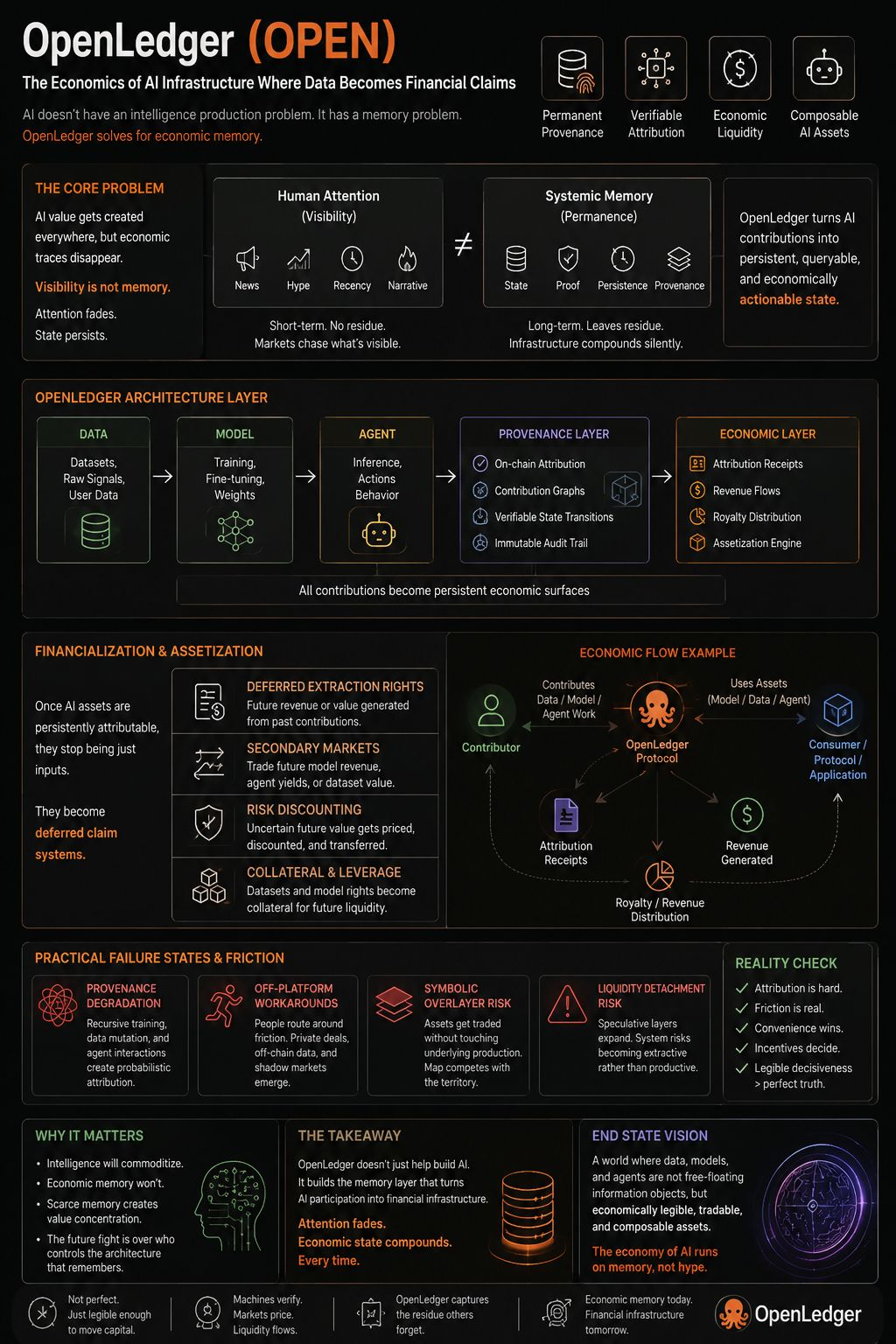
AI doesn’t really seem to have an intelligence production problem anymore.
It has a memory problem.
And yeah, I know that sounds odd at first.
Stick with me.
Intelligence gets produced everywhere now. Data gets generated constantly. Models learn from millions of signals. Agents execute actions all over the place. Stuff keeps happening nonstop.
But the weird part is what happens afterward.
The economic traces disappear.
That’s the part that bothers me.
Because people assume creating value automatically means keeping value.
It doesn’t.
Not even close.
I’ve seen this before in other systems too.
Humans mix up visibility and memory all the time. Markets do it constantly.
But they aren't the same thing.
Visibility runs on attention.
Memory runs on permanence.
Visibility asks:
"What are people looking at right now?"
Memory asks:
"What still exists after everyone gets distracted?"
Huge difference.
Markets love visible moments because visible moments fit neatly into headlines.
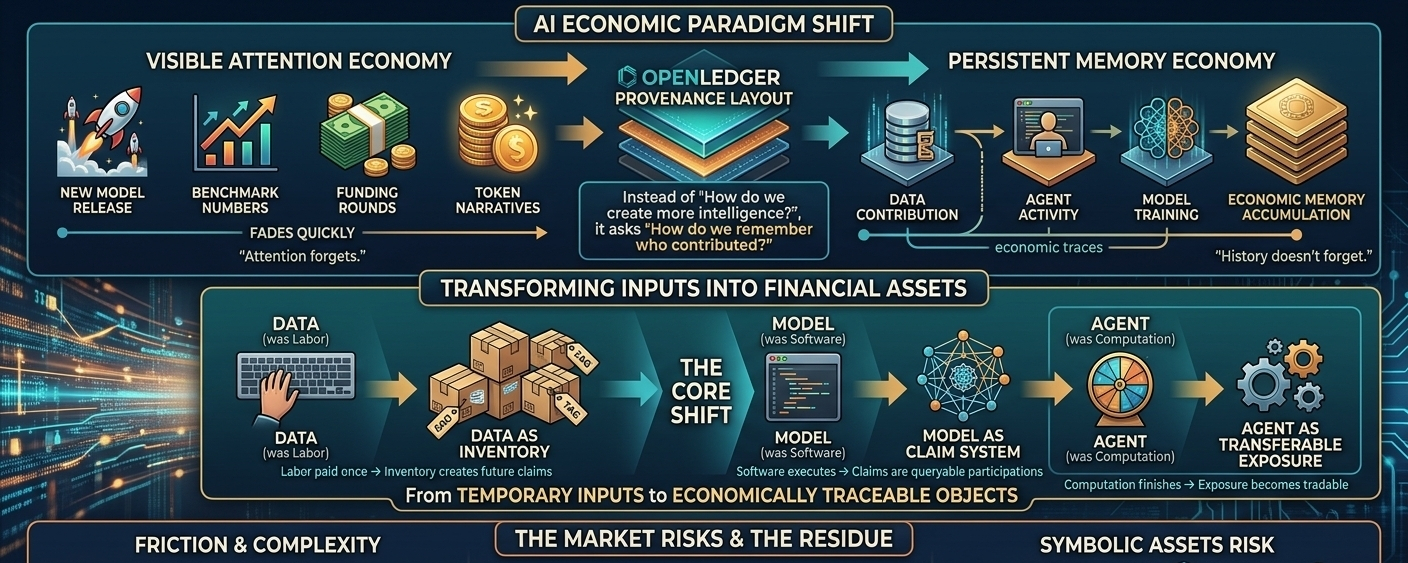
New AI model release.
Benchmark numbers.
Funding rounds.
Token narratives.
People see these things and think they're looking at the real story.
Maybe they are.
Maybe they aren't.
Because infrastructure almost never behaves like that.
Infrastructure leaves residue.
Think about a bridge for a second.
Nobody wakes up every morning thinking about a bridge. Nobody posts emotional threads about bridges.
But thousands of people still drive over it every day.
That's where the value comes from.
The repeated use.
The invisible dependency.
OpenLedger starts getting interesting here because it shifts the focus a little.
Instead of asking:
"How do we create more intelligence?"
It starts asking:
"How do we remember who contributed to the system after the work already happened?"
Small question.
Huge consequences.
Because if datasets, models, and agents become economically traceable objects instead of temporary inputs, things start changing fast.
Data stops behaving like labor.
It starts behaving like inventory.
And that's a very different world.
Labor gets paid once.
Inventory creates future claims.
Financial systems figured this out a long time ago.
Invoice factoring never cared much about whether someone already finished work. It cared about future payments attached to that work.
Litigation finance does the same thing. People don't buy lawsuits because they enjoy reading legal documents. They buy future claim potential.
Distressed debt markets work similarly.
They don't buy certainty.
They buy uncertainty at a discount.
That's where things get interesting.
Because OpenLedger starts sitting near some of those same mechanics.
A dataset stops being just information.
A model stops being just software.
An agent stops being just computation.
They start acting more like future claim systems.
The value doesn't sit entirely in what happens today.
Part of it sits in what might happen later.
Imagine somebody contributes data to a model today.
Months later that data turns out to be strategically useful.
Traditional systems often lose the trail. Attribution gets blurry. Economic memory fades away.
Gone.
But if the system preserves provenance, suddenly the story changes.
Now the participation history stays queryable.
And I think that distinction matters a lot.
Humans organize value through stories.
Machines organize value through retrieval.
Humans ask:
"Who deserves credit?"
Machines ask:
"What can I verify?"
Sounds similar.
It's really not.
Humans tolerate messy situations because people forget things. People negotiate. People reinterpret history every day.
Machines don't care.
Machines want enough certainty to execute something.
Not perfect certainty.
Just enough.
People miss this all the time.
Markets already work this way.
Credit scores aren't perfect.
Insurance models aren't perfect.
Bond markets definitely aren't perfect.
And money still moves around just fine.
Because nobody waits for perfect information.
People wait for enough information.
Big difference.
Now follow this logic a little further.
If economic participation becomes persistent, weird things probably start happening.
Secondary markets show up.
Speculation shows up.
Risk pricing shows up.
Because financial systems always start packaging future possibilities.
Always.
Can future model revenue become tradable?
Can agent activity become transferable exposure?
Can datasets eventually behave like collateral?
Weird questions?
Maybe.
But honestly, financial systems have a habit of turning strange ideas into assets very quickly.
Cash flow became bonds.
Mortgages became securities.
Risk became derivatives.
Attention became advertising inventory.
Why would AI systems magically avoid this?
I don't see a reason.
And once liquidity enters the room, behavior changes.
Every time.
People follow incentives.
Not narratives.
Not mission statements.
Not idealism.
I've watched enough markets to stop believing otherwise.
Now here's where things get messy.
Because theories always look cleaner than reality.
Always.
Attribution sounds nice until actual humans start interacting with it.
Models train recursively.
Data changes.
Agents interact with other agents.
Outputs feed future inputs.
Things blur together.
Fast.
Eventually provenance starts becoming probabilistic instead of perfectly clean.
That's where things get tricky.
Economic ownership gets harder to isolate.
And people start doing what people always do.
They route around friction.
Private agreements appear.
Off-chain workarounds appear.
Shadow systems appear.
Convenience usually wins.
Cost definitely wins.
People don't talk about this enough.
Architecture doesn't automatically force behavior.
Never has.
Napster created friction.
People found alternatives.
Banking systems create friction.
People build parallel systems.
Information systems create friction.
People create informal networks.
Same pattern.
Different industry.
And honestly, there's another risk sitting underneath all this.
The system itself could slowly become symbolic.
I've seen that happen before too.
At first, assets represent real productive activity.
Then people start trading the representation itself.
Then people start trading exposure to the representation.
Then people trade exposure to exposure.
You keep stacking layers.
Eventually people stop touching the underlying thing completely.
The map starts competing with the territory.
Not because anyone planned it.
Liquidity just moves toward easier surfaces.
It always does.
Which brings me back to the bigger question.
Everyone keeps obsessing over AI intelligence itself.
More models.
More compute.
More benchmarks.
Fine.
But I’m not convinced that's where the deepest value sits anymore.
Intelligence increasingly feels like something markets will commoditize.
Memory doesn't.
Economic memory feels different.
Scarcer.
Harder.
Because maybe the future fight isn't about who builds the smartest machine.
Maybe it's about who builds the system that remembers economic participation after everyone else already moved on.
Attention forgets things ridiculously fast.
Markets forget selectively.
Machine-queryable history doesn't really forget at all.
It just keeps accumulating.
And accumulated residue has a weird habit of turning into infrastructure long after people stop paying attention to it.