
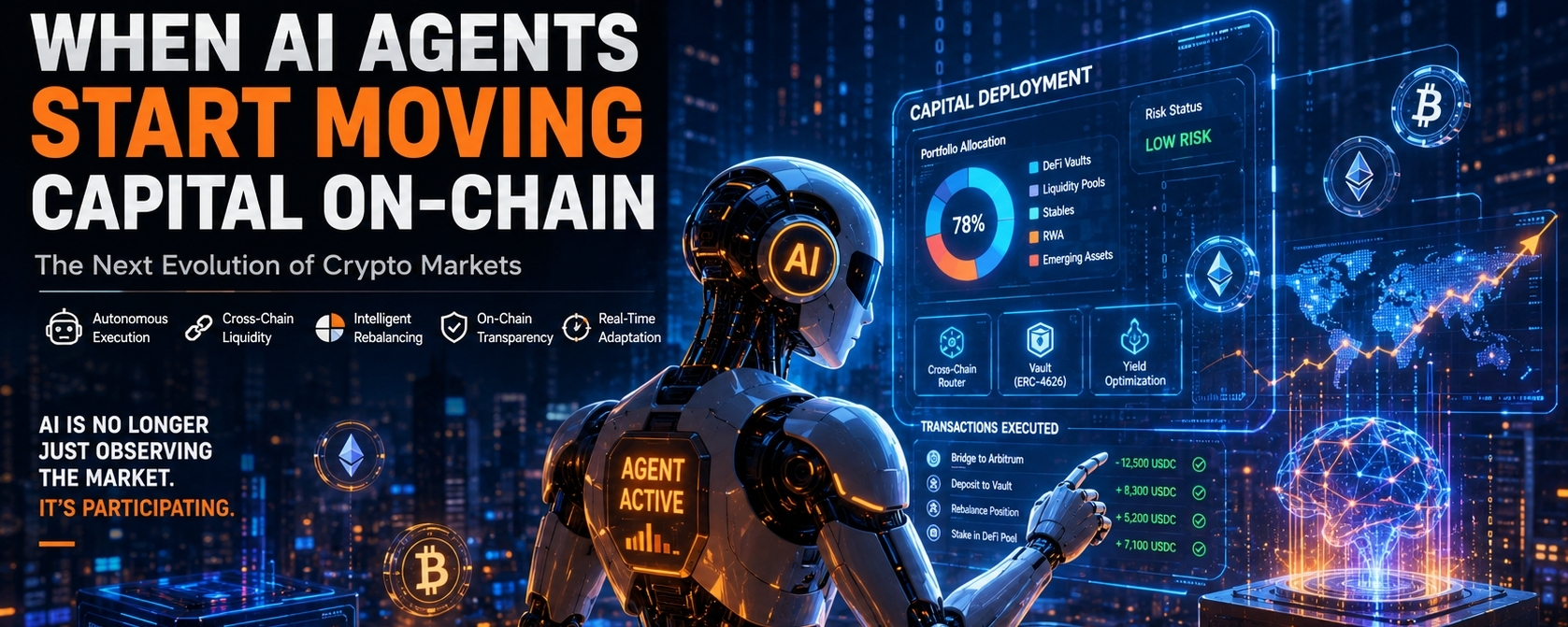
Something has been shifting in crypto, and it feels bigger than another short-lived narrative.
For years, the whole market has quietly depended on humans doing everything. Humans checking dashboards. Humans chasing yield. Humans bridging assets. Humans reacting to volatility after the move has already happened. Even when the tools got faster, the core behavior still felt manual.
That is why the AI agent conversation feels different to me.
The earlier “AI x crypto” wave was mostly about surfaces. Chatbots. Summaries. Signal tools. Nice to look at, useful sometimes, but still sitting outside the real flow of capital. They could explain the market, but they were not really part of it.
Now the idea is changing.
AI agents are moving closer to becoming active participants rather than passive observers. Not just writing commentary about markets, but actually executing actions inside them. Rebalancing positions. Routing liquidity. Managing treasury logic. Interacting with vaults like ERC-4626. Moving capital according to rules, conditions, and objectives without waiting for a human to click approve every single time.
That is a very different world.
Because once agents can actually move capital, crypto stops looking like a network of traders alone. It starts looking like a network of systems talking to other systems. Some human. Some automated. Some semi-autonomous. Some making decisions faster than most people can even process what is happening.
And that is where things get interesting.
People keep asking whether AI agents can trade profitably. That is not the only question worth asking. Markets already have bots everywhere. Arbitrage systems. Market makers. Liquidation engines. High-frequency strategies. Automation is not new.
What feels new is the way these agents may begin blending research, execution, coordination, and treasury management into one continuous loop. A trading bot just does one job. An agent could potentially watch the market, interpret what is changing, adjust exposure, move funds, and even adapt its own behavior based on conditions.
That does not feel like a simple bot anymore.
It feels more like a financial organism with persistence.
And honestly, I do not think the current on-chain infrastructure is fully ready for that.
Crypto is still loud, fragmented, and highly reactive. Humans already create enough chaos by rotating narratives and chasing momentum. Add autonomous systems into that mix, all competing for the same liquidity, and the feedback loops could get strange very quickly.
One agent moves into yield. Another notices. Liquidity shifts. Vault conditions change. Risk limits tighten. Gas spikes somewhere else. The system starts reacting to other systems reacting to other systems.
At that point, humans are no longer the center of the loop.
That is partly why projects like @OpenLedger have stayed interesting to me. Not because they have everything solved, but because they seem to be building around the idea that AI agents will need real infrastructure, not just polished interfaces.
That matters.
Once agents begin handling capital, the invisible layers suddenly become the important ones. Where the data came from. Which model influenced the action. How permissions were managed. Who gets credit when value is created. Whether the system can trace decisions cleanly across environments.
Those are not glamorous topics, but they are the ones that actually matter if AI is going to operate inside finance.
Crypto usually discovers infrastructure late. First comes hype. Then comes chaos. Then someone finally asks how the system is supposed to work at scale.
There is also a deeper tension forming between decentralization and agent efficiency.
Autonomous agents will probably prefer speed, coordination, and uninterrupted access to information. Decentralized systems prefer distribution, friction, governance, and consensus. Those instincts do not always align.
An agent managing capital does not care about ideology. It cares about execution quality. Latency. Liquidity depth. Reliability. Predictability.
That raises a real question: over time, will agent economies naturally gravitate toward the most efficient rails, even if crypto culture keeps insisting openness and fragmentation are the real strengths?
Markets usually reward coordination more than philosophy.
At the same time, fully centralized agent systems create a different problem. If autonomous financial behavior lives behind closed models and hidden infrastructure, then users may lose the ability to understand why capital is moving at all.
The market becomes more efficient, maybe. But also more opaque.
That part feels unresolved.
I do not think humans will disappear from the picture. I do think their role may change. Not because AI becomes some magical superintelligence, but because humans are inconsistent, distracted, and slow compared to systems that can monitor markets around the clock without fatigue.
Consistency itself becomes an advantage.
And crypto already rewards persistence more than brilliance most of the time.
So when I look at this space now, I do not really see a clean “AI future.” I see the early shape of a new market species forming. Not humans replacing machines. Not machines replacing humans. More like overlapping layers of decision-making starting to compete inside the same financial environment.
That is what makes it feel important.
Not just because AI agents may trade.
But because they may eventually participate.
And once that happens, the question is no longer whether the market is automated.
The question becomes who, or what, is actually making the market move.