

I didn’t come across OpenLedger with excitement. That part of me burned out a while ago.
After enough years watching crypto reinvent itself every eighteen months, you stop reacting to slogans. You develop this strange instinct instead a kind of emotional pattern recognition. You hear phrases like “AI infrastructure,” “decentralized intelligence,” or “ownership of data,” and somewhere in your head an old alarm quietly goes off. Not because the ideas are impossible, but because the industry has trained people to confuse ambition with inevitability.
So when I first read about OpenLedger, I approached it the same way I approach most new projects now: already tired.
An AI blockchain. A network designed to monetize data, models, and agents. Another attempt to merge crypto with artificial intelligence, two industries currently feeding each other narratives faster than either can properly digest them. On paper, it sounded dangerously close to the usual formula take a real technological shift, wrap a token around it, then let speculation do the storytelling.
And yet I kept reading.
Not because I was convinced. More because something about the project felt less eager to sell certainty than most things in this space usually do. OpenLedger keeps circling around one uncomfortable question that the broader AI industry still hasn’t answered properly: if large models are being trained on the labor, creativity, conversations, and data of millions of people, then who actually deserves value when those systems become profitable?
That question lingers longer than the token does.
The project talks a lot about attribution. Proof of Attribution, specifically this idea that intelligence should be traceable, that data contributions should be measurable, and that the people or systems helping train AI should not disappear into the background while centralized companies absorb all the upside. It sounds almost obvious once you hear it said out loud. Of course contribution should matter. Of course provenance matters.
But then the second thought arrives.
Do we really need a blockchain for this?
That’s the part I still wrestle with.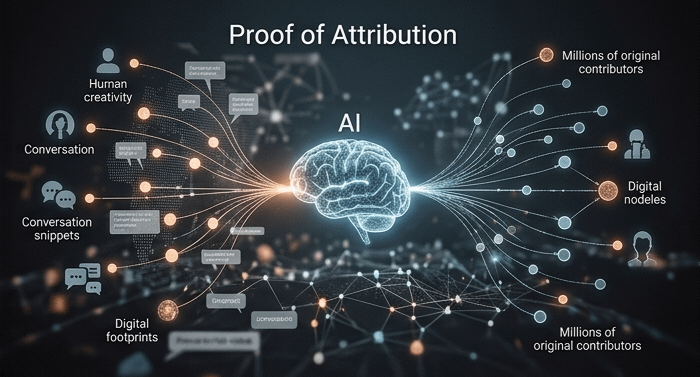
Because I’ve seen crypto become a solution looking for a wound too many times before. Entire ecosystems built around problems that were exaggerated just enough to justify tokens, governance systems, staking mechanics, and reward loops nobody asked for. OpenLedger says it wants to create a transparent economy around intelligence itself where models, agents, and datasets can interact on-chain and where contributors can actually be rewarded for the value they create.
Maybe that’s meaningful.
Or maybe it’s another layer of financialization wrapped around something humans haven’t fully understood yet.
I honestly can’t tell.
Still, I’ll admit this: the timing feels less random than most AI-crypto projects I’ve seen. We’re entering a period where AI systems are becoming less centralized in practice, even if the headlines still revolve around a handful of giant companies. Smaller specialized models are emerging. Autonomous agents are becoming real products instead of conference demos. Data itself is starting to look less like fuel and more like leverage.
And in that environment, OpenLedger’s core idea starts to feel less like marketing and more like an attempt to prepare for an argument that hasn’t fully arrived yet.
Who owns intelligence when intelligence becomes collaborative?
Not philosophically. Economically.
The project recently expanded its ecosystem around what it calls “Data Intelligence,” leaning into systems where AI outputs can supposedly be traced back to the datasets and contributors that shaped them. There’s an almost obsessive emphasis on transparency throughout their architecture attribution layers, reputation systems, on-chain records. You can feel the project trying very hard to build trust into a technological moment where trust is eroding almost everywhere.
That effort matters to me more than the token price ever will.
Because beneath all the branding, what OpenLedger seems to be reaching for is not just infrastructure. It’s a reputation economy around intelligence itself. A system where contribution is visible. Where models are accountable. Where value doesn’t disappear entirely into black boxes owned by a few companies with enough compute and capital to dominate everyone else.
The vision is ambitious enough to sound slightly unrealistic.
Which, strangely, is part of why I haven’t dismissed it yet.
The projects I distrust most are the ones that sound too complete too early. OpenLedger still feels unfinished in a way that makes it more believable. There are gaps. Open questions. Friction between the philosophy and the actual mechanics. You can sense how difficult this would be to scale meaningfully outside of crypto-native circles. You can also sense the possibility that the market may simply not care about attribution as much as builders think it will.
Most users choose convenience over transparency every single time.
History is brutal that way.
And yet there’s this small part of me the part not entirely flattened by cycles and narratives and overfunded promises that keeps watching projects like this more carefully than I’d like to admit. Because every once in a while, beneath all the noise, something emerges that isn’t entirely hollow. Not revolutionary. Not world-changing overnight. Just directionally important.
I don’t know if OpenLedger is one of those things.
But I know I’m not fully looking away either.