I’m watching OpenLedger the same way I watch most AI-crypto projects lately — carefully, quietly, and with a little distance from the excitement surrounding them. The pitch is attractive on the surface. AI models, data, and agents becoming monetizable assets through blockchain infrastructure. It sounds modern in exactly the way the market likes right now. Maybe too perfectly.
What I keep noticing is how fast people move from curiosity to conviction without spending much time in between.
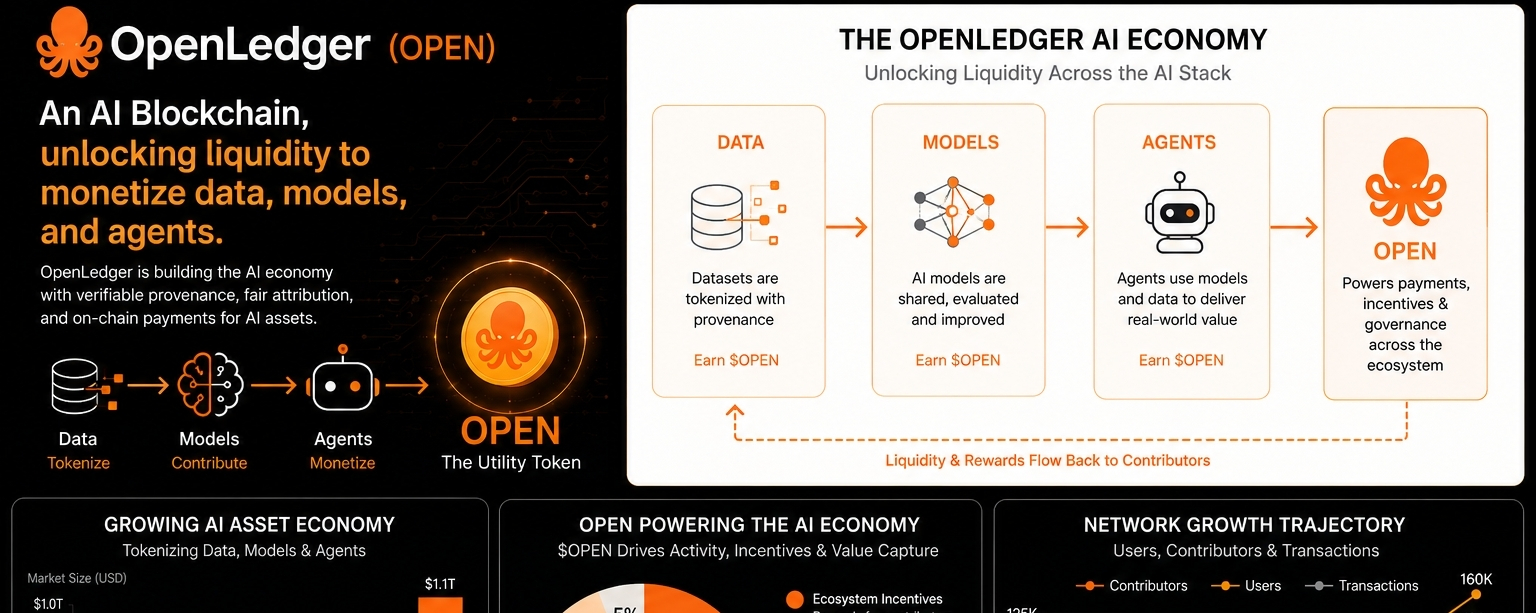
OpenLedger talks about unlocking liquidity around AI contributions, which honestly taps into a real issue. AI systems are built on endless streams of human input, data labeling, model training, behavioral feedback — yet most of the value ends up concentrated in a few companies once the systems become commercially useful. The idea of creating ownership layers around that process makes sense intellectually. I can understand why people want that future to exist.
But crypto has always been good at turning reasonable ideas into oversized expectations.
That’s the part I keep coming back to.
A lot of these projects assume decentralization is automatically the next stage of AI because centralized AI feels uncomfortable. But uncomfortable systems can still dominate for a very long time if they’re faster, easier, and more profitable. Most users don’t care where the infrastructure lives. They care whether the product works.
And that’s where things become less clear.
I’ve seen enough cycles now to recognize how easily narrative momentum can imitate real traction. Once a project becomes attached to AI, people start pricing in an imagined future before the actual ecosystem exists. Suddenly every roadmap feels massive. Every partnership feels historic. Every token becomes “infrastructure for the future.” The language gets bigger while the real usage stays relatively small.
That doesn’t mean OpenLedger is empty. It just means the market has a habit of rewarding possibility long before execution.
There’s also a strange fatigue around all this now. Every few months a new layer appears promising to redefine ownership, coordination, monetization, or intelligence itself. Some survive. Most slowly disappear after the attention shifts somewhere newer. What’s difficult is figuring out which projects are solving real friction and which ones mainly benefit from being adjacent to whatever theme currently attracts liquidity.
I don’t think skepticism means dismissing the idea entirely. AI agents interacting economically with networks feels increasingly realistic. Data marketplaces could matter later. Attribution systems probably become more important as AI scales. OpenLedger is at least aiming at a conversation that will likely stay relevant for years.
Still, relevance of the conversation doesn’t guarantee relevance of the project.
That’s the space I’m sitting in with this one. Watching the ambition, watching the incentives, watching whether users show up naturally once the hype becomes quieter. Because eventually every AI-blockchain project reaches the same moment where the narrative alone stops carrying it.
And I’m not sure anyone knows yet which side of that moment OpenLedger ends up on.