
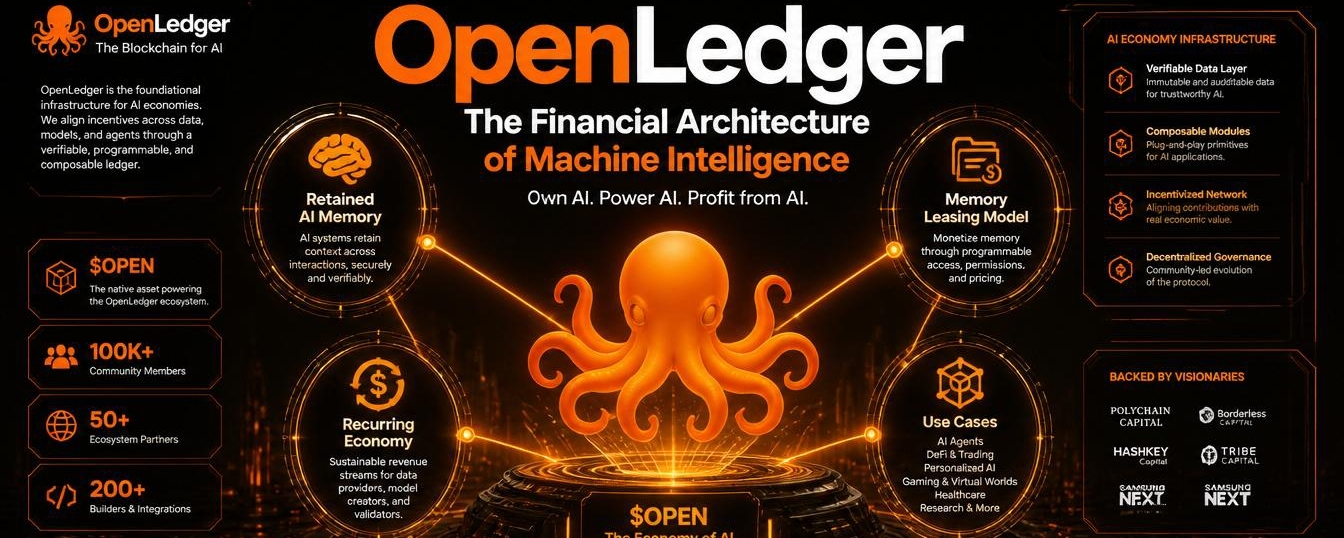
OpenLedger did not emerge from the same instincts that shaped much of early crypto.
Most blockchain systems were initially built around scarcity. Limited block space, fixed token supplies, and speculative liquidity became the dominant organizing principles of decentralized finance. Capital moved quickly between ecosystems, often chasing incentives rather than supporting durable economic activity. For many networks, growth depended less on long-term coordination and more on temporary attention.
Artificial intelligence changes the nature of that equation.
AI systems do not simply require investment capital. They depend on continuous streams of data, model refinement, computation, attribution, and coordination between participants who may never directly interact with one another. The challenge is no longer just how to build intelligent systems, but how to structure ownership, compensation, and trust around them.
This is the environment in which OpenLedger positions itself.
Rather than operating as a conventional blockchain competing for transaction volume, the protocol presents itself more like an economic framework for machine intelligence. Its focus is not only on enabling AI activity, but on creating financial infrastructure around the production and circulation of intelligence itself.
The underlying premise is relatively straightforward.
Data, models, and autonomous agents are increasingly becoming productive digital assets. Yet most existing systems still treat them in extremes: either as closed corporate property or as public resources with little enforceable ownership. OpenLedger attempts to occupy a middle ground by creating a blockchain environment where these assets can be tracked, attributed, monetized, and continuously compensated through on-chain coordination.
What makes the protocol interesting is not necessarily any single technical feature. It is the way the architecture is structured to reinforce economic accountability over time.
At the center of the system is the idea that AI outputs should retain economic lineage.
Traditional financial systems rely heavily on traceable ownership structures. Royalties, equity arrangements, and revenue-sharing agreements all depend on maintaining clear records of contribution and entitlement. OpenLedger applies a similar logic to machine intelligence.
Datasets become identifiable economic objects. Models inherit attribution from the data used to train them. Agents interacting with users generate value flows that can be distributed back across contributors according to predefined rules. Instead of treating AI inference as an isolated event, the protocol frames it as the final stage of a larger production chain.
That distinction matters because attribution is not purely a technical issue. It is fundamentally an institutional one.
Many decentralized AI systems struggle not because they lack computational capability, but because they fail to establish credible frameworks for value distribution. Contributors provide data or models without confidence that future usage will compensate them fairly. Over time, this uncertainty encourages extraction instead of stewardship. Participation becomes speculative rather than productive.
OpenLedger’s design attempts to reduce that instability by embedding economic accounting directly into the lifecycle of digital assets. Ownership rights and contribution histories are meant to exist as part of the system itself, rather than being negotiated informally after value has already been created.
In practice, the protocol resembles a coordinated clearing structure more than a typical blockchain marketplace.
Data providers, model developers, and agent operators each occupy different positions within the network. Their incentives are naturally different, and the architecture does not try to erase those differences. Instead, OpenLedger appears designed to separate responsibilities while still allowing interoperability between layers.
That separation is important.
A large portion of blockchain infrastructure historically pursued composability by merging functions together. OpenLedger moves in a more measured direction. Data provenance, model execution, governance, and liquidity coordination operate as distinct economic layers connected through shared settlement infrastructure.
There is a familiar logic to this approach.
Modern financial systems work because institutions perform specialized roles inside standardized accounting environments. Exchanges, custodians, issuers, and clearinghouses exist separately to reduce systemic confusion and isolate different forms of risk. OpenLedger applies a similar organizational discipline to decentralized AI coordination.
Its tokenized structure therefore seems less focused on generalized participation rewards and more focused on traceability. The protocol attempts to connect measurable contribution with transparent settlement outcomes. Trust is expected to emerge from visible accounting relationships rather than from emissions alone.
That design becomes increasingly relevant once autonomous agents enter the system.
Unlike static smart contracts, AI agents continuously interact with external information, adapt behavior, and potentially generate recurring revenue. These systems introduce ongoing economic relationships that resemble productive enterprises more than simple transactions.
OpenLedger appears structured around this continuity.
Agents are not treated merely as software interfaces. They function as economic participants with programmable revenue distribution attached to their activity. A model trained on multiple datasets, refined by different contributors, and deployed through independent agents can theoretically distribute value back across the full chain of production.
In that environment, liquidity begins to serve a different purpose.
Across much of crypto, liquidity has historically operated as speculative fuel. Capital flows rapidly because many systems lack stable cash-flow foundations. OpenLedger instead frames liquidity as accounting infrastructure — a mechanism for circulating value between productive AI assets and the contributors supporting them.
That model depends heavily on attribution integrity.
If attribution mechanisms fail, the economic trust supporting the network weakens quickly. Contributors lose confidence that compensation reflects actual participation. Data quality deteriorates. Governance becomes contentious. Over time, the system risks sliding back toward speculative extraction.
This is why governance carries unusual importance within the protocol.
In many decentralized systems, governance exists primarily as a way to adjust parameters after deployment. In OpenLedger’s case, governance appears more foundational because it directly shapes legitimacy around ownership, attribution, and settlement.
Questions involving data standards, dispute resolution, contribution weighting, and attribution methodology are not secondary matters. They define whether the accounting structure itself remains credible.
In some ways, the governance layer begins to resemble the role financial regulators or exchange rule-makers play in traditional markets. The challenge is maintaining enough flexibility for innovation while preserving enough procedural consistency for participants to trust the system over long periods of time.
That balance is difficult to sustain.
Systems that become too rigid often fail to adapt as technology changes. Systems that become too fluid lose predictability. OpenLedger’s emphasis on modularity suggests an awareness of that tension. Components can evolve independently without forcing the entire architecture into constant reinvention.
There is a certain restraint embedded in that philosophy.
The protocol does not present itself as an attempt to replace every existing structure overnight. Instead, it reflects a quieter belief that durable infrastructure emerges through layered coordination, procedural clarity, and gradual institutional refinement.
That mindset differs noticeably from the culture that defined many earlier blockchain cycles.
Even its approach to decentralization feels comparatively practical.
Decentralization is not framed as an abstract ideological goal. It functions more as an operational safeguard. Distributing control over data provenance, model ownership, and settlement reduces dependence on centralized entities whose incentives may eventually diverge from the interests of participants.
The emphasis is less on symbolism and more on durability.
At a broader level, OpenLedger also reflects a growing realization that AI markets may eventually resemble capital markets as much as software ecosystems.
As machine intelligence becomes economically productive, ownership around datasets, inference rights, and agent revenues starts to resemble forms of financial exposure. Participants will likely demand systems capable of pricing future productivity, isolating operational risk, and verifying contribution histories with greater precision.
OpenLedger can be viewed as an early attempt to build the accounting rails for that kind of environment.
Whether it succeeds will depend less on narrative momentum and more on institutional discipline. Systems coordinating economic rights around AI require unusually high levels of transparency and consistency. Small failures in attribution or governance can compound slowly into structural distrust.
The protocol’s long-term significance therefore rests on whether its internal logic remains coherent as complexity increases.
More broadly, OpenLedger reflects a shift taking place across parts of the blockchain industry itself. Earlier phases of crypto were largely defined by experiments in digital scarcity and speculative coordination. Increasingly, newer systems are becoming focused on economic organization: how networks account for production, distribute ownership, and sustain trust between participants operating at machine scale.
In that sense, OpenLedger represents less a standalone application and more a particular theory about financial infrastructure for artificial intelligence.
It assumes that intelligence will not remain confined within closed corporate systems. It assumes productive AI networks will require open settlement layers capable of tracking contribution across distributed participants. And it assumes that durable trust emerges not primarily from incentives, but from accounting structures that make economic relationships visible, auditable, and stable over time.
Those assumptions may evolve. The technologies surrounding them certainly will.
But the protocol’s importance lies in the seriousness of the institutional questions it is attempting to solve.
Not every blockchain project aims to become infrastructure in the classical sense of the word. OpenLedger appears to. Its development reflects the belief that decentralized systems mature not through spectacle, but through the patient refinement of governance, accounting, and coordination systems that people can continue relying on even as the surrounding technological environment changes.
That is a quieter ambition than most crypto narratives promote publicly.
It may also prove to be a more durable one.