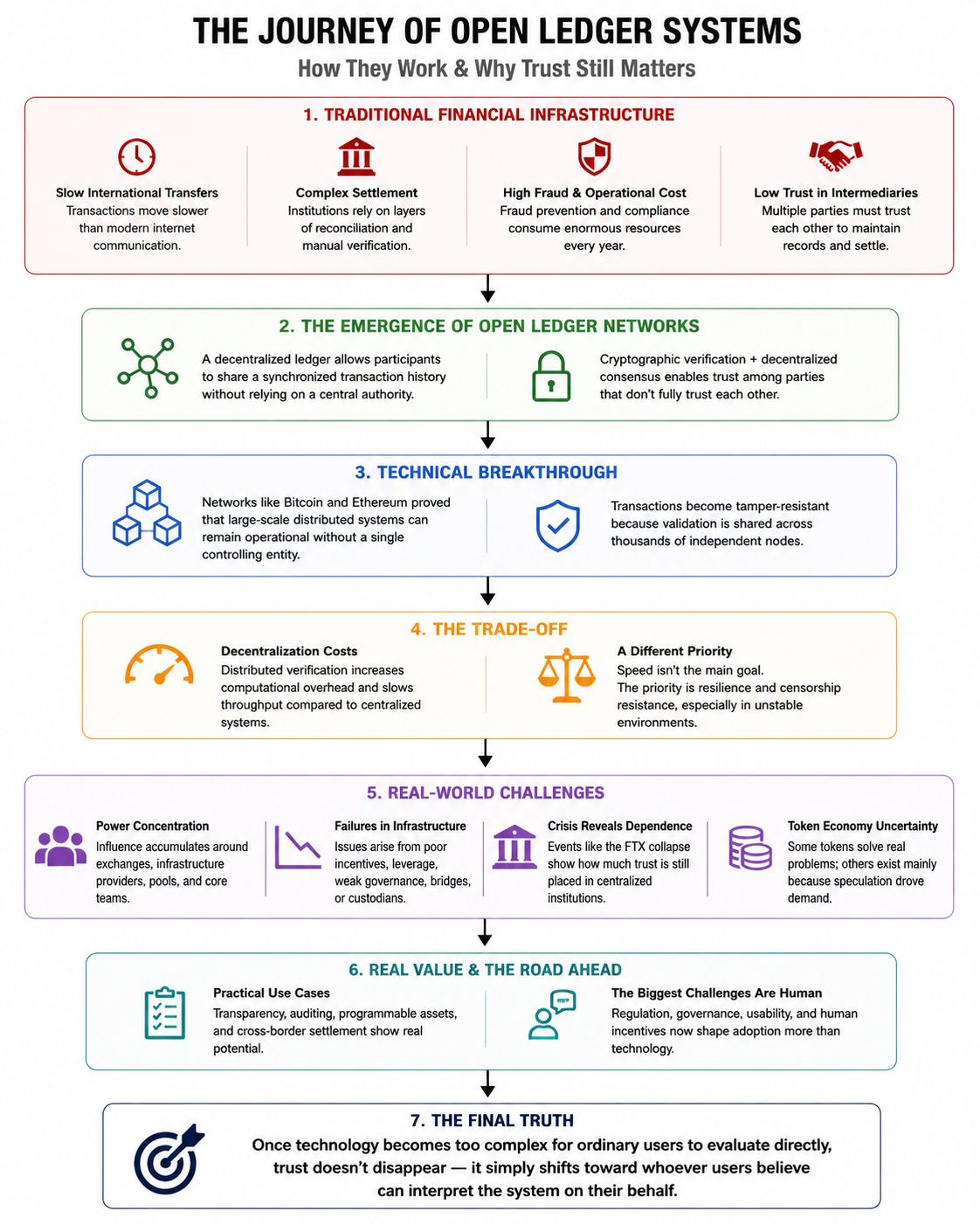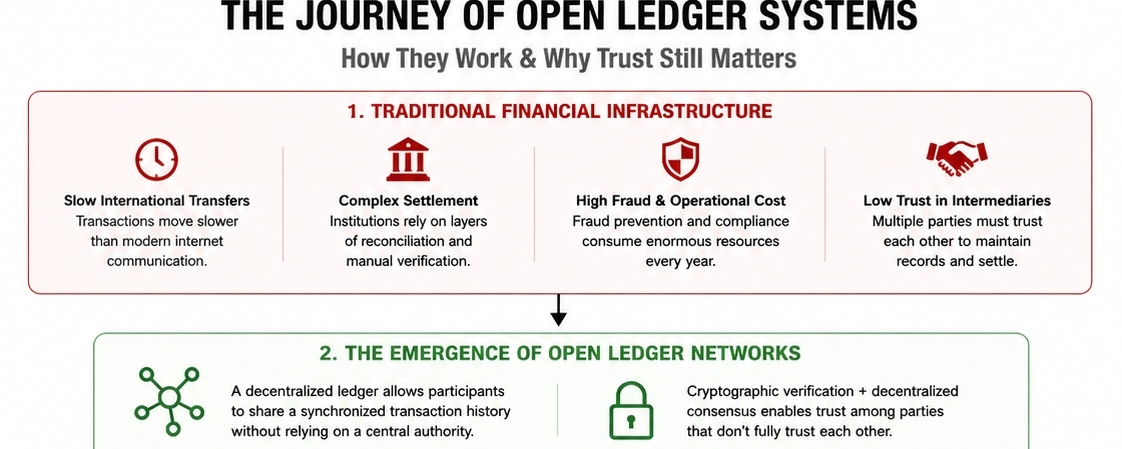

Open systems often become most attractive when existing institutions stop feeling efficient, transparent, or trustworthy. Financial infrastructure is a good example. International transfers can still move slower than modern internet communication, settlement between institutions requires layers of reconciliation, and fraud prevention consumes enormous operational resources every year.
That environment explains why open ledger networks attracted attention so quickly.
The underlying idea was compelling because it addressed a real coordination problem. Instead of multiple institutions maintaining separate databases and constantly verifying one another’s records, a distributed ledger could allow participants to share a synchronized transaction history. Blockchain systems demonstrated that cryptographic verification and decentralized consensus could maintain records without relying entirely on a single controlling authority.
Technically, that achievement mattered.
Networks like Bitcoin and Ethereum proved that large-scale distributed systems could remain operational even when participants did not fully trust one another. Transactions became difficult to alter because validation was shared across thousands of independent nodes rather than delegated to one institution alone.
But distributed trust introduces its own costs.
Traditional payment processors operate efficiently because centralized operators control infrastructure directly. Open ledger systems prioritize redundancy and verification across many participants, which naturally increases computational overhead and slows throughput. That trade-off explains why blockchain networks often struggle to match the transaction speed and settlement efficiency of systems built by centralized financial providers.
Supporters of decentralization would argue that speed was never the central objective. The larger goal was resilience: creating systems that remain operational even when governments, corporations, or intermediaries attempt to restrict participation. In regions facing financial instability or weak institutional trust, that characteristic can become more valuable than raw efficiency.
The more complicated challenge appears once theory meets practical adoption.
In principle, decentralized ecosystems distribute influence broadly across participants. In practice, power frequently accumulates around exchanges, infrastructure providers, staking services, mining pools, and core development teams. Most users are not validating transactions themselves or reviewing protocol governance decisions independently. As systems grow more complex, convenience often recentralizes authority around organizations capable of simplifying the experience.
That pattern becomes most visible during crises.
Major failures in crypto markets rarely emerge because the underlying mathematics collapses. More commonly, problems originate in the surrounding infrastructure: poorly designed incentives, excessive leverage, weak governance, vulnerable bridges, or centralized custodians managing user assets irresponsibly. The collapse of FTX demonstrated how dependent many participants still were on traditional forms of institutional trust despite the industry’s decentralization narrative.
The token economy introduced another layer of uncertainty.
Some blockchain networks genuinely require native assets to coordinate validators, secure transactions, and maintain network participation. Others adopted tokens primarily because speculative markets rewarded rapid financialization during periods of intense investor enthusiasm. During bullish cycles, rising prices often created the appearance of sustainable innovation even when underlying utility remained unclear.
That does not mean the entire sector lacks substance.
@OpenLedger systems continue to show practical value in areas such as transparent auditing, programmable asset transfers, and cross-border settlement where multiple institutions must coordinate efficiently without sharing full trust. Even prominent industry figures like Changpeng Zhao have acknowledged that the largest remaining obstacles are increasingly social rather than technical. Regulation, governance, usability, and human incentives now shape adoption more than raw cryptographic capability alone.
Because once technology becomes too complicated for ordinary users to evaluate directly, trust does not disappear.
It simply shifts toward whoever users believe can interpret the system on their behalf.