
I must say, I didn't really think much about OpenLedger when I initially viewed it.
It seemed like another crypto project working to bring together AI, data, incentives and participation in a single network. And perhaps this is an unfair assessment, but once you've been around for a while in crypto, you begin to notice that you just see the same patterns everywhere. All projects discuss coordination. All projects talk about coordination. All projects discuss contributors. All projects mention contributors. All projects will return value to the people supporting ecosystem growth.
Therefore, I initially thought I knew what it meant before I was sitting with it right.
Then I had a fleeting moment of observing, for a brief period, what seemed to be more of a human nature than technical nature.
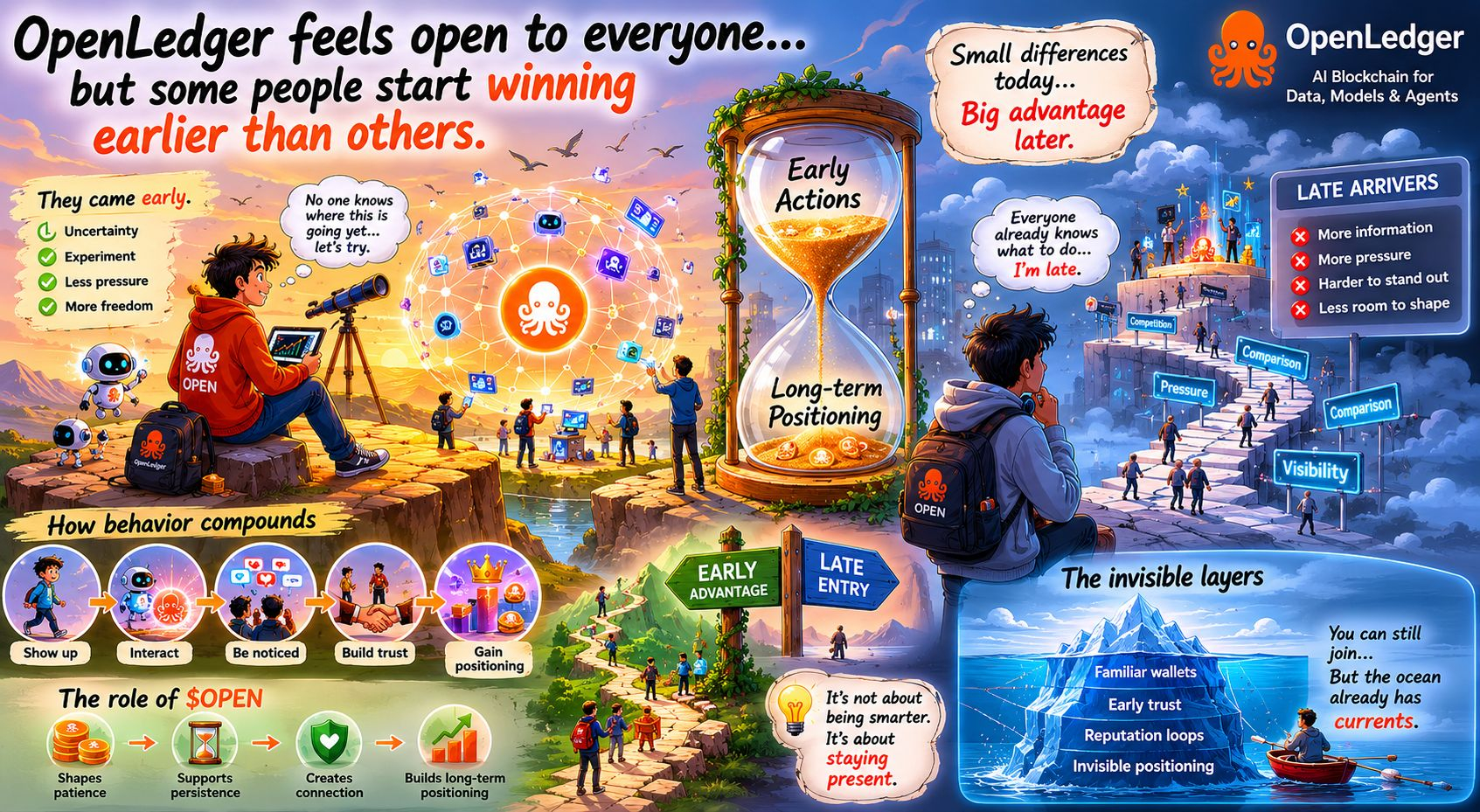
Early Birds are completely different than Late Birds.
Not just in terms of money, I mean.
I mean emotionally.
The initial users walk around the system in a leisurely manner. They don't overthink when they try things. They interact more casually, they get along more easily. In fact, they sometimes make a wrong choice, but it doesn't matter – the surroundings are still peaceful enough to experiment.
No one's watching at this time.
This is what it does to people.
I believe that we tend to underestimate the effect of attention on the behavior of people in crypto systems. If you get too full, human experimentation naturally ceases. They begin to figure out all the stuff. Every action is more measured now, because all of a sudden we have some comparisons, visibility, pressure and expectations.
However, in the early stages, people are free to roam, although they are somewhat hidden by uncertainty.
And one way or another, that freedom slowly turns into a plus later.
That's what I'm still thinking about.
From the outside, systems such as @OpenLedger appear totally open. Anybody can join. Anybody can contribute. The rules are technically the same for all. However, after some time the network subconsciously begins to remember the people who were active in the past, before it became clear.
Not officially.
Just socially.
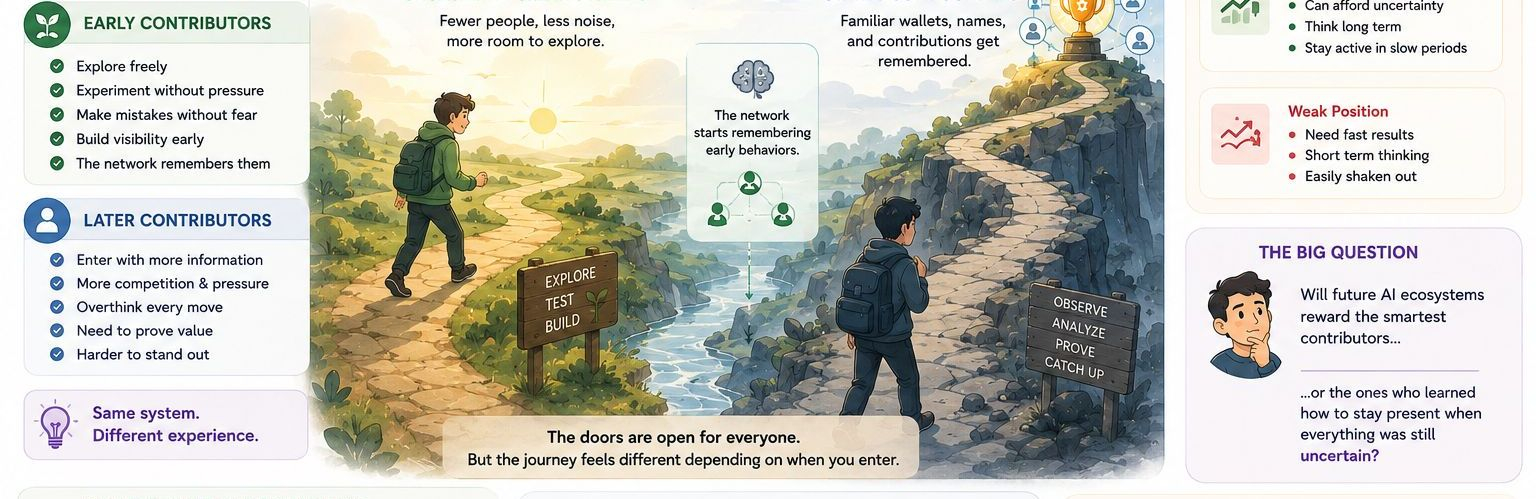
You begin to see the same wallets time and time again. Familiar contributors. Known names in discussion, participation, data sets, activity. Once they become familiar with each other, it is easier for those people to continue to attract attention without trying as hard as they did before.
While older users enter the same ecosystem, emotionally it feels different to them.
Now, it's on to the pressure to play right.
Rapid need to learn something.
Urge to make no errors.
I believed that is what changes things more than most realize.
The weird thing is that no one did it that way.
It's simply a consequence of the combination of human behavior and open systems for long enough.
Also this changed my views on OPEN. For most, tokens are rewards or incentives, but for me, it's a way to subtly influence my patience.
During "slow" times, those better-positioned can remain cool. They have emotional room for ambivalence. They don't require instant gratification from every interaction since they have a sense of belonging in the direction in which the network is going.
Rarely do smaller players operate in such a manner.
They desire signs promptly.
Movement quickly.
Validation quickly.
And I'm being honest; I get it.
Crypto teaches people how to ride the momentum because they can sometimes get tired of being early in an unknown system. Especially when nobody is fully aware of the direction in which the project is going.
I believe the genuine strength within networks such as these could well be non-intelligence.
Perhaps it’s the uncertainty comfort.
Before there's any social proof, there's a way to keep on coming back.
Before there’s clarity.
Participation is safe before it comes.
After a while of that, the initial behaviors begin to become positioning that the newer user can observe, but no longer exactly mimic.
Not due to the system becoming closed.
However, due to the fact that human behavior was already impacting the atmosphere within it.
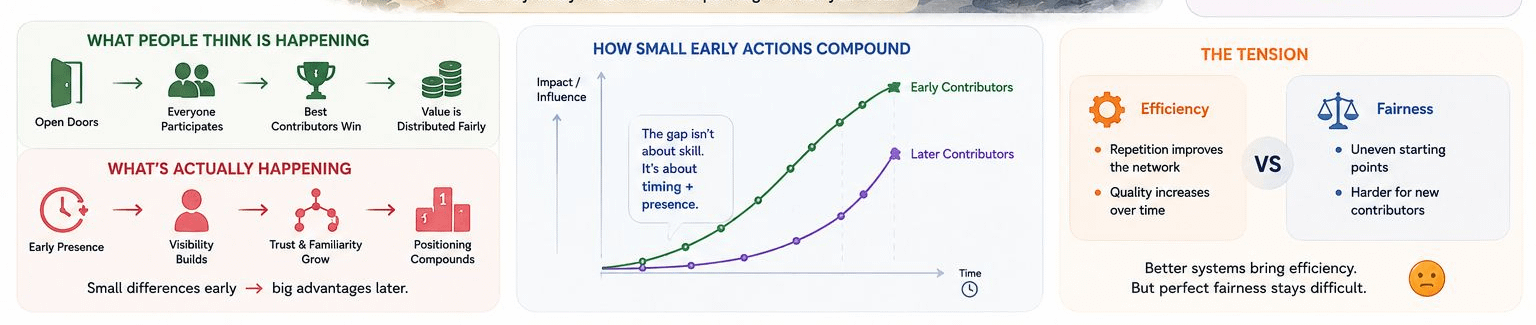
I don't even know if this is necessarily bad. Perhaps these invisible layers are all part of an open network's nature over the course of time. Perhaps it's impossible once attention, incentives and reputation begin to feed off of each other for long enough.
Nevertheless, there's this thing I wonder about.
Assuming that future AI ecosystems will be more reliant on participation-based networks such as @OpenLedger will the greatest benefit go to the smartest participants…
or just those who were able to remain in the moment, when things were not settled, not yet out of the question?
