
The other night I was stuck in one of those endless crypto group chats where the conversation jumps from memes to market predictions to AI in a matter of minutes.
Someone mentioned a new AI tool they had been using. Another person replied with a list of models they thought were better. Then the discussion shifted toward which AI company might dominate the next few years.
I was reading everything, but one thought kept sitting in the back of my mind.
Nobody was talking about where all this intelligence actually comes from.
We talk about models all the time. We compare performance, speed, features, and funding rounds. But behind every AI system is an enormous amount of data that somebody created, collected, organized, or contributed at some point.
And honestly, that part rarely gets attention.
That curiosity is what led me down the rabbit hole of learning about OpenLedger.
At first, I expected another familiar story. Crypto has seen no shortage of projects combining AI and blockchain over the last few years. Most sound impressive for five minutes, but after digging deeper, the actual purpose becomes harder to find.
OpenLedger felt different because the conversation wasn't centered around making AI sound smarter.
Instead, it seemed focused on something much more basic.
How do we recognize the people and resources that help AI become valuable in the first place?
The longer I thought about that question, the more reasonable it sounded.
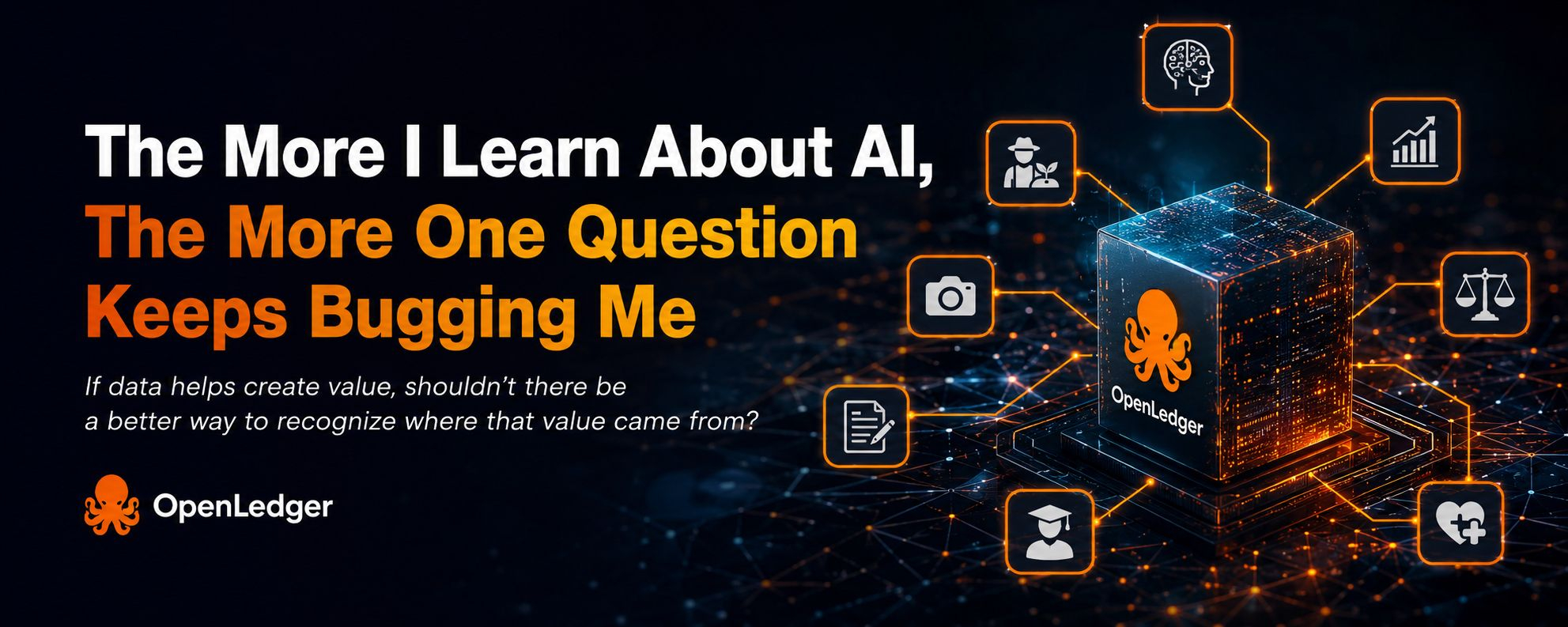
Imagine a farmer growing crops, a photographer building an image collection, or a researcher spending years organizing specialized information. If that knowledge eventually helps train useful AI systems, should there be a way to acknowledge that contribution?
I don't think that's a strange question anymore.
In fact, it feels like a question the industry will eventually have to answer.
Right now, data often feels invisible. Once it enters a training pipeline, it becomes part of something much larger, and tracing its impact becomes extremely difficult.
OpenLedger appears to be exploring ways to change that.
What I found interesting is that the project doesn't only treat data as something that powers AI. It treats data as something that carries value of its own.
That might sound obvious, but many discussions skip over that detail completely.
The AI conversation usually focuses on outputs.
Better answers.
Better images.
Better agents.
Better automation.
But before any of that exists, there has to be useful information somewhere underneath.
Without that foundation, none of the impressive results happen.
I also noticed that OpenLedger seems interested in a future where specialized AI becomes increasingly important.
Personally, that idea makes a lot of sense.
The most useful tools in my daily life aren't the ones that try to do everything. They're usually the ones designed to solve a specific problem really well.
AI could end up following the same path.
A healthcare assistant, a legal research tool, and a financial analysis system all need different kinds of knowledge. The quality of their underlying data may become just as important as the model itself.
That's why attribution keeps standing out to me whenever I read about projects like this.
Not because it's the flashiest topic.
Actually, it's probably one of the least exciting things to put in a headline.
But infrastructure often works that way.
Most people never think about roads until they're damaged.
Most people never think about electricity until it disappears.
Likewise, we rarely think about how AI systems are supplied with valuable information until questions about ownership and incentives start appearing.
Another thing I appreciated was that OpenLedger seems to be trying to solve an actual structural problem rather than simply attaching AI terminology to a blockchain product.
Whether the solution works perfectly is another discussion entirely.
Every ambitious project faces challenges.
Every new framework looks cleaner in theory than in practice.
That's just reality.
But I tend to respect projects more when they're attempting to tackle difficult questions instead of recycling narratives that happen to be popular for a season.
And if there's one thing crypto has taught me over the years, it's that narratives come and go much faster than infrastructure.
The projects people remember years later are often the ones quietly building foundations while everyone else is focused on headlines.
After spending time understanding OpenLedger, I didn't walk away thinking I had discovered some guaranteed future winner.
That's not really how I look at projects anymore.
What stayed with me was a simple idea.
As AI becomes more powerful, the value flowing through data will probably become more important, not less.
The systems that can connect contributors, information, models, and incentives in a transparent way may end up solving a problem that many people haven't fully noticed yet.
Maybe that's why OpenLedger caught my attention.
Not because it promises a revolution overnight.
But because it asks a question that feels increasingly difficult to ignore:
If data helps create value, shouldn't there be a better way to recognize where that value came from?
