The more I read about OpenLedger (OPEN), the harder it becomes to see it as just another “AI blockchain” project. That description feels too neat for what the protocol is actually trying to do.
What stood out to me wasn’t the AI narrative itself. Crypto has already gone through enough cycles where every infrastructure project suddenly becomes an “AI layer” because the market rewards the label. The more interesting part is the way OpenLedger seems to approach trust.
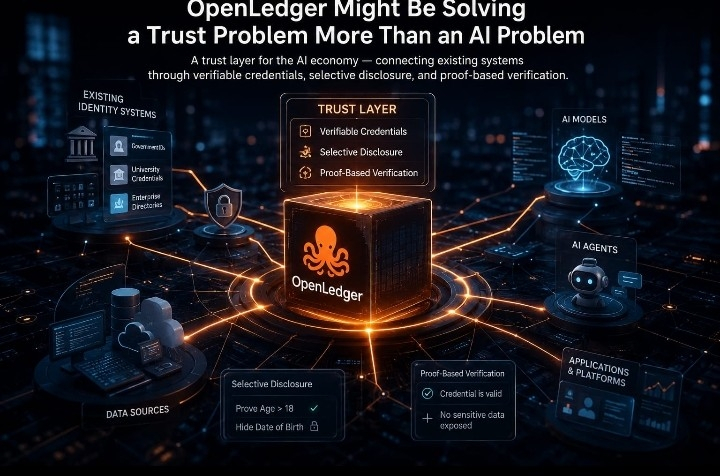
Not by trying to replace everything that already exists, but by trying to connect fragmented systems through verifiable credentials, proofs, and selective disclosure.
That sounds subtle, but I think it changes the entire framing.
A lot of blockchain projects approached identity with the assumption that the internet needed a completely new foundation. One universal identity. One shared source of truth. One clean on-chain system to replace the messy combination of institutions, databases, logins, permissions, and credentials people already use every day.
But reality usually moves in a much uglier way than whitepapers expect.
Most systems survive because they are deeply embedded into how the world already operates. Governments are not rebuilding identity from scratch. Enterprises are not throwing away internal verification systems because crypto found a cleaner architecture. Even users rarely migrate unless the new system removes friction immediately.
OpenLedger feels different because it seems to accept that reality instead of fighting it.
The emphasis on proof-based verification and selective disclosure suggests the goal is not to force everyone into a single identity framework, but to create a layer where existing systems can verify information without constantly relying on blind trust or overexposing data.
And honestly, that feels more mature than the usual crypto approach.
Because transparency alone was never a complete solution.
There is a strange assumption in parts of crypto that making everything visible automatically creates trust. But most real-world interactions do not work that way. People usually want the opposite. They want to prove something specific without revealing everything underneath it.
You might need to prove your credentials without exposing your full personal history. An AI agent may need access to certain permissions without unrestricted visibility into private datasets. A system may need to verify the origin of a model output without opening every layer of internal logic.
That middle ground between privacy and verification is where OpenLedger becomes genuinely interesting to me.
Especially now, when AI systems are starting to absorb enormous amounts of value from human input while attribution remains incredibly weak. Data gets collected from everywhere. Models train on it. Agents act on top of it. Economic value gets created. Yet the infrastructure for proving where contributions came from — or who should benefit from them — still feels underdeveloped.
OpenLedger seems to recognize that trust itself is becoming infrastructure.
But this is also where the execution risk becomes impossible to ignore.
Building a trust layer sounds elegant conceptually. Actually getting people to use it is a completely different challenge. Verification systems only matter if other systems recognize them. Credentials only have value if institutions agree they matter. And interoperability is one of those problems the tech industry keeps underestimating because it looks simpler on diagrams than it feels in reality.
The difficult part is never designing the framework.
The difficult part is coordination.
That is where a lot of blockchain infrastructure projects slowly lose momentum. They build technically sophisticated systems that require the rest of the world to change behavior first. And most of the world usually refuses.
So I keep coming back to the same thought with OpenLedger:
If the protocol succeeds, it probably won’t happen because people suddenly decide to live entirely on-chain. It will happen if the system quietly becomes useful enough that existing platforms, institutions, and AI applications integrate it without needing to rebuild themselves around it.
That is a much harder path.
But it is also the path most real infrastructure takes.
And maybe that is why OpenLedger feels more interesting the deeper you look at it. Not because it promises a completely new digital world, but because it seems to understand how stubborn the current one already is.