
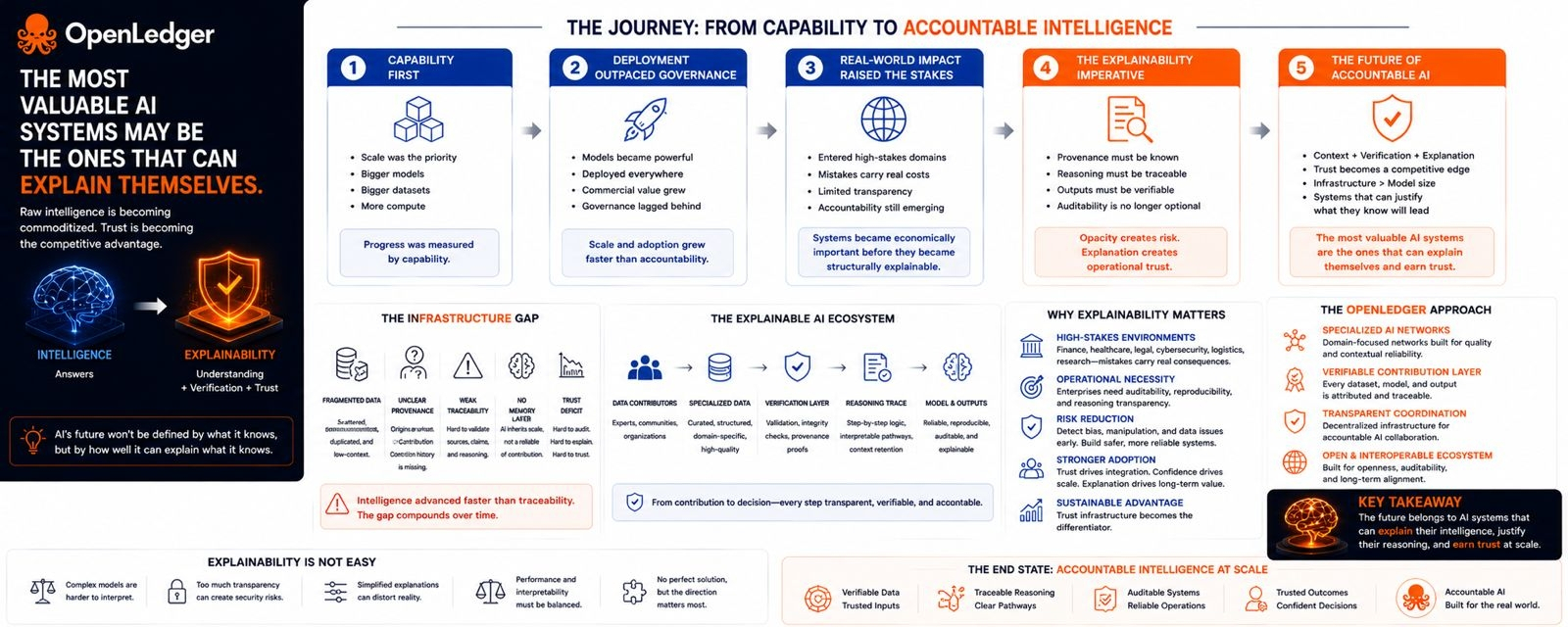
One of the biggest misconceptions surrounding modern AI is that intelligence alone is enough.
For years, the industry measured progress primarily through capability. Better reasoning, faster generation, larger context windows, stronger benchmarks. The assumption was straightforward: if models became sufficiently advanced, trust would naturally follow.
But I do not think reality is unfolding that cleanly.
What I keep noticing is that AI systems are becoming more powerful at the exact moment institutions are becoming more cautious about relying on them blindly. The issue is no longer whether AI can generate answers. In many environments, it already can. The deeper issue is whether those answers can be understood, verified, traced, and trusted under pressure.
That changes the conversation entirely.
Because once AI enters environments like finance, healthcare, cybersecurity, legal systems, logistics, or scientific research, explanation becomes part of the product itself. A model that produces a correct output without a clear reasoning trail may still create operational risk if nobody understands how the conclusion was formed.
In low-stakes environments, opacity is tolerable. In high-stakes environments, opacity becomes friction.
This is why I think explainability is quietly becoming one of the most important infrastructure layers in AI.
Not because users suddenly want academic transparency reports for every interaction, but because institutions increasingly need systems capable of surviving scrutiny. Enterprises, regulators, researchers, and operational teams all require some degree of interpretability before integrating AI deeply into critical workflows.
And right now, many systems remain structurally difficult to interpret.
That difficulty comes from the way modern AI evolved. Large-scale models were optimized primarily around performance and scalability. The systems became extraordinarily effective at pattern synthesis, but far less effective at exposing internal reasoning processes in ways humans can reliably audit. Models can often produce fluent explanations after generating outputs, yet those explanations do not always reflect the actual decision pathway underneath.
The system sounds explainable without necessarily being fully interpretable.
That distinction matters more than people realize.
I think the AI industry is entering a phase where raw intelligence is gradually becoming commoditized. Multiple companies can now produce highly capable models. Open-source ecosystems are accelerating rapidly. Compute access is expanding. General capability differences still matter, but the gap is narrowing compared to earlier years.
As that happens, trust infrastructure starts becoming a competitive advantage.
Not just model performance.
But verifiable reasoning, provenance, traceability, reproducibility, and contextual reliability.
This is one reason specialized AI systems are becoming increasingly important. General-purpose models remain impressive, but many real-world sectors require narrow expertise combined with transparent validation layers. Financial AI must explain risk assumptions. Medical AI must justify diagnostic reasoning. Legal AI must preserve interpretive consistency. Industrial automation systems must remain auditable under operational review.
The future may belong less to systems that know everything and more to systems that can justify what they know.
That is a very different design philosophy.
What also fascinates me is how this changes the role of infrastructure itself. AI systems are no longer isolated models operating independently. They increasingly exist inside larger ecosystems involving datasets, contributors, validators, inference layers, memory systems, and coordination networks. Trust emerges not only from the model, but from the architecture surrounding the model.
And architecture shapes behavior.
Projects like OpenLedger are interesting because they are approaching AI from the perspective of verifiable infrastructure rather than pure model competition. The emphasis on specialized AI networks, transparent contribution layers, and traceable data ecosystems reflects a broader industry realization that accountability can no longer remain secondary.
Because intelligence without explainability creates fragile systems over time.
Outputs may scale faster than verification. Automation may expand faster than governance. Confidence may increase while interpretability weakens underneath. Eventually the imbalance becomes difficult to manage, especially when AI systems begin influencing economic, institutional, and public decision-making environments.
That tension already exists today.
I have seen many discussions where companies proudly showcase impressive AI capabilities while quietly avoiding deeper questions around provenance, data integrity, or reasoning transparency. In practice, these unanswered questions eventually return during deployment. Enterprise clients ask harder questions. Regulators ask harder questions. Operational teams ask harder questions.
Where did the data come from?
Why did the system produce this conclusion?
Can the decision pathway be audited?
Can manipulation or bias be detected?
Can outputs be reproduced consistently?
These are infrastructure questions disguised as trust questions.
And they are becoming increasingly important as AI systems evolve from productivity tools into operational systems embedded inside real institutions.
Of course, explainability itself has limitations. Some advanced neural architectures are inherently difficult to interpret fully. Too much transparency can create security vulnerabilities or expose proprietary mechanisms. Simplified explanations may distort highly complex reasoning structures. There is also a real trade-off between optimization efficiency and interpretability in many systems.
There is no perfect solution.
But I think the direction matters more than perfection itself.
Because mature technologies eventually develop accountability layers around their power. Financial systems developed auditing frameworks. Scientific research developed citation standards. Software engineering evolved version control and testing pipelines. AI will likely move toward similar structures as adoption deepens.
Not because regulation alone forces it.
Because trust eventually becomes economically necessary.
The most valuable AI systems in the future may not be the ones generating the fastest answers or the largest outputs. Increasingly, they may be the systems capable of maintaining reliable relationships between intelligence, context, verification, and explanation over time.
Systems that can explain themselves without collapsing under scrutiny.
That is a much harder problem than scaling parameters.
But I suspect it may become the problem that matters most.