

 Reputation without a pricing mechanism is just narrative. It influences behavior loosely, degrades when convenient, and carries no enforceable economic consequence when it breaks down. The reason credit infrastructure became foundational in traditional finance is not because it tracks history. It is because that history has a direct, measurable effect on future access and cost of capital.
The same logic applies to AI systems moving into financial infrastructure. The reputation economy forming around @OpenLedger becomes economically real only when three specific conditions are satisfied at the same time.
The Three Conditions That Make AI Reputation Economically Real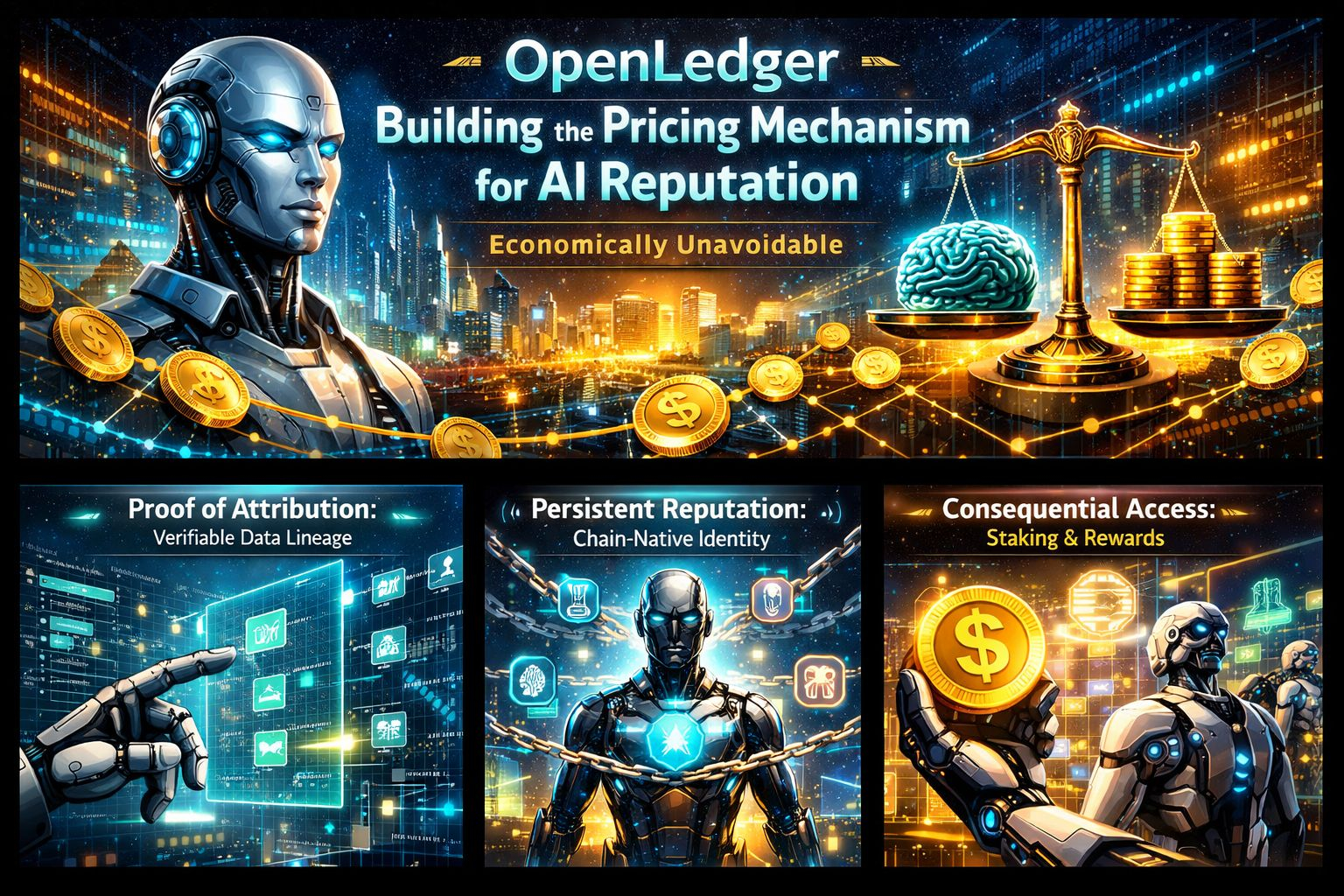
The first condition is that the history has to be hard to fabricate. A reputation record that can be gamed or selectively presented is not a reputation record. It is a marketing document. Proof of Attribution settles on a public ledger tied to verifiable data lineage. The contribution either happened or it did not. The execution either occurred inside a permitted scope or it did not. No selective presentation is architecturally possible.
The second condition is that the record has to persist across contexts. A reputation that resets when an agent changes deployment environments, gets rebranded, or migrates between protocols has no compounding value over time. OpenLedger's attribution engine is chain-native. The history travels with the agent identity rather than sitting in a centralized database that any operator can quietly modify. Persistence here is structural, not a policy decision that can be reversed.
The third condition is the one most discussions skip entirely. The reputation has to be economically consequential when it changes. A score that affects nothing is ignored by every rational participant in the system. This is where $OPEN becomes architecturally important in a way standard token analyses miss.
How Open Makes Reputation Consequential
Every agent operating on OpenLedger interacts with the Open layer across multiple surfaces. Gas for execution. Staking for model deployment. Attribution rewards for verified data contribution. Bonded access for higher-tier skill ecosystems.
Each of those interactions is simultaneously an economic action and a reputation event recorded on the same chain. An agent with consistent execution history and strong attribution quality accumulates a verifiable track record affecting its standing inside the network's coordination layers. An agent with a history of out-of-scope actions, rejected contributions, or execution failures carries that forward with equal transparency.
When access to deeper capital infrastructure, premium orchestration layers, and advanced autonomous skills becomes conditional on attribution history, reputation stops being descriptive and becomes prescriptive. It determines what the agent can access next. That is the structural moment a reputation economy moves from being conceptually interesting to being economically unavoidable.
Why the Timing Is Not Accidental
Previous cycles built programmable capital and decentralized execution. The infrastructure left unbuilt was verifiable identity and behavioral accountability for autonomous systems. That gap was manageable when agents were simple and human-supervised at every decision point. It becomes critical once agents are self-initiating, self-improving, and coordinating across financial infrastructure without requiring human authorization at each step.
#OpenLedger is building inside that gap during the window before the problem is widely recognized and priced. Arriving before the demand is visible is either too early or exactly right, depending entirely on how quickly autonomous agent deployment scales across the next twelve to eighteen months.
My $OPEN position continues in profit. What started as an execution and attribution thesis has progressively revealed itself as a foundational infrastructure position around how autonomous systems earn and maintain credibility inside digital economies. Each week of following this build strengthens that read rather than complicating it.
This is not financial advice. Always do your own research before making any investment decisions.