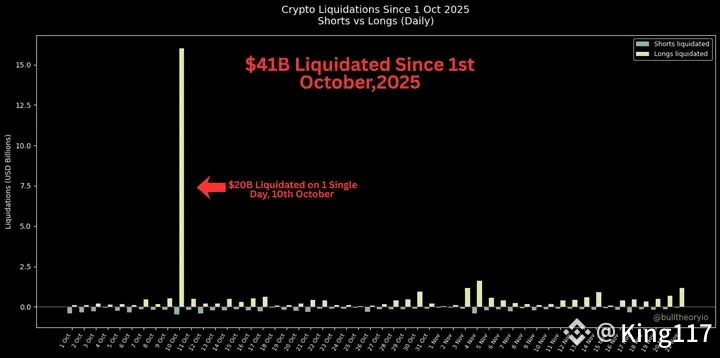
After October 10, something clearly changed in the crypto market — and the data fully confirms it.
On that single day, the crypto market saw the largest liquidation event in its history: nearly $20 billion wiped out in less than 24 hours.
From October 1 to today, total liquidations have crossed $41 billion — an abnormal number for a period that had no major macro shock, no protocol failure, no exchange collapse, and no black swan event.
What’s even stranger:
The stock market recovered, the S&P 500 hit new highs, and NVIDIA delivered strong earnings — yet the crypto market never stabilized.
No bounce.
No relief rally.
No market rotation.
Just one straight downward line: forced selling, short pauses, and then more selling.
Daily liquidation patterns show the same behavior every time:
Every recovery attempt is crushed by a fresh wave of long liquidations.
Even on days when global markets are stable or green, crypto suddenly nukes $100M–$1B in leveraged positions out of nowhere.
This kind of repeated movement usually points to one of three things:
1. A major institution unwinding positions
2. Structural deleveraging inside big trading firms
3. Thin order books causing systemic liquidity gaps
But the real problem is that nobody has openly explained what happened.
No major fund commented.
No statement.
No confirmation of who triggered the chain reaction on October 10.
And here’s the most shocking part:
There was nothing in the macro environment on October 10 that could justify such a massive liquidation wave.
No ETF decision.
No regulatory shock.
No major economic data.
No on-chain failure.
Yet that day’s sell-off damaged the market structure in a way that has continued for 45 straight days.
Traders got wiped out.
Open interest collapsed.
Liquidity dried up even in major trading pairs.
Even now, the market shows unusually high liquidations on very small moves — proof that the October 10 event caused internal damage that no one fully understands yet.
Normally, after such a massive liquidation event, the market retraces or at least stabilizes.
But this time, none of that happened.
The selling appears consistent, controlled, and systematic — as if one large institution or a group of institutions is still reducing exposure.
And that leads to the real question:
Who did this?
Billions were liquidated.
The market structure changed.
Retail investors suffered massive losses.
And still, to this day, no one knows who lost — or who profited.
When $41 billion disappears in six weeks, with $20 billion in a single day, the market deserves to know why.
And this is exactly where the Digital Asset Market Clarity Act becomes critical.
The real problem isn’t just the liquidation —
The real problem is the absence of clear rules.
The CLARITY Act directly tackles these weaknesses:
• Complete ban on wash trading
• CFTC oversight with real-time monitoring
• Spoofing & front-running classified as criminal offenses
• Mandatory monthly audits and proof-of-reserves for all exchanges serving U.S. customers
If these rules were already in place, we could at least know:
Who triggered the October 10 liquidation cascade?
And what the actual cause was?
The crypto market doesn’t just need stability —
It needs transparency.