
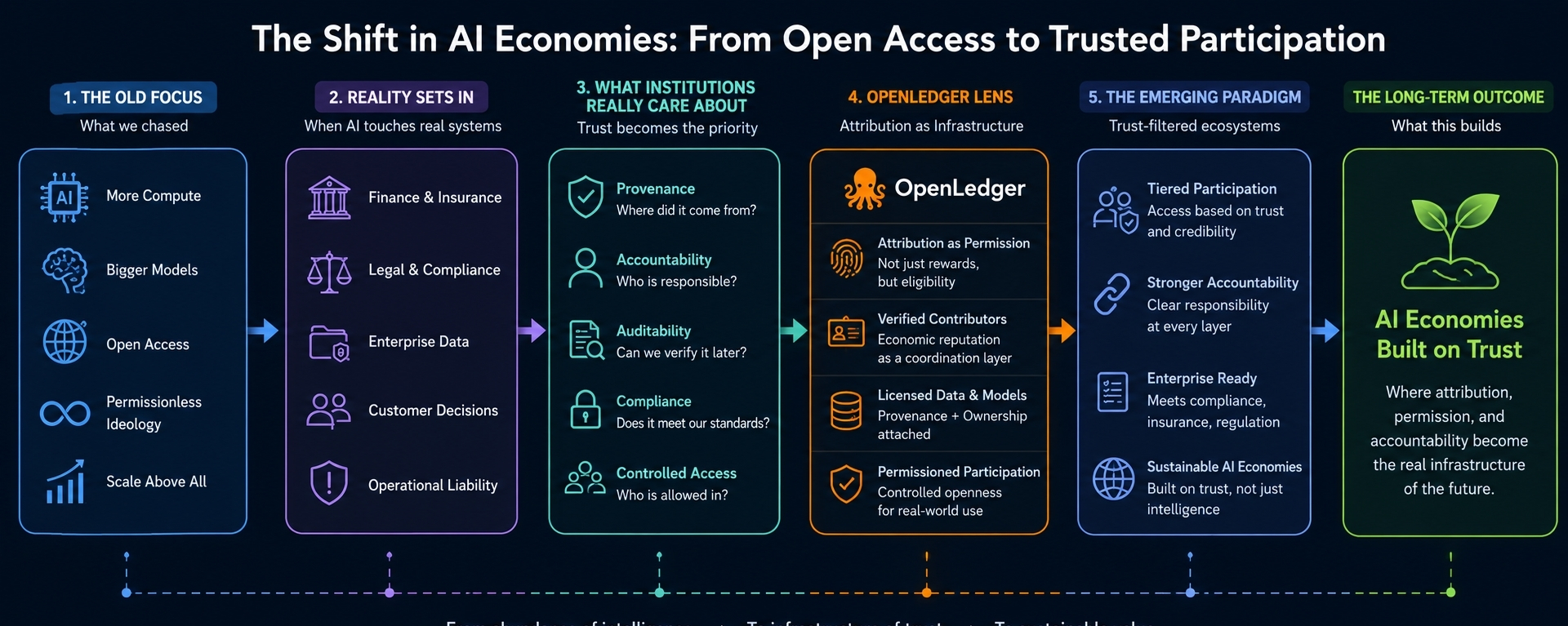
The relationship between AI and blockchain is starting to evolve beyond the speculative phase. A few years ago, most conversations around “AI + crypto” felt surface-level — projects attaching AI branding to tokens without solving any real infrastructure problem. But the market is slowly becoming more practical now. Developers, researchers, and even investors are asking tougher questions.
Where does AI data come from?
Who owns the models?
How do contributors get paid?
And perhaps most importantly — how do you build systems where value flows fairly between data providers, model builders, and the applications using them?
That shift in thinking matters.
If you’ve been in this space long enough, you start recognizing when an industry moves from narratives into infrastructure. The noise gets quieter. The products become harder to explain in one sentence. And the real builders stop focusing on “what pumps next” and start focusing on systems that can actually survive adoption.
That’s where projects like OpenLedger become interesting.
OpenLedger positions itself as an AI blockchain focused on monetizing data, models, and agents. On paper, that may sound abstract. But from my perspective, it touches one of the most important issues emerging in the AI economy: liquidity for intelligence itself.
For years, data has been treated as a raw material. Platforms collect it, centralized companies refine it, and AI models consume it. Yet the people producing valuable datasets, training specialized models, or building autonomous agents rarely capture proportional value from the systems they help create.
OpenLedger appears to be targeting that imbalance directly.
What stands out to me is that the project isn’t merely trying to launch another AI token. The bigger idea seems to revolve around creating an infrastructure layer where AI assets become programmable and economically connected. In simpler terms, the network wants data, models, and agents to behave almost like financial primitives — assets that can move, integrate, earn, and scale across applications.
That distinction matters more than many people realize.
In previous crypto cycles, the focus was often on consumer speculation first and utility second. We saw thousands of protocols promising “decentralized everything,” but very few addressed deployment realities. Scalability was weak, onboarding was painful, and most systems lacked meaningful usage outside trading activity.
The AI cycle is forcing a different conversation.
AI systems require constant data flow, computation, automation, and coordination. That creates infrastructure demands that are much closer to cloud computing than traditional meme-driven crypto markets. The projects likely to matter long term are the ones solving operational problems rather than purely financial ones.
OpenLedger’s thesis fits into that broader evolution.
A useful comparison might be how cloud infrastructure evolved during the early internet era. Most users never thought about AWS, server orchestration, or distributed databases. They only noticed the applications built on top. But underneath every major internet platform sat invisible infrastructure layers making everything work reliably.
AI is entering a similar phase now.
Everyone is focused on chatbots and interfaces, but beneath that sits a growing need for decentralized coordination around datasets, model ownership, inference, verification, and economic incentives. If blockchain contributes meaningfully to AI, it likely won’t happen through flashy consumer narratives alone. It will happen through backend infrastructure that quietly improves how AI systems operate.
That’s the angle where OpenLedger becomes more compelling.
The concept of unlocking liquidity around models and agents could eventually allow smaller developers to participate in AI economies without relying entirely on large centralized platforms. Instead of a handful of corporations controlling distribution and monetization, blockchain-based coordination layers could create more open marketplaces for intelligence.
Of course, the challenge is execution.
This is where experienced market participants usually become more cautious than excited.
Building infrastructure is significantly harder than building narratives. It requires sustained developer adoption, technical reliability, and ecosystem incentives that continue functioning even after market sentiment cools down. Many blockchain projects underestimate how difficult it is to attract long-term builders once speculation fades.
From my perspective, one of the biggest risks for AI-related crypto projects is that they become too dependent on trend momentum. AI is currently one of the strongest narratives in technology, but narratives move faster than infrastructure maturity. If products cannot demonstrate real usage, integrations, or deployment value, the market eventually notices.
OpenLedger will likely need to prove that its ecosystem can support actual AI workflows at scale — not just theoretical architecture.
Scalability becomes especially important here because AI systems generate enormous amounts of interaction and computation. Traditional blockchains were not designed with AI-native throughput in mind. If networks cannot efficiently handle coordination between models, agents, and datasets, adoption bottlenecks appear quickly.
Usability is another overlooked factor.
Crypto developers sometimes assume technical sophistication automatically creates value. But in reality, the systems that survive are usually the ones that simplify complexity for builders. If integrating AI assets into OpenLedger feels cumbersome, developers will default back to centralized tools regardless of ideological preferences.
This is something the market understands much better now compared to previous cycles.
Back in 2021, many investors chased whitepapers and tokenomics without deeply evaluating product friction. Today, developers care more about APIs, deployment speed, tooling quality, interoperability, and whether systems can actually integrate into existing workflows.
That shift feels healthy.
It suggests the industry is gradually maturing from speculation-first thinking toward operational utility.
Another important point is automation.
AI agents are becoming increasingly autonomous in how they process information, execute tasks, and interact with digital environments. If these agents eventually operate economically — paying for services, accessing data, interacting with applications — blockchain rails may become more useful than many people currently expect.
Not because decentralization is fashionable, but because programmable economic coordination becomes necessary.
That’s a subtle but important distinction.
The strongest crypto infrastructure projects are often the ones that solve coordination problems invisible to average users. Most people do not think about settlement layers, liquidity routing, or validator consensus when using blockchain applications. They simply expect systems to work.
Similarly, future AI users may never think about the networks coordinating datasets, compensating contributors, or verifying model interactions behind the scenes.
But those backend systems could become extremely valuable.
What stands out to me about OpenLedger is that it seems positioned closer to that infrastructure layer rather than purely consumer speculation. Whether it succeeds depends less on short-term market excitement and more on whether developers genuinely find utility in the ecosystem.
And honestly, that’s probably the healthier way to evaluate projects now.
If you’ve survived multiple market cycles, you learn that sustainable value rarely comes from the loudest narratives. It usually emerges quietly through infrastructure adoption long before the broader market fully notices.
That does not mean risks disappear.
Regulatory uncertainty around AI data ownership remains unresolved globally. Economic models around decentralized AI marketplaces are still experimental. Competition is intense, especially with centralized AI companies moving extremely quickly. And blockchain scalability itself remains an ongoing challenge industry-wide.
But despite those uncertainties, the direction feels increasingly logical.
AI is becoming more decentralized in development while simultaneously becoming more centralized in ownership and monetization. That tension creates space for alternative infrastructure models to emerge. Projects attempting to align incentives between data providers, developers, and AI systems may eventually become more important than today’s market valuations imply.
OpenLedger appears to be operating inside that broader transition.
Not as a guaranteed winner, and not as a short-term speculative miracle, but as part of a growing effort to rethink how intelligence itself moves across digital economies.
And from my perspective, that’s the deeper story worth paying attention to.
Because the next phase of crypto may not be defined by which token trends the hardest on social media. It may be defined by which networks quietly become indispensable underneath the AI systems people use every day.