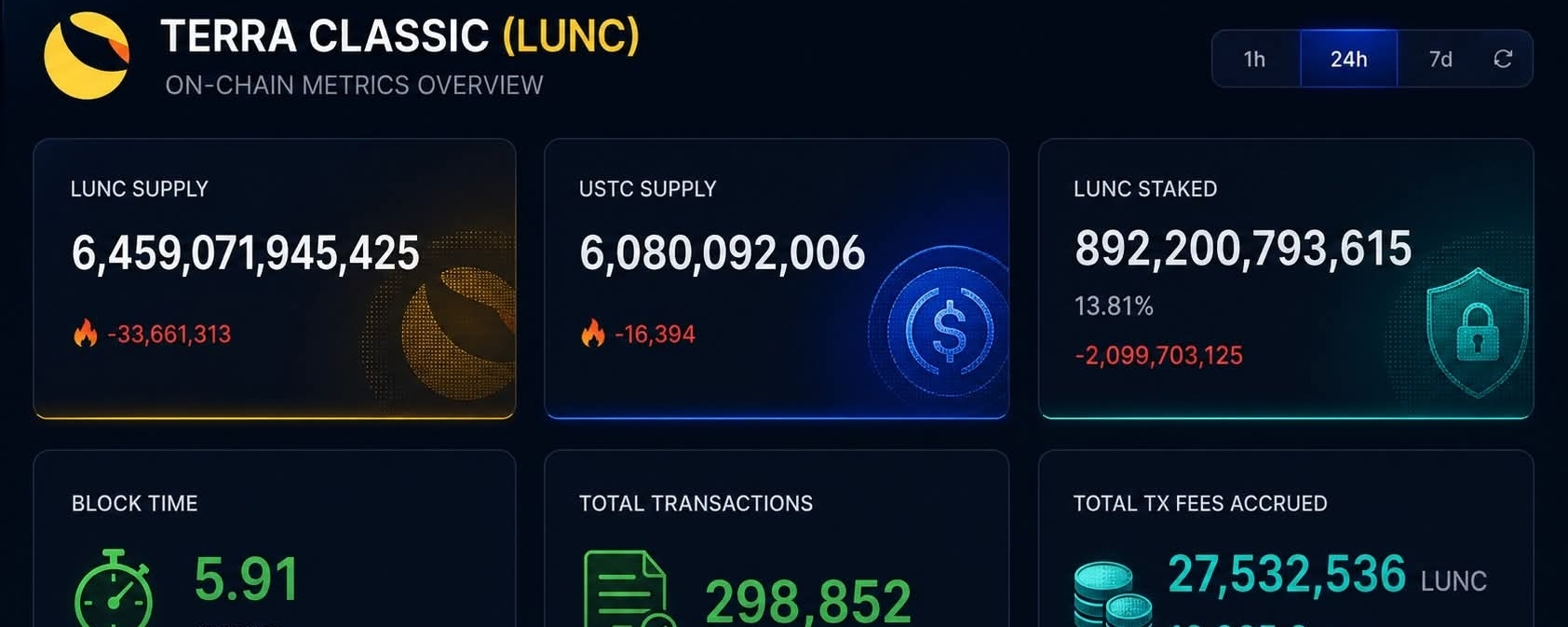
The fundamental landscape for Terra Classic (LUNC) is undergoing a notable shift. Recent data from May 2026 reveals a network steadily reinforcing its core metrics, driven by a highly coordinated community deflationary framework and robust network engagement. Long removed from its legacy structure, the modern, community-governed Layer-1 protocol is seeing tangible improvements across its supply dynamics, network security, and architecture.
1. Accelerated Deflation: The Supply Drop
The definitive focal point of the Terra Classic ecosystem remains its programmatic token burning mechanism, which has transitioned from a temporary recovery tactic into an automated deflationary engine.
The Institutional Engine: Centralized trading platforms continue to heavily anchor the network’s supply reduction. Most notably, Binance executed a massive single-day buyback-and-burn of 923 million LUNC tokens utilizing its spot and margin trading fees. This institutional push has driven Binance’s cumulative contribution alone past the 80 billion mark.
On-Chain Velocity: Complementing exchange-led burn events is the network's native 0.5% on-chain transaction tax. This fee automatically routes a portion of all wallet transfers, staking rewards, and decentralized application (dApp) interactions directly to a dead burn address.
Cumulative Impact: Thanks to an uptick in daily network activity, the overall burn rate has fluctuated between 105 million and 215 million LUNC per day. This ongoing momentum has pushed the cumulative lifetime burn of the network to an impressive 446+ billion LUNC tokens permanently removed from circulation.
2. Validator Staking Strength
A shrinking supply only tells half the story; where the remaining tokens reside dictates the actual health of the blockchain. In May 2026, the network's Delegated Proof-of-Stake (DPoS) ecosystem achieved a significant security milestone.
Nearly 1 trillion LUNC tokens are now actively staked and delegated across more than 130 active network validators.
Why This Matters: High staking participation serves a dual purpose. First, it directly removes massive quantities of liquid LUNC from the open market, reducing immediate sell-side pressure and making the ecosystem more responsive to positive capital inflows. Second, it structurally hardens the blockchain, increasing economic resistance against governance manipulation or potential network attacks.
3. Network Growth and Infrastructure Upgrades
Rather than relying purely on speculative social momentum, the Terra Classic developer community is aggressively modernizing the network's underlying tech stack to prove it can compete as a resilient Layer-1 blockchain.
The v4.0.1 Core Upgrade
The successful deployment of the v4.0.1 network upgrade has renewed broader ecosystem confidence. This key infrastructural release addressed critical vulnerability patches and drastically optimized Inter-Blockchain Communication (IBC) protocols within the Cosmos SDK network. The upgrade allows seamless cross-chain asset transfers, paving the way for developers to build or migrate dApps back to Terra Classic.
Market Module Reactivation & Utility Proposals
Looking forward, community governance is shifting focus toward sustainable on-chain utility. Active proposals are currently exploring the partial reactivation of Market Module 2.0—the network's original asset swap/arbitrage engine. Additionally, developers and governance participants are aggressively vetting algorithmic models to explore a strategic repeg of its companion asset, USTC. Restoring these core native mechanics remains the single most anticipated long-term utility catalyst for the ecosystem.
The Big Picture
The convergence of these metrics painted a highly bullish picture for market participants. The network recently broke past its multi-month resistance of $0.000046, briefly sparking a massive rally above the psychological $0.000100 milestone and driving its market cap back above $450M.
While short-term price discovery remains volatile, the fundamentals tell a clear story: the supply is steadily contracting, network security via staking is at historic strengths, and the development pipeline is actively shipping code. For a blockchain entirely run by its community, the structural progress achieved demonstrates a highly resilient architecture built for the long haul.