
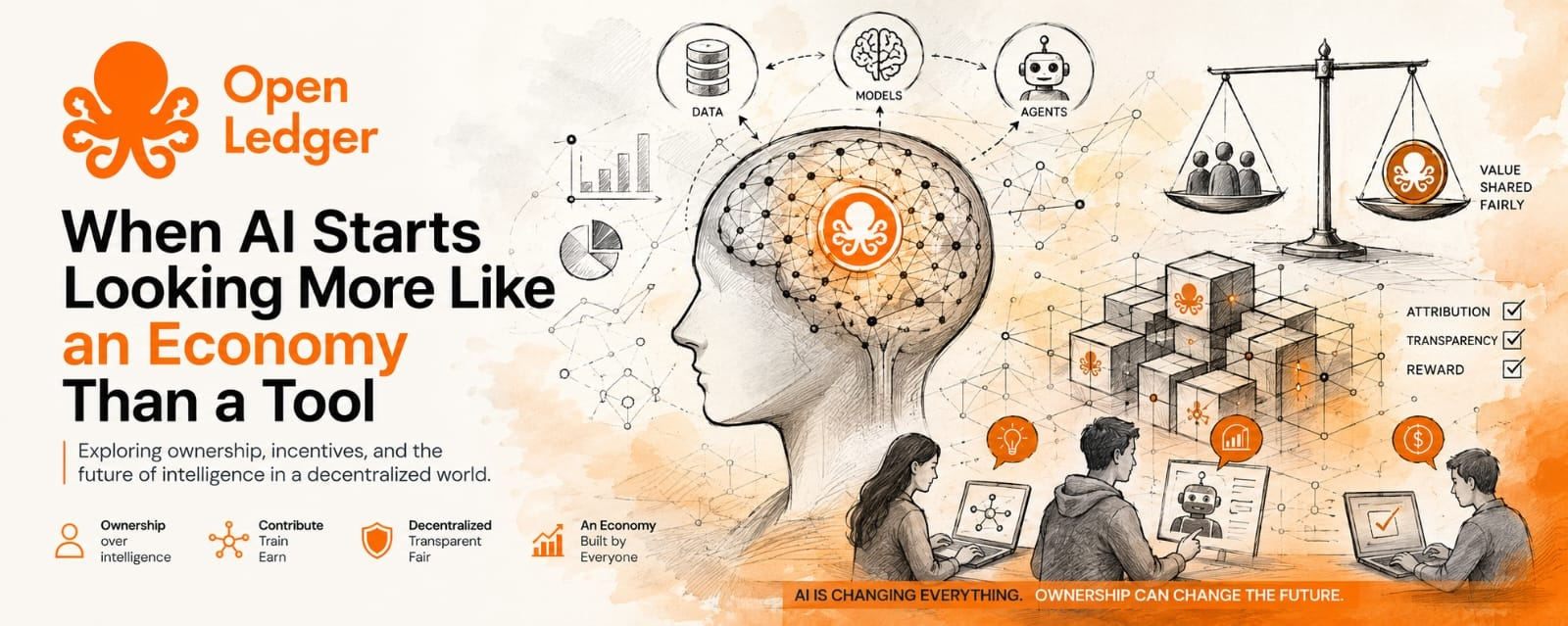
I’ve been thinking about OpenLedger differently lately.
Not as a normal crypto project. Not even as another AI narrative trying to capture attention during a bullish market cycle.
It feels more like a reaction to a growing fear that the future of AI is quietly becoming concentrated into the hands of a very small group of companies.
A few weeks ago, I was watching the market react to another major AI product release. Smaller AI-related tokens suddenly started pumping, even though most traders probably never tested the underlying technology themselves. That caught my attention because it showed something important. People are no longer only speculating on AI capabilities. They are speculating on ownership, control, and access to the infrastructure behind intelligence itself.
That is where OpenLedger becomes interesting.
The core idea sounds reasonable on paper. If people contribute data, improve models, operate AI agents, or help train systems, they should share in the economic value instead of feeding centralized platforms for free.
I understand why that idea resonates.
At the same time, I keep wondering whether most users actually want ownership, or whether they simply want products that work smoothly.
Those are very different things.
I made this mistake before as an investor. A couple of years ago, I became convinced that users deeply cared about decentralization in social applications. I allocated capital into several projects focused on user-owned data and tokenized engagement systems. The infrastructure looked impressive. The incentive models looked sustainable.
But regular users still preferred centralized apps because the experience felt easier and more convenient.
That experience changed how I evaluate AI protocols today.
Most people already exchange huge amounts of information every day without thinking twice about it. Search history, prompts, personal preferences, behavioral data, shopping patterns. Convenience usually wins against abstract concerns about ownership.
That is why I think the hardest problem for AI-crypto systems is not technical infrastructure.
It is human behavior.
OpenLedger is essentially experimenting with the idea that intelligence can become an economic layer. Contributions can be measured, attributed, rewarded, and potentially traded. That sounds efficient at first. But the more I think about it, the more complicated it starts feeling.
I noticed this while testing several AI productivity tools recently. Attribution sounded great initially. If someone contributes valuable training data or improves model performance, they deserve recognition.
But eventually I started wondering whether constant attribution changes the nature of participation itself.
Imagine a future where every prompt, correction, dataset contribution, or AI-generated insight carries permanent economic metadata attached to it.
Nothing stays informal anymore.
The internet used to thrive on messy collaboration. People experimented freely because not every interaction needed to become a monetized asset or permanent financial record. Once everything becomes measurable, people naturally begin optimizing behavior around rewards.
That creates a subtle psychological shift.
Participation slowly turns into performance.
There is another contradiction here that keeps bothering me.
AI and blockchain almost have opposite personalities.
AI systems are increasingly probabilistic, opaque, and unpredictable. Even advanced research teams often struggle to fully explain why certain outputs appear. Blockchain systems, meanwhile, are designed around deterministic rules, transparency, verification, and hard accountability.
Trying to merge those worlds creates an unusual attempt to quantify things that are naturally difficult to quantify.
Creativity.
Originality.
Trust.
Usefulness.
Markets can price tokens relatively efficiently because supply and demand are visible.
I am not fully convinced markets can cleanly price intelligence.
This happened to me recently during a conversation with a friend who actively trades AI-agent ecosystems. He kept evaluating projects through token velocity, staking mechanisms, treasury structure, and emission schedules. Meanwhile, I kept asking whether the actual AI products solved meaningful problems.
We were analyzing the same sector while thinking in completely different frameworks.
That disconnect feels important.
A lot of AI-crypto systems risk optimizing financial activity faster than genuine utility.
At the same time, I understand exactly why these projects continue appearing.
The current AI economy already feels heavily concentrated. A small number of companies control massive compute infrastructure, proprietary datasets, distribution channels, and increasingly the consumer relationship itself. Once those advantages compound long enough, meaningful competition becomes difficult.
So protocols like OpenLedger are trying to build alternative coordination systems before the existing power structure hardens permanently.
Even if these experiments never fully solve decentralization, the motivation behind them feels legitimate.
My hesitation mainly comes from watching how financialization changes incentives over time.
Once datasets, models, or AI agents become liquid assets, speculation naturally enters the system. Builders stop optimizing only for usefulness. They begin optimizing for valuation, visibility, token demand, and narrative momentum.
I have watched this happen repeatedly across different crypto cycles.
A project launches with a meaningful technical goal.
Then attention arrives.
Then leverage arrives.
Eventually the market rewards what is easiest to market instead of what is hardest to build.
That does not destroy innovation entirely, but it definitely changes its direction.
So I do not really see OpenLedger as something that suddenly redefines AI overnight.
I see it more as an experiment built around an important fear that intelligence itself is becoming centralized faster than society knows how to respond.
Maybe blockchain helps slow that concentration.
Maybe it simply introduces a different set of tradeoffs involving surveillance, speculation, and behavioral distortion.
Either way, I think these conversations matter because the AI economy is no longer theoretical. It is already shaping incentives, labor, creativity, and information flow in real time.
The bigger question is whether decentralized ownership genuinely improves the future of intelligence, or whether it simply creates another financial layer around systems most people will never fully control anyway.
And honestly, I still do not know the answer.
Do you think people genuinely care about owning part of the AI economy, or will convenience always dominate? And if intelligence becomes fully financialized, what happens to creativity that cannot be easily measured or priced?
$OPEN @OpenLedger #OpenLedger $IQ $REQ
