
Most people still talk about AI fine-tuning like it’s contract work. That’s probably the first assumption I’d challenge.
A company needs domain-specific intelligence, hires a team, buys a curated dataset, pays for model adaptation, then closes the transaction. Done. Clean accounting. Predictable procurement. Nobody likes open-ended obligations.
But the more AI starts behaving less like software you install and more like infrastructure that keeps producing value, the stranger that model looks.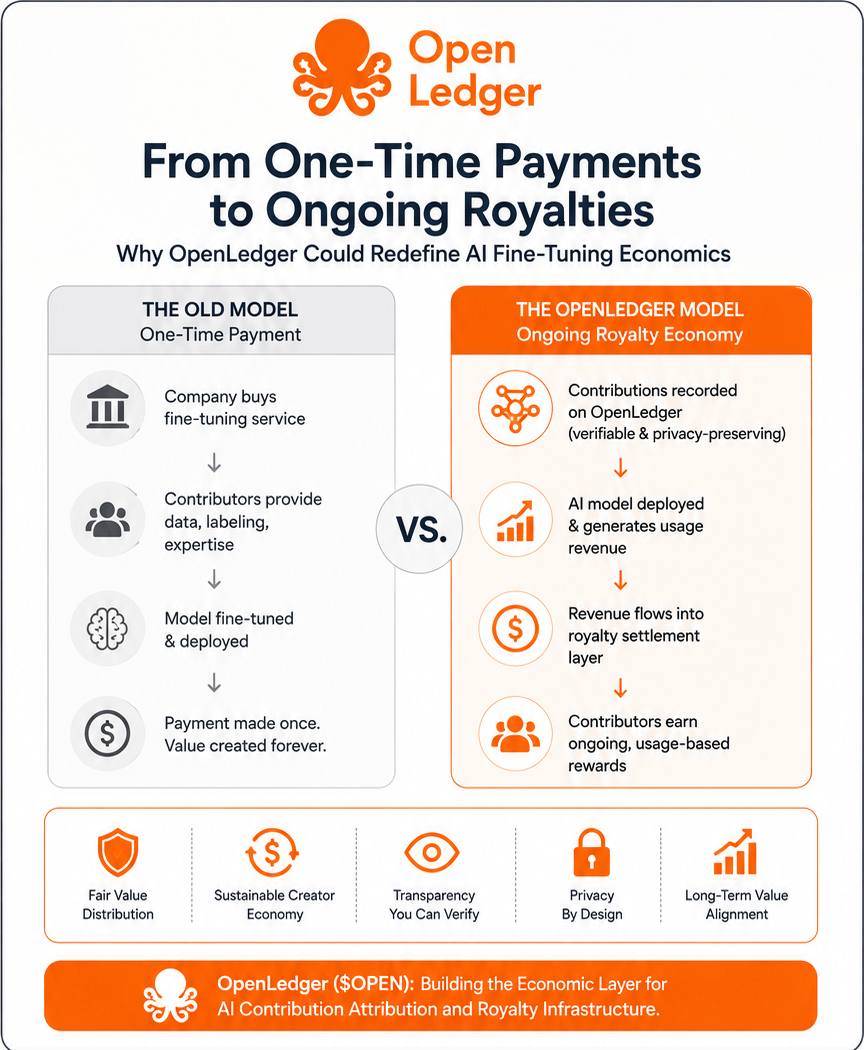
I’ve been thinking about this because markets often misprice where value actually forms. People obsess over compute because it’s visible. GPU costs are easy to understand. Inference pricing makes sense. Even tokenized compute narratives feel intuitive, whether or not they survive competition.
What feels less obvious is this: in many practical AI businesses, the real economic edge may not sit in the model itself.
It sits in what happened after the model existed.
A general-purpose language model is useful. Sure. But that alone rarely creates durable commercial differentiation. The real money usually appears when the system gets shaped by proprietary workflows, sector-specific corrections, operational feedback, human edge cases, ugly real-world exceptions. Healthcare. Legal review. Logistics routing. Enterprise support systems. Fraud detection.
That layer isn’t glamorous. It’s where humans quietly make the model less stupid.
And once that clicked for me, the compensation model started looking outdated.
If a contributor helps fine-tune a model that keeps generating revenue for years, why does the economic logic still resemble freelance labor instead of participation rights?
That’s not even a crypto question yet. Just a structural one.
Music figured this out decades ago. Software licensing did too. Asset management lives on recurring economics. Even franchise systems understand that initial setup and ongoing value are different economic events.
AI fine-tuning mostly doesn’t.
You get paid once, even if your contribution becomes permanently embedded in a profitable system.
Maybe that’s normal. Maybe companies prefer it because uncertainty is expensive.
Still feels like a mismatch.
This is where OpenLedger gets interesting to me, though probably not in the way most market participants frame it.
A lot of AI crypto narratives still orbit compute marketplaces. Faster inference. cheaper access. decentralized hardware coordination. I understand the appeal. Compute is tangible.
But if compute eventually becomes more competitive and margins compress, the scarcer layer may be attribution.
Not intelligence. Attribution.
Meaning: who actually helped shape the intelligence in ways that mattered commercially?
That sounds philosophical until money enters the room.
Imagine an enterprise AI assistant fine-tuned using contributions from medical annotators, domain reviewers, specialist datasets, workflow engineers, maybe even continuous correction loops from actual usage. Now imagine that product generates millions in enterprise subscription revenue over time.
Who gets economic recognition?
Today, probably whoever owns deployment rights.
OpenLedger seems to be exploring something more structurally ambitious: turning contribution provenance into an economic coordination layer.
Provenance sounds technical, but the idea is simple. Can the system credibly trace what contributed to what?
Because without that, recurring compensation is fantasy.
And honestly, attribution in AI is messy enough even before token economics enter.
Fine-tuning isn’t like paying one songwriter. Contributions overlap. Weightings change. Some inputs improve behavior dramatically. Others create hidden failure risk. Some corrections matter only under rare production conditions six months later. Good luck assigning exact economic percentages cleanly.
That’s where most simplistic “AI royalty” narratives fall apart.
But OpenLedger’s broader architecture around verifiable datanets and contribution tracking suggests a more interesting possibility: not perfect attribution, but economically credible attribution.
That distinction matters.
Markets don’t require philosophical certainty. They require systems people are willing to settle against.
Very different standard.
If OpenLedger creates infrastructure where economically meaningful AI contributions can be recorded, weighted, and periodically recognized, then AI fine-tuning starts looking less like labor procurement and more like royalty-bearing infrastructure participation.
That changes the entire token conversation.
Because then $OPEN isn’t just access plumbing.
It becomes part of settlement logic.
Still, I can already hear the enterprise objections.
Finance teams hate indefinite obligations.
Legal departments hate ambiguous economic entitlements even more.
A one-time payment is simple. Future revenue-sharing introduces complexity, disputes, tax treatment questions, contract renegotiation pressure, cross-border accounting headaches, intellectual property uncertainty. If contributor rights start resembling ongoing claims tied to commercial performance, regulators may interpret things differently depending on jurisdiction.
And privacy gets awkward fast.
Some of the most valuable fine-tuning happens in sensitive environments. Healthcare records. Enterprise workflows. Customer support transcripts. Internal compliance processes.
You can’t solve attribution by casually exposing contribution trails.
So if OpenLedger wants this thesis to work, privacy-preserving verification becomes essential. Not optional. The architecture has to prove contribution relevance without leaking confidential operational data.
That’s a hard engineering problem, not branding language.
Then comes incentive distortion.
Crypto people know this pattern well.
The moment future rewards become visible, behavior changes. Contributors optimize for payout metrics instead of actual quality. Spam enters. Reputation games start. Systems get farmed.
So attribution infrastructure without filtering becomes extraction infrastructure.
That risk is real.
Still, I think the bigger shift here deserves attention.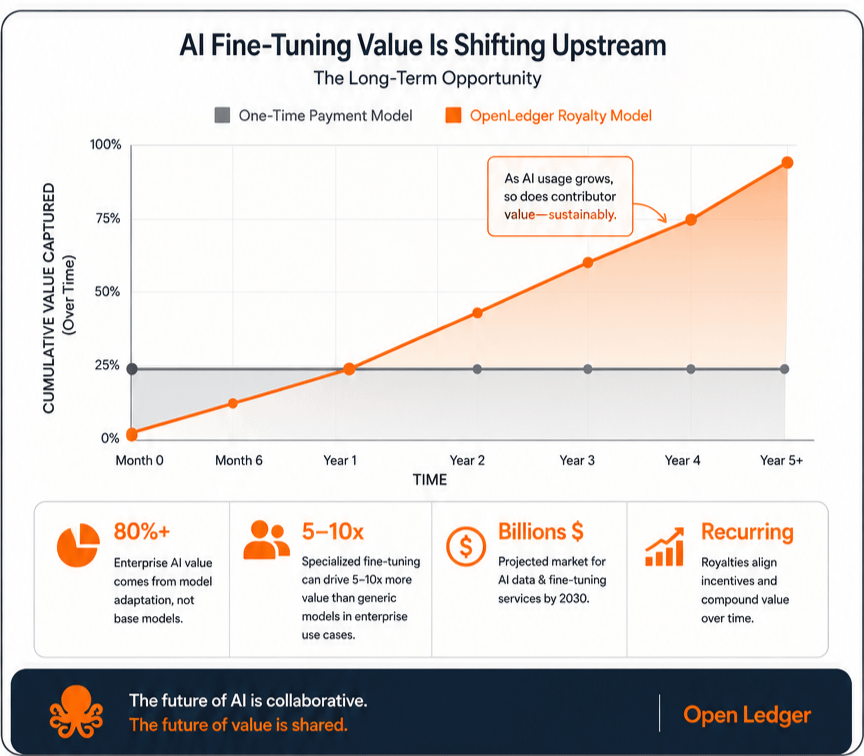
AI may be moving away from a simple ownership economy toward something closer to participation economics, at least in specialized markets where model adaptation carries most of the economic value.
Not everywhere.
Commodity AI probably stays transactional.
But high-value vertical intelligence? Different story.
If that happens, the important infrastructure may not be the network making intelligence cheaper.
It may be the one deciding whether contributors remain economically relevant after the model starts making money.
That’s a much stranger market.
And probably a more durable one.

Artikel
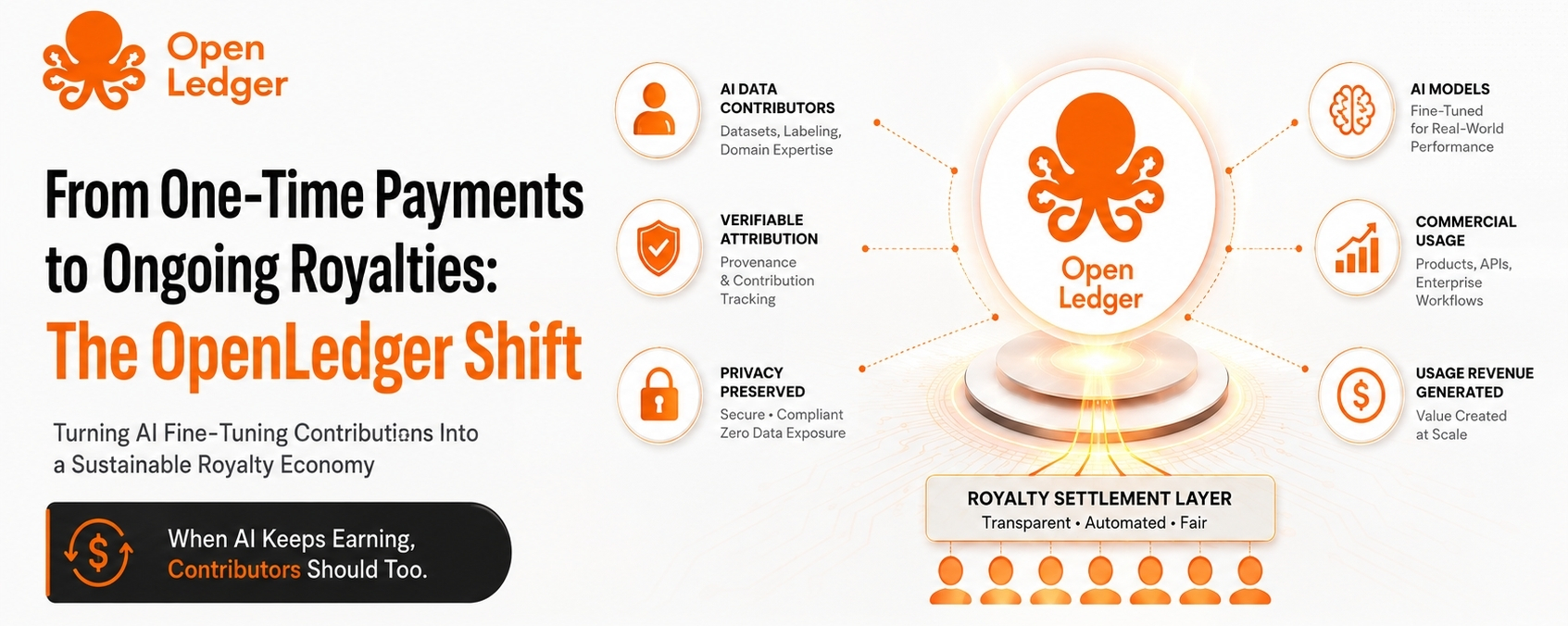
OpenLedger ($OPEN) Might Turn AI Fine-Tuning Into a Royalty Economy, Not a One-Time Payment Market
Haftungsausschluss: Die hier bereitgestellten Informationen enthalten Meinungen Dritter und/oder gesponserte Inhalte und stellen keine Finanzberatung dar. Siehe AGB.