
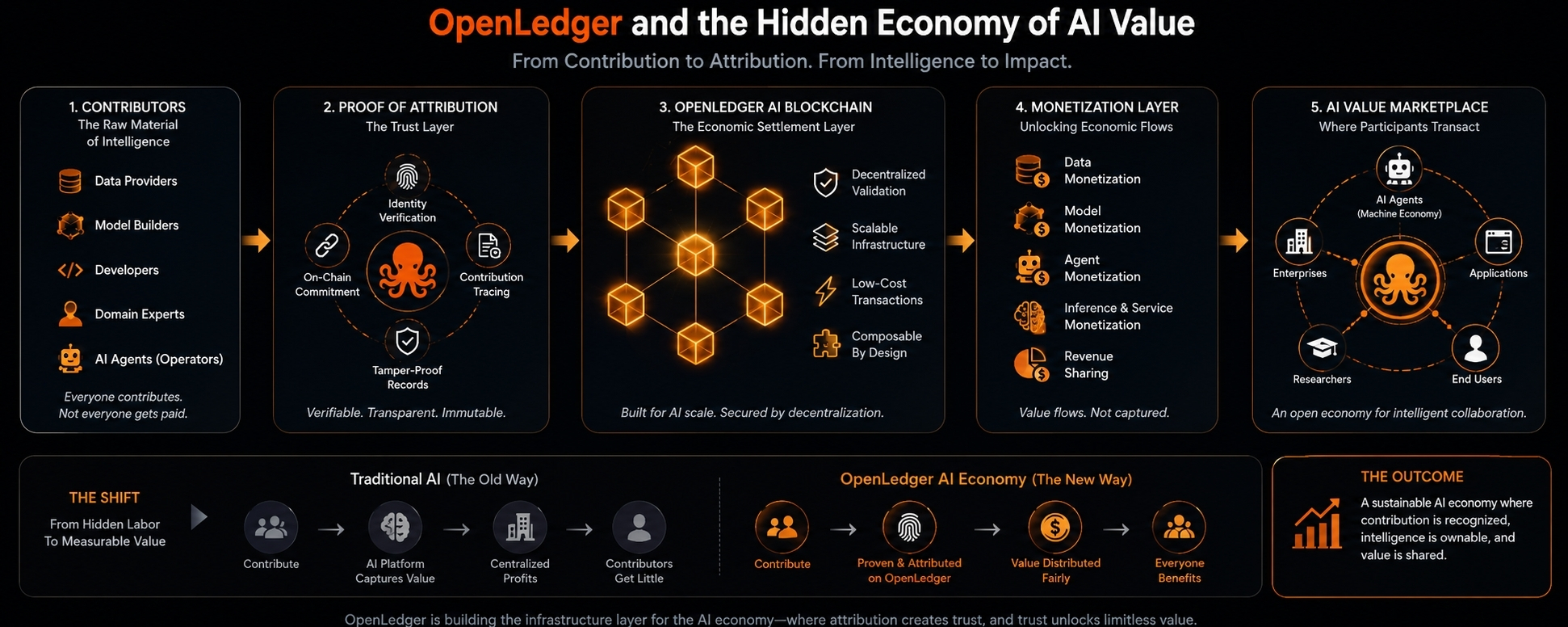
@OpenLedger keeps pulling me back for one reason that feels easy to miss if you only look at the AI narrative from the surface.
It treats AI less like software and more like an economy.
That distinction changes everything.
Most AI conversations still orbit around performance. Better models. Faster inference. More capable agents. Cheaper compute. The market stays obsessed with output quality because output is what people can see. It’s visible. Easy to benchmark. Easy to market.
But underneath all of that, there’s a quieter market forming around ownership.
Who owns the data that trains intelligence? Who captures value when a model generates revenue? Who gets paid when an autonomous agent creates economic output on-chain? And maybe the harder question: how do you prove any of it without rebuilding trust manually every time?
That’s where OpenLedger starts getting interesting to me.
Not because it’s another AI blockchain project. Crypto doesn’t need more narratives stapled together with token incentives and a homepage animation. We’ve seen enough of that cycle already.
What feels different here is that OpenLedger AI Blockchain seems designed around monetization pressure.
And monetization pressure is real.
Every useful AI system eventually runs into it.
Data contributors want compensation. Model builders want recurring revenue. Agent operators want scalable execution with transparent economics. End users want low-cost access. Platforms want fees. Investors want network growth. Somewhere in between all of that, value leaks everywhere.
OpenLedger appears built around trying to capture that leakage.
That matters more than people think.
AI data monetization sounds abstract until you zoom in and watch what actually happens on the internet. People are already feeding enormous amounts of unpaid labor into AI systems every day. Prompts, responses, datasets, behavioral feedback, niche expertise, image labeling, reinforcement loops. The raw material is everywhere, but the economic attribution layer remains fragmented.
That fragmentation eventually becomes a market inefficiency.
And markets usually price inefficiencies sooner or later.
OpenLedger’s emphasis on Proof of Attribution sits right in that gap.
I think that concept deserves more attention than it gets.
Because attribution isn’t just a technical feature. It’s an economic primitive.
If decentralized AI is going to become a real sector rather than a temporary market cycle, attribution has to become measurable. Otherwise the revenue stack collapses upward toward whoever controls distribution, and everyone beneath that layer becomes invisible labor.
We’ve seen that dynamic before in Web2.
Platforms captured the upside. Contributors fed the machine.
Crypto keeps claiming it wants a different outcome. OpenLedger at least feels like it’s trying to design for one.
Of course that doesn’t mean it’s easy.
Actually it’s incredibly hard.
Maybe harder than the market currently prices in.
Building AI infrastructure blockchain rails is one challenge. Getting participants to behave honestly inside those rails is another. Incentive design in decentralized systems always looks elegant on paper. Then real users arrive with profit motives, short attention spans, and wildly different time horizons.
That’s when stress appears.
Contributors optimize for payouts.
Developers optimize for scale.
Speculators optimize for token velocity.
Users optimize for convenience.
Those incentives rarely move in perfect alignment.
That’s the part I keep thinking about with the OpenLedger token.
Because token behavior around AI infrastructure often becomes a referendum on belief before utility fully arrives. Markets front-run adoption aggressively. Narrative capital moves faster than product usage. Liquidity appears before stable demand does. Then expectations become difficult to satisfy.
We’ve seen that pattern across crypto infrastructure over and over.
The token gets priced like future inevitability while the network is still negotiating present-day behavior.
Sometimes that works.
Sometimes it breaks.
The long-term question for OpenLedger probably isn’t whether AI grows. That part feels obvious at this point. AI agents crypto infrastructure will continue expanding because autonomous digital labor has clear economic demand.
The harder question is whether value generated inside those systems can settle fairly enough that participants continue contributing.
That’s a retention question disguised as a protocol question.
And retention is where crypto often gets exposed.
Liquidity can be rented.
Attention can be rented.
Users can be incentivized temporarily.
But durable contribution usually requires stronger alignment than emissions alone.
OpenLedger feels aware of that.
Its design reads less like a short-term growth mechanism and more like an attempt to build market rails around AI participation itself. Data becomes attributable. Models become monetizable. Agents become economic actors. Value becomes measurable across the stack instead of disappearing into platform opacity.
That’s powerful if it works.
But even then there’s friction.
A lot of friction.
Attribution systems add complexity. Verification adds latency. Monetization frameworks can create overhead that feels heavy compared to centralized alternatives. Most users say they care about ownership until ownership adds extra steps to their workflow.
Then convenience wins.
Convenience almost always wins.
So OpenLedger has to balance something difficult: preserving decentralized AI economics without making the experience feel expensive or slow.
That balance is rare.
Too much decentralization and nobody uses it.
Too much abstraction and the ownership layer loses meaning.
The strongest infrastructure projects usually survive because they find a middle ground users barely notice.
If OpenLedger gets there, that becomes very interesting.
Especially because AI is moving toward agents.
And agents introduce an entirely different market structure.
When agents transact with models, access datasets, pay for inference, exchange outputs, or trigger on-chain execution, they create machine-to-machine economies. At that point, infrastructure isn’t just serving humans anymore.
It’s serving autonomous participants.
That changes how liquidity behaves.
That changes fee design.
That changes attribution.
And eventually it changes what blockchains are even for.
This is why OpenLedger keeps standing out to me.
Not because it promises bigger AI.
But because it asks what economic infrastructure AI needs once intelligence becomes productive.
That’s a more durable question.
The crypto market often gets distracted by narratives because narratives are easy to trade. Infrastructure is slower. Less visual. Harder to explain in one sentence. Usually underappreciated until the system suddenly becomes necessary.
Then everyone notices at once.
OpenLedger feels closer to that category.
Still early. Still uncertain. Plenty unresolved. Real execution risk. Real adoption risk. Real incentive complexity.
But also real signal.
And increasingly I think that’s where the important work is happening in crypto now—not at the layer of attention, but underneath it.
In the quiet architecture around value creation.
If OpenLedger succeeds, it probably won’t be because people called it an AI blockchain project loudly enough.
It’ll be because it solved a much less glamorous problem.
How to make contribution measurable.
How to make intelligence ownable.
And how to let value move through AI systems without disappearing into the black box between creation and capture.
That’s a different lens to view this through.
Less “What can AI do?”
More “Who gets paid when AI does it?”
That question feels smaller at first.
But I suspect it ends up being the bigger market.
