
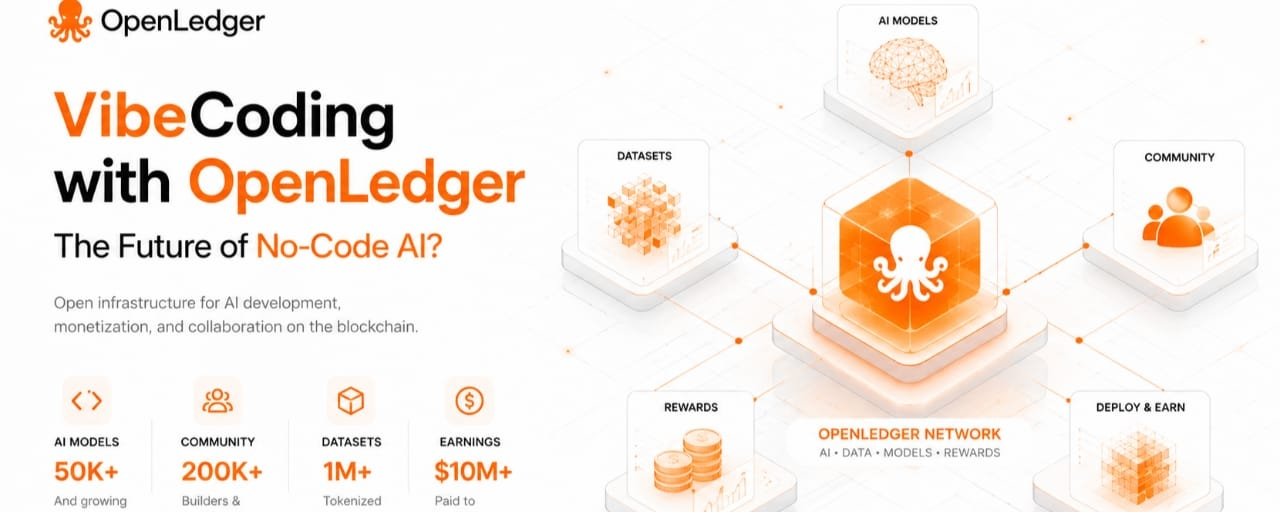
There was a time when I thought “vibecoding” was just another modern label for something much older: humanity’s desire to escape complexity.
We’ve always wanted to skip syntax, bypass rigid structure, and interact with machines as naturally as we talk to other people. Every tech cycle repeats the same promise — that technical barriers will disappear and anyone will be able to build, create, or operate systems of their own.
Most of those promises eventually fade away.
That’s why I initially looked at Vibecoding in the OpenLedger ecosystem with some skepticism. It felt perfectly aligned with the current AI narrative: prompts instead of programming, intention replacing implementation, humans simply describing what they want while machines generate the rest.
It sounds exciting.
But it also feels risky.
Because every new layer of abstraction tends to distance people from understanding what’s happening underneath. We use the internet without understanding routing, rely on social media without understanding recommendation systems, and interact with AI while very few truly understand data provenance or attribution.
There’s something uncomfortable about the industry turning everything into “magic.”
But over time, I realized the most important part of Vibecoding may have nothing to do with no-code tools at all.
It’s about coordination.
Many people see Vibecoding as a productivity upgrade, but that may be the least interesting layer. What actually matters is how it changes the relationship between expertise and participation.
In the past, technology ecosystems operated like isolated territories. Developers had their own language, researchers stayed inside academic circles, designers worked separately, and ordinary users rarely had a place in the creation process.
But once the interface becomes natural language, the system opens up in a different way.
It stops feeling like software alone and starts feeling more like culture.
Someone deeply familiar with a niche community can design AI workflows without being an engineer. A collector who understands market psychology can coordinate agents through intuition. A researcher can encode an entire worldview into system behavior without writing thousands of lines of code.
From my perspective, Vibecoding doesn’t eliminate expertise.
It reshapes expertise.
That’s what changed how I look at OpenLedger.
I’m beginning to see it less as a company building AI tools and more as an attribution infrastructure — a system where contributions can persist long enough to be recognized, connected, and reused across other systems.
It sounds abstract, but it’s actually a deeply human problem.
For years, the internet has operated through a strange paradox: collective value is created through countless invisible contributions, yet ownership remains concentrated at the platform level. The people generating the data rarely own it, and communities producing behavioral intelligence seldom capture the value they create.
AI only amplifies this paradox.
The deeper I look, the more I feel the future of AI may not be decided by model wars or benchmark supremacy, despite the market’s obsession with them.
The real question may be: Who builds the persistence layer for contribution?
Who remembers who contributed what? Who preserves the lineage of knowledge? Who enables coordination without erasing attribution?
That’s the invisible infrastructure most of the market overlooks because it’s far less flashy than AI agents posting demos on social media.
But history often works this way.
TCP/IP wasn’t flashy. Linux wasn’t flashy. Database standards weren’t flashy.
Yet civilization-scale coordination was built on top of those quiet foundational layers.
Maybe Vibecoding will eventually become another overhyped narrative. There will probably be endless AI wrappers and countless “build anything with prompts” projects that appear and disappear.
But underneath the noise, I think something deeper is forming.
A world where software is no longer a static product, but an ongoing flow between humans, agents, communities, and data.
Where coding starts to resemble social behavior more than pure technical skill.
And maybe the strangest part is this:
As technology becomes increasingly invisible, the central question remains deeply human: How do people coordinate long enough to create something more lasting than themselves?