
I’ve been in crypto long enough to see how every cycle creates a new obsession. First it was payments, then smart contracts, then NFTs, then modular systems, and now everything revolves around AI. Most of the time i ignore narratives when they become too loud because hype usually arrives before real understanding. But i when i start digging into OpenLedger, something felt different to me.
What caught my attention wasn’t just the idea of an AI blockchain. We already have dozens of projects trying to attach themselves to AI. What made me stop and think was the deeper economic question underneath OpenLedger: who actually deserves the value created by intelligence?
The more i looked into modern AI systems, the more uncomfortable i became with how the industry really works. Almost every powerful model today is built on invisible human contribution. People create the data, the conversations, the corrections, the feedback loops, the behavioral patterns, the specialized knowledge, yet most of them never receive ownership or long-term value from what they helped build. A small group of corporations absorbs the economic upside while millions unknowingly become unpaid infrastructure.
That’s where i noticed OpenLedger approaching AI differently.
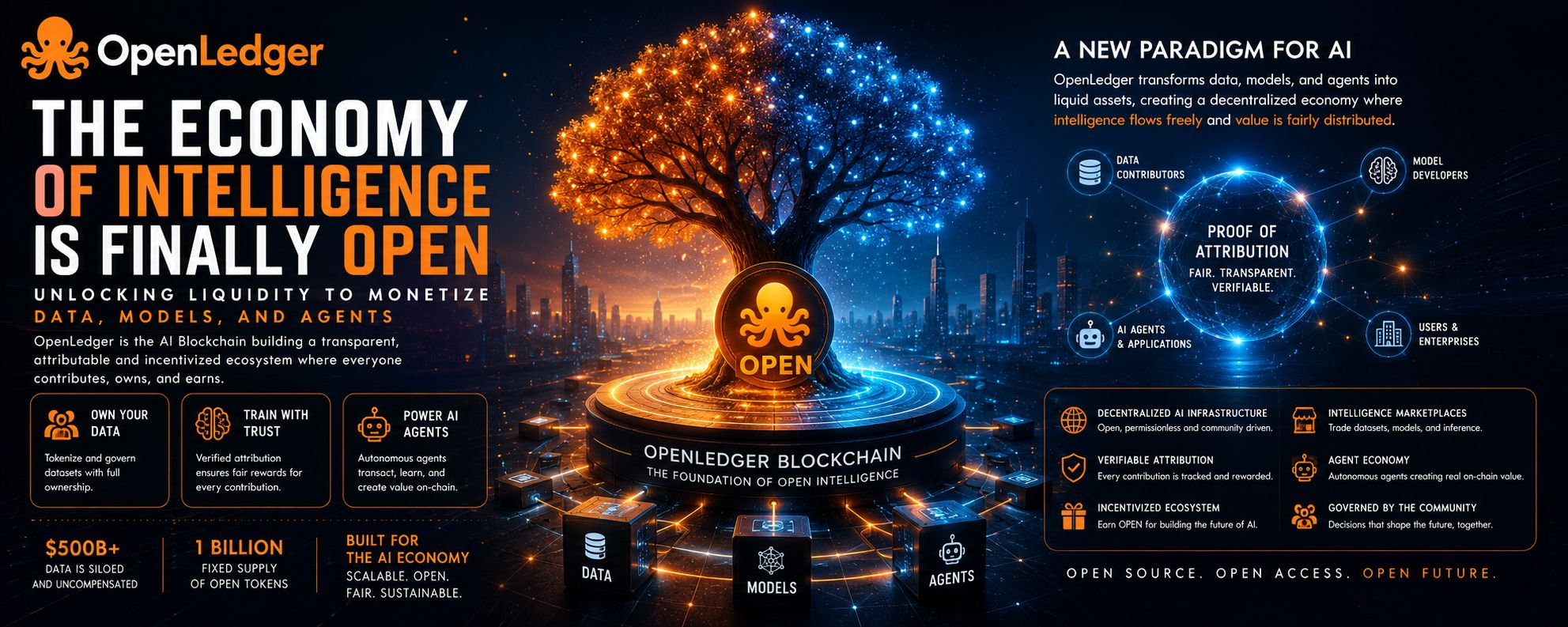
Instead of treating intelligence like a closed corporate product, it treats AI like an economic network where contributors, datasets, models, and agents can all become part of an open value system. The idea sounds simple at first, but the implications are massive once you really think about it.
I m noticing that the future AI economy may not be controlled only by whoever has the biggest models. Models are becoming cheaper, open-source development is accelerating, and fine-tuning is spreading everywhere. The real scarcity might become high-quality attributed data and trusted intelligence coordination. That changes the entire power structure of AI.
What makes OpenLedger interesting to me is how much focus it places on attribution. Most people outside the industry don’t realize this yet, but attribution could become one of the biggest problems AI faces over the next decade. Nobody truly knows how to fairly track who contributed value once intelligence becomes layered across millions of inputs. And if AI agents eventually become autonomous economic actors, the problem becomes even bigger.
I start thinking about a future where AI agents negotiate, transact, research, automate businesses, and interact with each other without constant human supervision. Once that happens, trust becomes everything. People will want to know where the intelligence came from, who trained it, what data shaped it, and who deserves compensation from its outputs.
That’s why OpenLedger keeps staying in my mind.
I noticed the project is quietly trying to build infrastructure for something much larger than speculation. It’s attempting to create an economy where intelligence itself becomes traceable, measurable, and monetizable at the contributor level. That is a completely different vision compared to most AI crypto projects chasing temporary attention.
The deeper i go into this sector, the more i realize AI is slowly transforming data into labor. Every interaction online now has potential economic value because it can shape future machine intelligence. But the current internet still operates like users should give away that value for free while platforms centralize the rewards.
OpenLedger feels like a challenge to that structure.
And honestly, i think that’s why it stands out to me more than the usual AI narratives flooding the market. It isn’t only asking how to build smarter machines. It’s asking who should own the value those machines generate.
That question might become one of the most important economic debates of the next decade.