
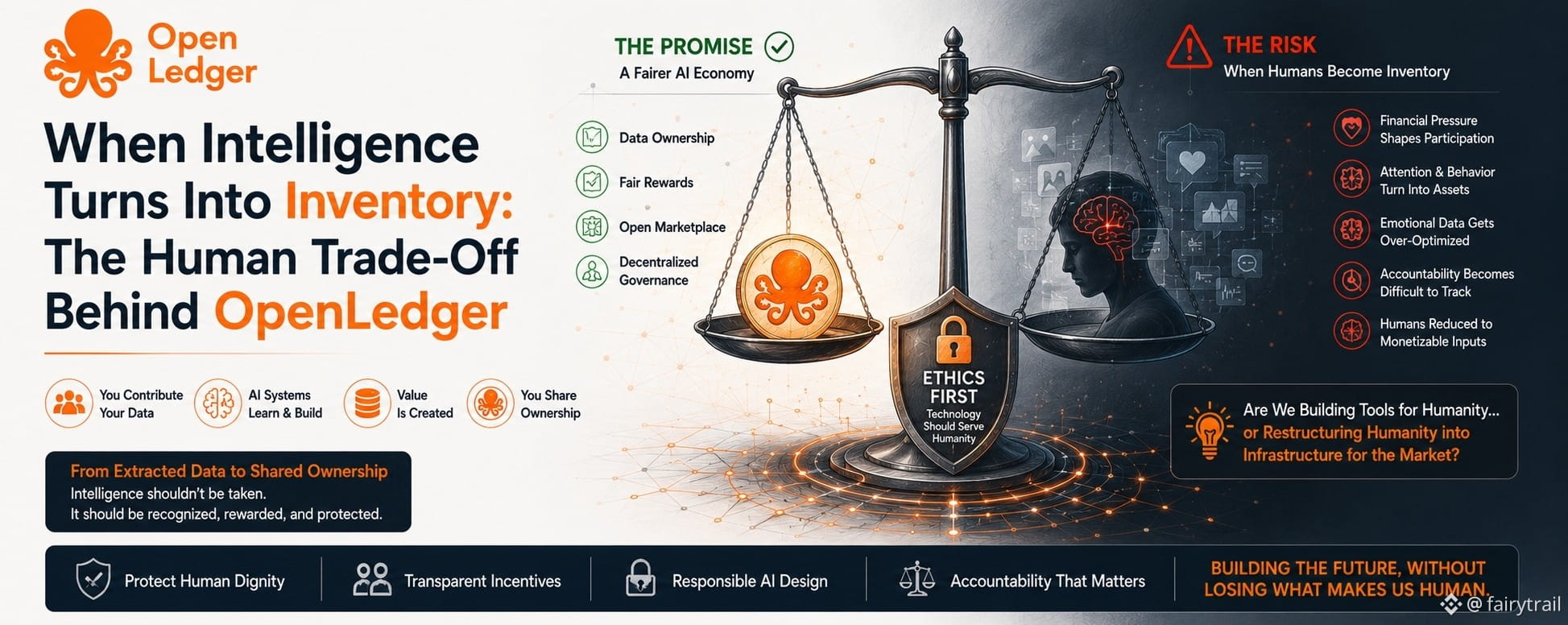
A few nights ago, I was staring at a trading screen while reading another thread about AI infrastructure and decentralized networks. Bitcoin was flat, AI tokens were pumping again, and every second post on my feed sounded like the future had already arrived. That was when I started thinking more seriously about OpenLedger.
At first, I understood the excitement immediately. The pitch feels almost irresistible if you spend enough time around crypto or AI. Instead of giant companies quietly absorbing everyone’s data for free, OpenLedger proposes a system where data contributors, model builders, and agent creators can finally share ownership in the value they help create. In theory, intelligence stops being extracted only by corporations and starts becoming an open marketplace.
Honestly, I wanted to believe in that idea.
I remember opening a small long position on AI infrastructure tokens earlier this year because the narrative looked powerful. AI was becoming expensive to train, expensive to scale, and increasingly dependent on data pipelines. Projects connecting AI with blockchain suddenly looked like a logical next step. The market loved it too. Every dashboard metric was climbing: active wallets, AI interactions, contributor activity, token velocity.
But after the excitement cooled down, I noticed something uncomfortable.
The entire system depends on turning human behavior into economic fuel.
That changes the emotional structure of participation.
I saw a small example of this during a Discord discussion with freelance designers. One artist explained that she had started feeding years of stylistic work into AI training environments because commissions were slowing down. She did not sound excited about the technology. She sounded financially cornered. That difference matters more than people admit.
Crypto markets often describe participation as freedom, but markets also create pressure. Sometimes invisible pressure.
When a system rewards people for monetizing personal information, creativity, or behavioral patterns, participation slowly stops feeling optional. It starts feeling economic.
That is where projects like OpenLedger become psychologically complicated.
The optimistic framing says people finally own their data.
The darker possibility is that people eventually feel forced to sell pieces of themselves because ownership alone does not remove financial desperation.
I made a similar mistake myself during the last AI token cycle. I focused too much on token mechanics and not enough on human incentives. I was comparing throughput numbers, governance structures, and agent execution layers while ignoring the social consequences underneath. That happens a lot in crypto. We analyze systems as if humans automatically adapt cleanly to incentives.
Real life does not work that way.
A trader protecting losses behaves differently from a researcher exploring technology. A developer trying to pay rent makes different decisions than someone building for curiosity. Incentives reshape behavior faster than ideology does.
That is why I keep questioning the phrase “intelligence as liquidity.”
Liquidity sounds efficient in presentations. Investors love that language because liquidity implies movement, scale, and opportunity. But intelligence is tied to memory, emotion, identity, and experience. Once those become tradable inputs, the market inevitably starts assigning value to certain kinds of humanity over others.
And markets are not designed around emotional well-being.
I noticed this while testing sentiment-driven AI trading tools a few months ago. The systems responded more aggressively to outrage than calm discussion because emotional volatility generated stronger engagement patterns. That realization stayed with me. If emotionally reactive data becomes more profitable than thoughtful data, networks may slowly optimize for emotional instability without openly admitting it.
The scary part is that nobody involved has to be malicious for that outcome to happen.
The incentive structure alone can create it.
That is also why decentralization does not automatically solve accountability problems.
Supporters often argue that decentralized governance prevents centralized abuse, and sometimes that is true. But decentralization can also scatter responsibility so widely that nobody fully owns the consequences anymore.
Imagine an AI agent operating across decentralized infrastructure causes financial harm, manipulates users, or leaks sensitive information. Who carries responsibility then?
The developer?
The contributors?
The validators?
The governance voters?
The token holders who financially benefited from network growth?
I think people underestimate how badly humans still need visible accountability during crises. Blockchain systems often celebrate trustless architecture, but real trust never disappears. It simply moves elsewhere.
That tension becomes even more dangerous when speculation enters the ecosystem.
I have already seen traders discussing AI ecosystems the same way meme coin traders discuss volatility rotations. They are not analyzing ethical design. They are hunting momentum. Once that mindset dominates, systems built around human intelligence risk treating people less like participants and more like raw material.
That sounds dramatic, but history keeps repeating this pattern.
Social media monetized attention.
Gig platforms monetized availability.
Now AI infrastructure risks monetizing cognition itself.
OpenLedger is interesting because it sits directly inside that transition.
To be fair, I do not think projects like OpenLedger are driven by bad intentions. Most builders in this space genuinely want fairer systems. They are reacting to legitimate frustrations with centralized AI companies controlling data, computation, and profits.
I respect that motivation.
But good intentions do not cancel structural pressure.
Once markets discover profitable human behaviors, those behaviors get amplified relentlessly.
That is why I think the real challenge for OpenLedger is not technical scalability. It is designing an ecosystem where humans still feel like humans instead of monetizable components.
Because the future presentations are easy to imagine already. Higher agent activity. Larger datasets. Faster transactions. Bigger token flows.
The harder question is whether ordinary people inside those systems actually feel safer, freer, or more respected.
Or whether they simply become more financially measurable.
Maybe that is the real dividing line for AI blockchains over the next few years. Not whether they can tokenize intelligence efficiently, but whether they can protect human dignity while doing it.
If intelligence, memory, creativity, and behavior all become market assets, can systems like OpenLedger prevent people from slowly seeing themselves the same way?
And if they cannot, are we still building tools for humanity, or quietly restructuring humanity into infrastructure for the market?
$OPEN @OpenLedger #OpenLedger $PLAY $BEAT
