
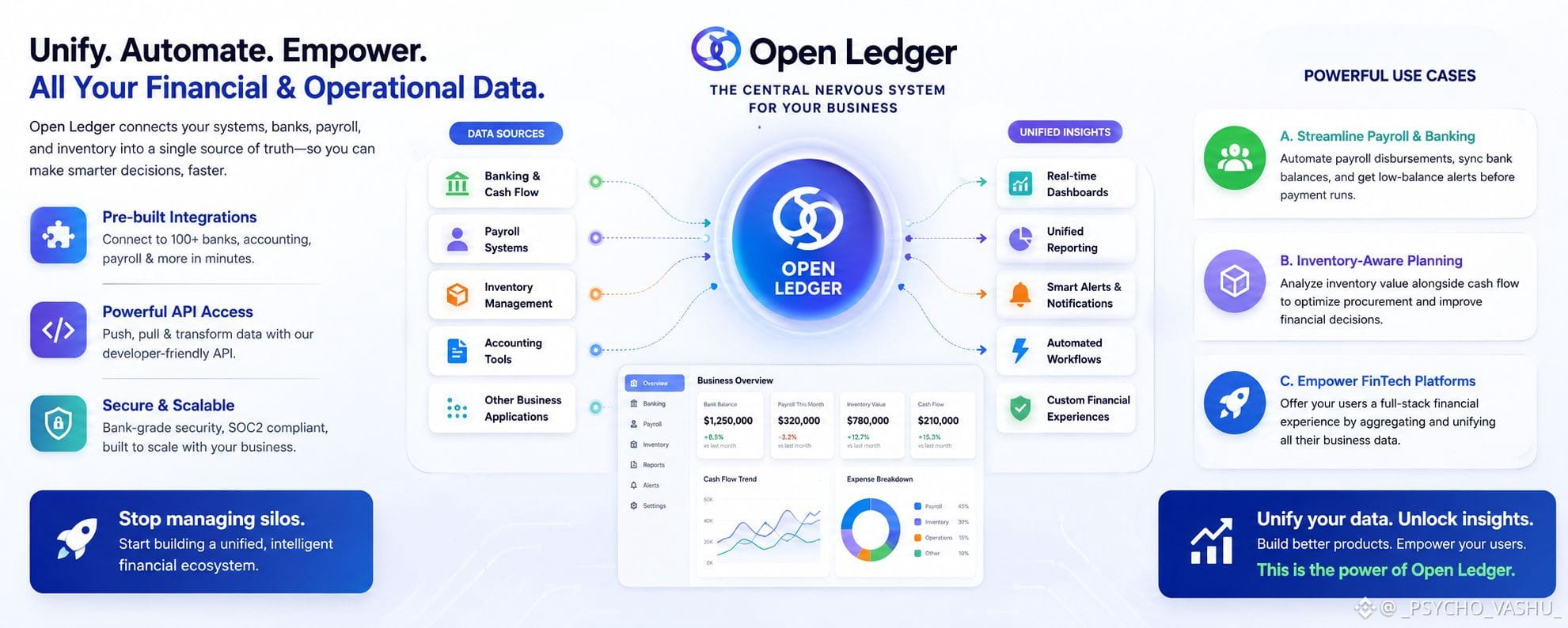
In today’s rapidly evolving digital economy, businesses are drowning in data—but often starving for insights. For companies managing complex operations, the challenge isn't a lack of information; it is the **fragmentation** of that information. When payroll sits in one silo, inventory management in another, and banking data elsewhere, leadership loses the "single source of truth" necessary to make agile, data-driven decisions.
This is where **Open Ledger** enters the frame as a transformative middleware solution. By offering seamless, pre-built integrations alongside a robust, developer-friendly API, Open Ledger allows platforms to unify diverse financial and operational data streams into a cohesive, actionable dashboard.
The Problem: The "Data Silo" Tax
Most businesses today rely on a "best-of-breed" stack. They use one platform for accounting, another for payroll processing, a third for inventory tracking, and multiple banking portals to manage cash flow.
While these tools are excellent individually, they rarely communicate effectively. This leads to:
* **Manual Reconciliation:** Teams spend hours exporting CSV files and reconciling mismatched data.
* **Operational Latency:** By the time reports are generated, the data is often days or weeks old.
* **Strategic Blind Spots:** When banking data doesn't "talk" to inventory data, it is impossible to accurately forecast cash flow or predict procurement needs based on real-time sales.
The Solution: Open Ledger as the Central Nervous System
Open Ledger acts as the connective tissue for your business applications. Whether you are a fintech provider building a neobank, an ERP software company, or a vertical SaaS platform, Open Ledger provides the infrastructure to ingest and normalize data from disparate sources.
1. Pre-built Integrations: Speed to Market
Building custom integrations for hundreds of different banks, accounting software packages (like QuickBooks or Xero), and payroll providers is a massive engineering undertaking. It requires maintaining constant connections, handling API updates, and managing security compliance.
Open Ledger removes this burden with a library of **pre-built, secure integrations**. Your product team can deploy these connections in a fraction of the time, allowing you to focus on building value-add features for your customers rather than maintaining backend connectivity.
2. The Power of Direct API Access
For organizations with highly customized workflows or proprietary tech stacks, Open Ledger offers a **clean, well-documented API**. By pushing data directly into Open Ledger, you transform raw, unstructured information into a standardized format.
This API-first approach allows you to:
* **Automate Workflows:** Trigger payments automatically when inventory hits a certain threshold.
* **Unified Reporting:** Create comprehensive dashboards that combine payroll burn rates with real-time banking balances.
* **Custom Experiences:** Build white-labeled financial portals for your end-users, giving them a high-level view of their business health without them needing to log into five different accounts.
Key Use Cases: Where Unification Matters Most
A. Streamlining Payroll and Banking
By linking payroll systems directly to banking portals, businesses can automate disbursements. When payroll data is synced with bank balances, Open Ledger can provide alerts for low-balance scenarios before a scheduled payment run, preventing overdrafts and service interruptions.
B. Inventory-Aware Financial Planning
When inventory data flows into the same ledger as banking data, you gain the ability to conduct **inventory-based cash flow analysis**. You can immediately see how much capital is tied up in stock and calculate the exact ROI of your procurement cycles, turning static inventory lists into dynamic financial assets.
C. Empowering FinTech Platforms
For FinTech startups, Open Ledger provides the infrastructure to offer a "full-stack" banking experience. By aggregating data from external accounts, you can provide your customers with holistic financial management tools, increasing engagement and retention by becoming the primary hub for their business operation.
D. Security and Scalability: Built for Growth
At the core of Open Ledger is a commitment to security. Handling financial and operational data requires bank-grade encryption, SOC2 compliance, and rigorous data privacy standards. Open Ledger ensures that as your data volume scales—from a handful of transactions to millions—the integrity, privacy, and speed of your data streams remain uncompromised.
The Competitive Advantage
In a market where customers demand instant gratification and total transparency, the companies that win are those that provide the clearest view of reality. By leveraging Open Ledger, you are not just integrating software; you are **optimizing your customer’s business intelligence.**
When your users can see their payroll, inventory, and banking data in one unified, real-time interface, the friction of manual management disappears. You move from being a "tool" they use to a "partner" they rely on.
Conclusion
The future of business operations is integrated, automated, and unified. With Open Ledger’s robust ecosystem of pre-built integrations and flexible API, the barriers between disparate data sets are finally coming down.
Whether you are looking to accelerate your development timeline with off-the-shelf integrations or build a bespoke financial engine using our API, Open Ledger provides the tools to bridge the gap. It is time to stop managing silos and start managing a unified, intelligent, and scalable business ecosystem.
**Are you ready to unify your data and unlock new operati
onal insights for your customers?