
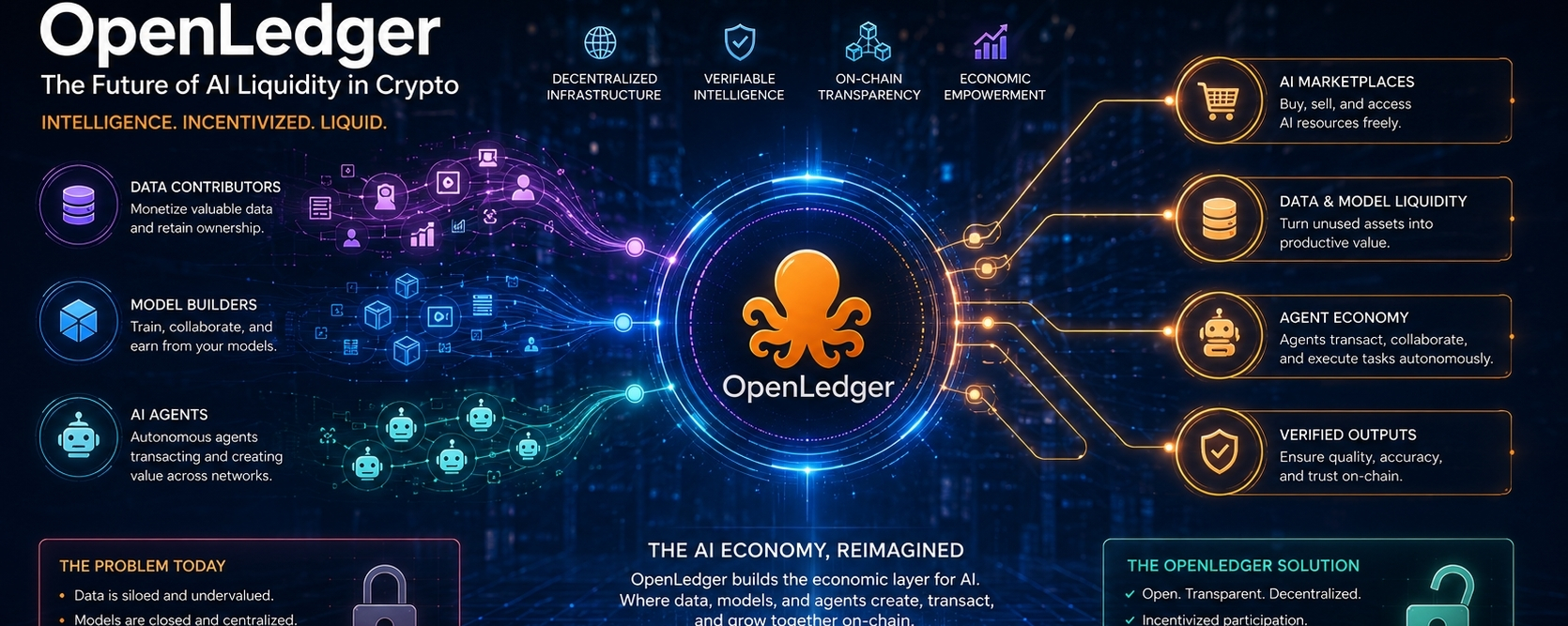
I’ve been around crypto long enough to remember when every cycle had its unlocking idle assets narrative.
First it was GPU power. Then storage. Then liquidity itself.
Now it feels like the market is slowly circling around something less obvious: unused intelligence.
Not just AI models. The raw ingredients behind them. Data. Inference. Human feedback. Autonomous agents doing work across networks without anyone really noticing.
That’s partly why OpenLedger caught my attention.
At first glance, it looked like another AI-chain attempt. Crypto has seen enough of those already. Most end up feeling like a regular blockchain with “AI” attached somewhere in the branding deck. I’ve become skeptical almost automatically whenever I see those two words together now.
But OpenLedger seems to be approaching the problem from a different angle.
Instead of treating AI like a feature sitting on top of a chain the network is trying to build liquidity around intelligence itself. Data contributors, model builders, and AI agents become participants in an economy where outputs can actually be priced, verified and monetized on-chain.
That idea sounds abstract until you think about how fragmented the current AI landscape really is.
Right now massive amounts of useful data sit trapped inside platforms that never reward the people generating it. Models get built behind closed APIs. Agents operate inside isolated systems with almost no transparent coordination layer underneath them.
Crypto people usually talk about ownership. AI people talk about capability. OpenLedger feels like one of the few projects trying to connect those two conversations instead of forcing them apart.
I remember when DeFi first started making liquidity visible.
Before that capital mostly just sat there. Then suddenly every idle asset became something programmable. Yield-bearing. Borrowable. Usable.
Maybe OpenLedger is trying to do something similar for AI resources.
Not in the exact same way, obviously. But the mental model feels familiar. Data becomes productive. Models become composable. Agents become economically active instead of isolated software processes hidden behind corporate infrastructure.
What interests me most is the agent side of this.
The internet is slowly shifting toward autonomous systems interacting with each other more often than humans realize. Trading bots already do it. Recommendation systems do it. AI workflows increasingly call other AI workflows.
Yet there’s still no clean economic layer for that interaction.
That gap keeps bothering me the more I think about it.
If AI agents eventually perform real digital labor, how do they transact? How do they pay for data access? How are outputs verified? Who captures the value generated between models and users?
Traditional systems can technically handle some of this but they weren’t designed around open coordination between independent machine actors. Crypto infrastructure probably makes more sense there, even if the industry still feels early and messy.
And honestly messy might be unavoidable.
I think people underestimate how difficult it is to merge AI systems with crypto incentives without creating noise or speculation that overwhelms actual utility. We’ve already seen countless projects rush into the narrative because the ticker moves faster when “AI” is attached to it.
That’s why I’m still cautious.
There’s always a chance the infrastructure arrives before real demand does. Crypto is famous for building highways before cities exist. Sometimes that works brilliantly years later. Sometimes the highway just stays empty.
OpenLedger sits somewhere in that uncertainty for me.
Still, the broader direction feels important.
The AI economy is becoming increasingly concentrated around a handful of giant companies controlling compute, distribution, and monetization. That concentration might produce incredible products, but it also creates bottlenecks around access and ownership.
Crypto has always reacted strongly against bottlenecks.
Not because decentralization automatically fixes everything. It doesn’t. Most crypto veterans know that by now. But because open systems occasionally allow strange new coordination models to emerge that centralized systems would never even attempt.
Maybe I’m overthinking it, but the real value of projects like OpenLedger might not come from replacing existing AI giants at all.
It could come from enabling smaller economies around specialized intelligence.
Niche datasets. Independent model providers. Autonomous agents performing narrow tasks extremely well. Tiny machine-to-machine markets that don’t need permission from a central platform to exist.
That possibility feels more believable to me than the idea of one chain suddenly becoming “the AI blockchain.
I also can’t ignore how timing affects everything here.
A few years ago, most people outside crypto barely cared about decentralized infrastructure. Now AI has made questions around ownership, transparency, and data sourcing feel a lot more urgent. Even non-crypto users are starting to notice how much invisible value they generate online without participating in the upside.
That shift matters.
You can almost feel the market searching for new frameworks to handle it.
Whether OpenLedger becomes a major part of that framework, I genuinely don’t know yet. And I think pretending certainty in crypto is usually a mistake anyway.
But I do think the intersection of AI and blockchain is evolving past simple narrative trading now. Slowly. Unevenly. With a lot of failed experiments in between.
OpenLedger feels like one of those experiments worth paying attention to, not because it promises some instant future, but because it’s asking a real question:
What happens when intelligence itself becomes a liquid digital resource?
I keep coming back to that thought more than the token charts or hype cycles around it.
Maybe that’s the more interesting signal here.
