
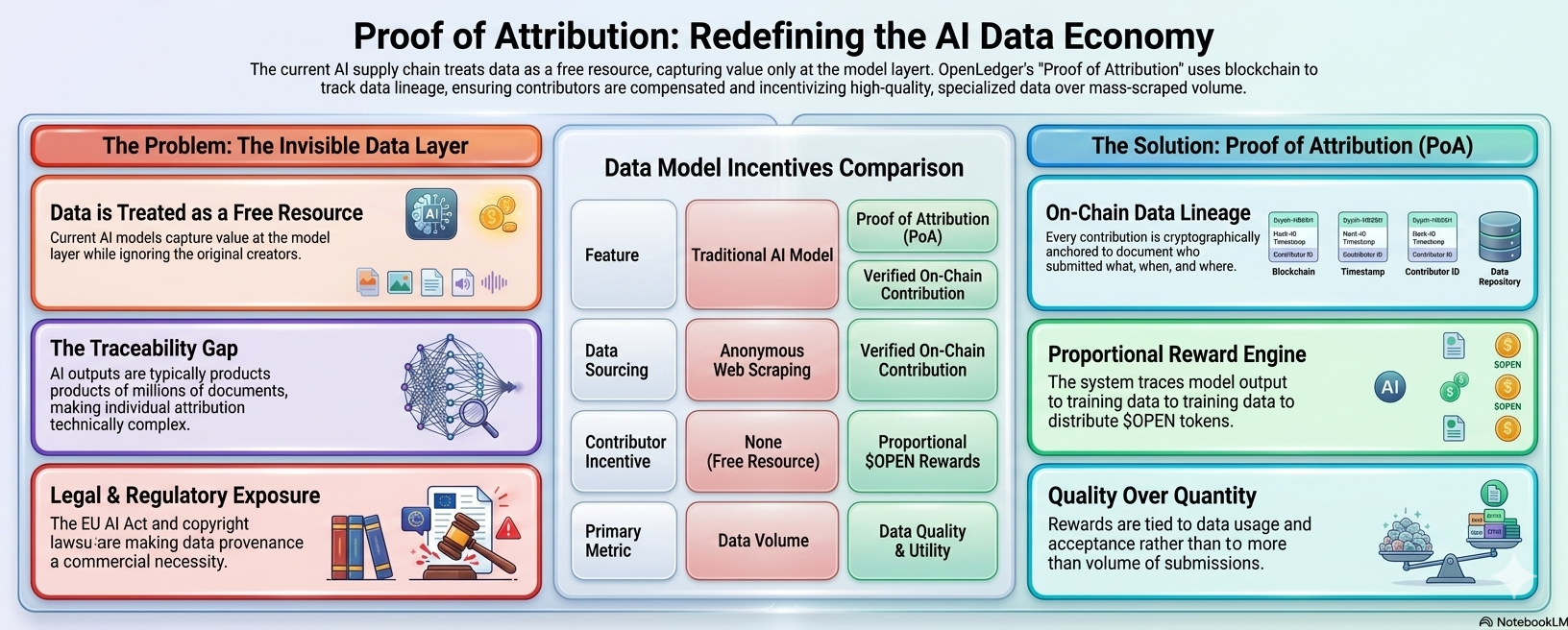
Every time you interact with a large language model, you are benefiting from the accumulated knowledge of millions of people who wrote articles, published research, documented code, and created content across decades. That knowledge was the raw material. The model is the product. And somewhere between the two, the people who created the raw material stopped mattering.
This is not a cynical observation it is simply how the current AI supply chain works. Data is collected, processed, and used. Value is captured at the model layer. The data layer is treated as a free resource rather than a contributor deserving compensation.
Proof of Attribution is @OpenLedger's answer to this structural problem. Understanding what it is and what it would actually take to make it work requires looking at the problem more carefully than most discussions do.
What attribution actually means in this context
Attribution in AI is not a simple concept. When a model generates a response, that response is not traceable to a single data source the way a quoted passage is traceable to a book. It is the product of statistical patterns learned from thousands or millions of documents simultaneously. Determining what percentage of a given output is attributable to which contributor is a genuinely complex technical problem.
OpenLedger's approach involves creating on-chain records at the point of data contribution documenting what was submitted, by whom, when, and to which Datanet. When a model trained on that data is used at inference time, the system attempts to trace the lineage of the output back through the training data and trigger proportional reward distribution in $OPEN tokens to verified contributors.
This is the Proof of Attribution engine. The cryptographic anchoring of data contributions is the part that blockchain handles well. The attribution calculation at inference time is the part that requires significant engineering and will likely evolve considerably as the system scales.
Why this matters beyond the crypto narrative
The significance of Proof of Attribution is not primarily a Web3 story. It is a regulatory and commercial story that happens to use blockchain infrastructure.
Europe's AI Act has introduced requirements around transparency in AI training data. Several major copyright cases involving AI-generated content are working through courts in the United States and Europe. Enterprises building AI-powered products are beginning to ask questions about data provenance that they did not ask two years ago — not out of philosophical concern, but because legal exposure is becoming real.
A system that can produce verifiable, on-chain records of data provenance showing exactly what data was used, from whom it came, and whether it was contributed with proper consent addresses a compliance need that is growing, not shrinking. This is where OpenLedger's partnership with Story Protocol becomes strategically relevant. Story Protocol is building legal infrastructure for intellectual property on-chain. The combination of attribution tracking and legal IP frameworks is not marketing overlap — it is a coherent response to where AI regulation is heading.
The incentive structure that Proof of Attribution creates
Beyond compliance, the more interesting long-term implication of Proof of Attribution is what it does to data quality incentives.
In the current model, data contributors have no financial stake in the quality of what they provide. Anonymous data scraping produces enormous volume with inconsistent quality. There is no mechanism to reward a domain expert who contributes highly specialized, verified knowledge over someone who submits low-quality generic content.
OpenLedger's system attempts to change this by making contributor rewards proportional to how much their data is actually used — and by building quality validation into the Datanets contribution layer, where acceptance rates matter more than submission volume. If your data is consistently used and consistently accepted, your attribution score and reward flow increase. If your submissions are low quality, they are rejected without penalizing your standing, but they also do not generate rewards.
This creates a market for data quality rather than data quantity — which is exactly what specialized AI models need.
The honest limitations
Proof of Attribution as a concept is compelling. As a production system handling enterprise-scale inference volumes, it has not yet been stress-tested in public.
Attribution at inference time introduces computational overhead. The more granular the attribution tracking, the higher the cost per inference. At small scale this is manageable. At the scale where enterprise revenue becomes meaningful, the efficiency of the attribution calculation will need to be optimized aggressively — otherwise it becomes a cost that erodes the economic case for using the platform.
There is also the question of gaming. Any system that distributes financial rewards based on measurable contributions will attract attempts to optimize for the metric rather than the underlying goal. OpenLedger's quality validation mechanisms will need to be robust enough to distinguish genuine domain expertise from sophisticated attempts to game the acceptance rate.
These are solvable engineering problems, not fundamental flaws. But they are the real work that lies between a well-designed system and a deployed one that performs under pressure.
The bigger picture
Proof of Attribution is not just a feature inside OpenLedger's platform. If it works, it is the foundation of a different model for how AI value is created and distributed — one where the people who build the knowledge base that makes AI useful are participants in the economics of AI, not just inputs to it.
That is a meaningful shift. It will not happen overnight, and it will require sustained technical execution to deliver. But the direction is clear, and the external pressures regulatory, legal, and commercial are pushing toward exactly the kind of infrastructure OpenLedger is trying to build.
That alignment between the project's thesis and the direction of the industry is what makes it worth following seriously.