
I have noticed something strange over the last year.
People no longer question whether AI will become part of everyday life. That debate is mostly over. The real tension now feels quieter. People are starting to question whether they can trust anything produced online anymore.
A few years ago, seeing polished content used to mean something. If a product demo looked clean, if a thread sounded intelligent, or if a report felt well researched, people assumed effort existed behind it. Now the internet feels different. Everything looks finished. Everything sounds confident. But fewer people know what is real, who created it, or where it originally came from.
That shift changes the economy in ways most people still underestimate.
The internet was built around unlimited distribution. AI is pushing that idea even further by making creation itself almost unlimited. Content is no longer scarce. Information is no longer scarce. Even intelligence is starting to feel less scarce than before.
So naturally, another question starts appearing underneath all this noise.
If everything can be generated endlessly, what actually keeps value attached to anything?
That is partly why OpenLedger caught my attention.
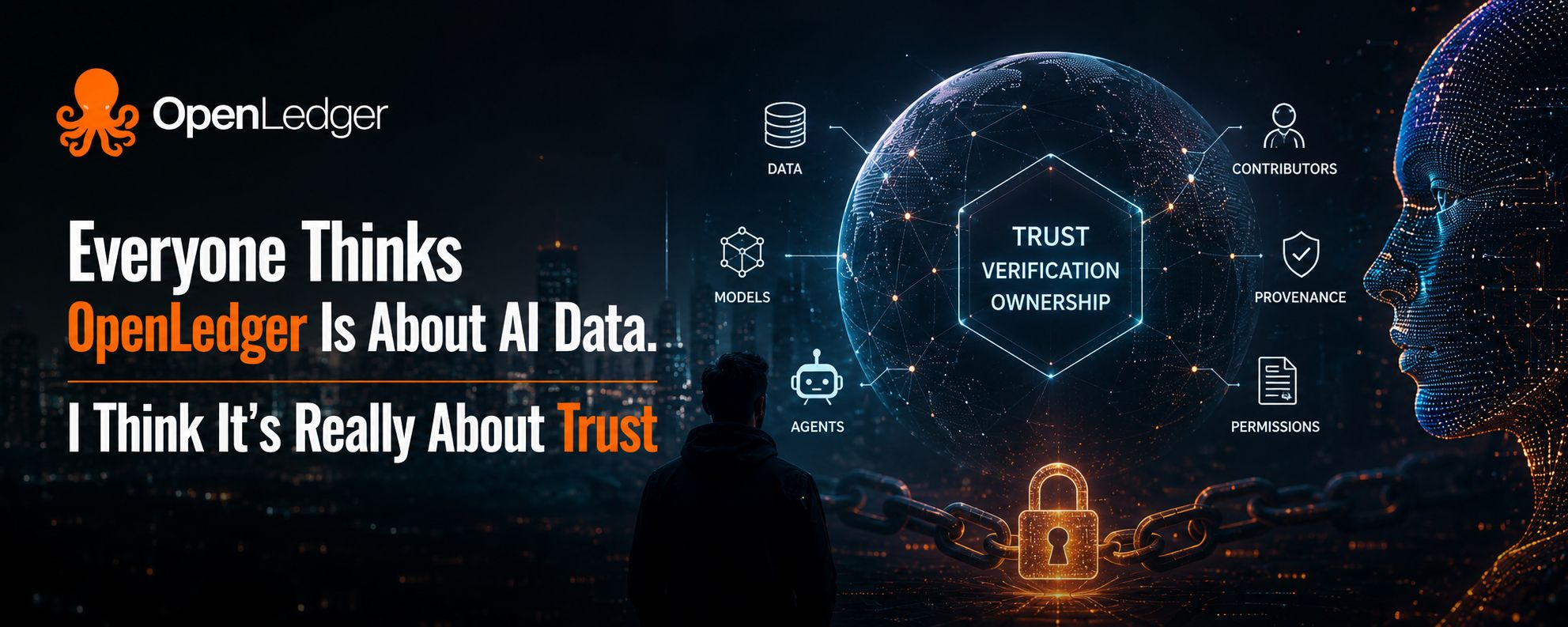
Most people describe it as an AI blockchain focused on monetizing data, models, and agents. But I think that explanation misses the more important layer underneath it.
To me, the project feels less like a marketplace story and more like an attempt to solve a growing trust problem inside AI economies.
Because right now, AI systems are built on massive extraction. Models consume public information, platforms absorb user behavior, and outputs get recycled back into the internet again. The cycle keeps accelerating, but attribution becomes weaker every year. Most contributors disappear inside the machine long before value comes back to them.
And honestly, I think people are getting tired of that dynamic.
Creators feel it. Developers feel it. Even ordinary users feel it when they realize how difficult it has become to identify original work online. Everyone keeps talking about scale, but very few people talk about ownership in a meaningful way anymore.
OpenLedger seems to be trying to build around that tension.
Instead of treating data as something disposable, the network appears focused on tracking contribution and participation more directly. The idea is simple enough to understand. If people, datasets, models, or AI agents are helping create value, then maybe they should not become invisible inside the process.
But this is also where things become difficult.
Because once you start assigning economic value to contribution, the clean narratives disappear fast.
Who decides whether a dataset is valuable?
Who verifies authenticity when AI generated content already floods the internet?
How do you separate useful information from synthetic garbage once machines begin training on other machine outputs?
And maybe the biggest question of all is this.
Will people actually care enough about provenance to change their behavior?
I think crypto sometimes overestimates how much users prioritize ideals. Most people choose convenience first. They use the fastest platform, the easiest interface, or the cheapest option available. Even if decentralized systems are philosophically better, friction still kills adoption.
That matters a lot for projects like OpenLedger.
Because enterprise adoption is not driven by excitement. It is driven by operational trust. Businesses need accountability. They need traceability. They need to know where information came from and whether future legal or reputational problems can emerge from hidden data sources.
In that sense, blockchain infrastructure actually makes more sense than many critics admit.
Not because blockchains magically solve AI, but because shared verification systems become valuable once trust starts collapsing online. If AI economies continue growing, somebody eventually needs to track contribution, permissions, and access rights in a transparent way.
Still, I think skepticism is healthy here.
Crypto has a habit of turning every coordination problem into a token narrative. Sometimes that works. Sometimes it simply adds speculation on top of unresolved infrastructure issues. OpenLedger still has to prove that its economic system creates durable incentives instead of temporary attention cycles.
That challenge becomes harder when you look at how concentrated AI development already is.
Large corporations own massive proprietary datasets, enormous compute resources, and distribution advantages that smaller participants simply cannot match. So even if decentralized infrastructure exists, power can still quietly centralize around whoever controls the best data and the strongest commercial relationships.
That is why I keep asking myself a different question while looking at projects like this.
Maybe the future scarcity is not intelligence itself.
Maybe the real scarcity becomes trusted permission.
Because once AI can generate almost anything instantly, verified human contribution starts becoming more valuable, not less valuable. Specialized datasets become more valuable. High quality environments become more valuable. Systems that can prove authenticity become more valuable.
In a strange way, abundance creates demand for stronger filters.
And honestly, I think society is emotionally unprepared for that transition.
People are already exhausted by fake engagement, manipulated narratives, and synthetic online behavior. AI will intensify that feeling dramatically. The internet may eventually become so saturated with generated material that trust itself becomes premium infrastructure.
That possibility changes how I view OpenLedger.
I do not think the most interesting part is simply monetizing AI assets. The deeper opportunity may be creating systems that help preserve accountability once machine generated economies become impossible to audit manually.
Of course, that vision also comes with uncomfortable implications.
Who controls verification standards?
Who decides which contributions deserve compensation?
Can decentralized systems remain open without becoming chaotic?
And if permission becomes the core economic layer of AI, who ultimately owns that permission infrastructure?
Those questions matter more than people realize because they touch something deeply human. Everyone wants recognition. Everyone wants ownership over their contribution. But AI systems naturally blur those boundaries by remixing knowledge at massive scale.
That tension is not going away.
If anything, I think it becomes one of the defining economic problems of the next decade.
So when I look at OpenLedger, I do not immediately see another AI crypto narrative competing for attention. I see an early attempt to rebuild trust layers in a digital world where originality, attribution, and ownership are all becoming harder to define.
Maybe it works. Maybe it struggles under the same coordination problems that hurt many blockchain projects before it.
But I do think the underlying direction matters.
Because eventually, the internet may stop rewarding whoever produces the most information.
It may start rewarding whoever can still prove where information came from in the first place.
And honestly, that feels like a much bigger shift than most people currently understand.
