
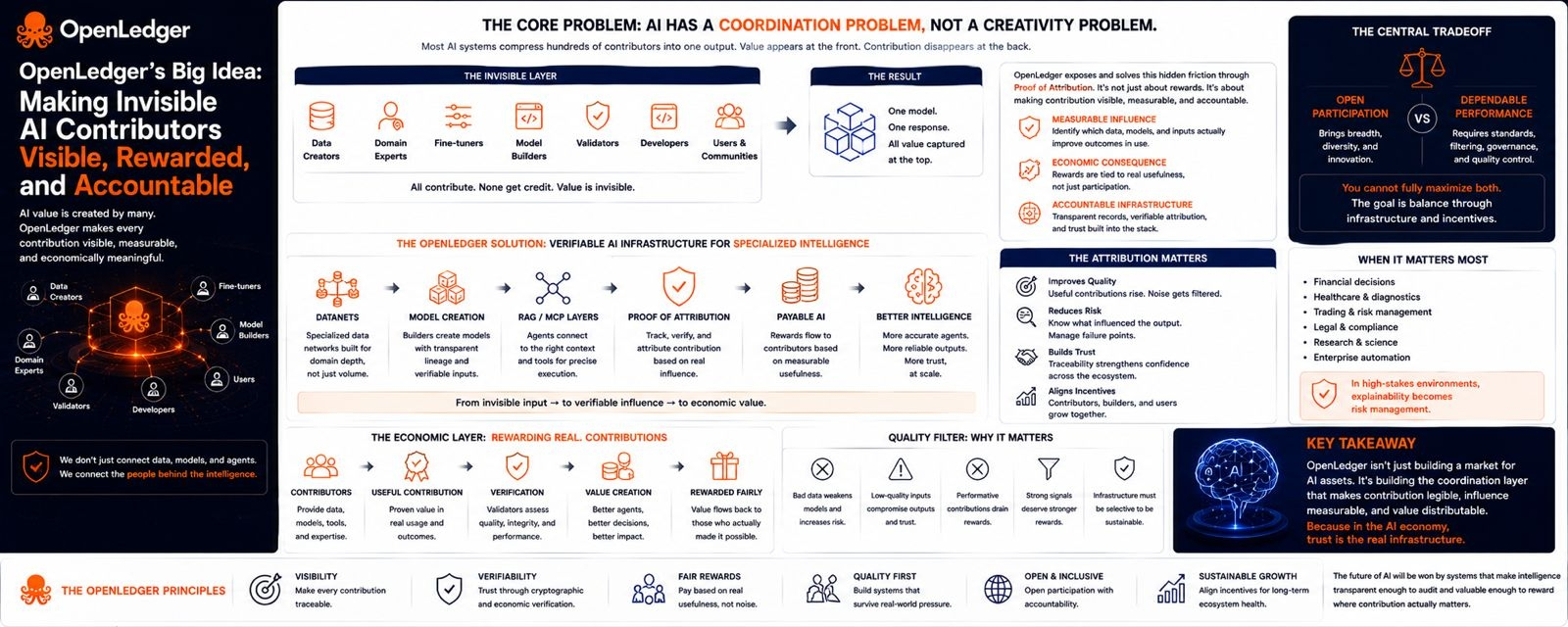
At first, OpenLedger looked like another attempt to connect AI with blockchain. Another protocol. Another infrastructure layer. Another project trying to place itself between data, models, agents, and incentives. On the surface, the idea seemed simple: create a system where AI data, models, and agents can be monetized through a blockchain-based structure.
But the more I looked at it, the more the real issue became clear. OpenLedger is not only trying to make AI assets tradable or rewardable. That is the surface layer. The deeper layer is more important. AI has a coordination problem. Not a creativity problem. Not only a compute problem. A coordination problem.
Modern AI depends on invisible contributors. Data creators, domain experts, fine-tuners, model builders, validators, developers, users, and communities all shape the final output. But most AI systems compress all of that contribution into one response, one model, or one product experience. The value appears at the front, while the contribution disappears at the back.
That is the hidden friction OpenLedger is trying to expose. Its Proof of Attribution is not only about rewarding people. It is about making contribution visible inside a system that usually hides it. That distinction matters. When people talk about AI monetization, they usually think about selling models, agents, APIs, or applications. But attribution-based AI asks a deeper question: who created the value before the model became useful?
I noticed this most clearly when thinking about specialized AI agents. A general chatbot can survive with broad knowledge and acceptable mistakes. But a specialized agent cannot. A finance agent, healthcare assistant, legal workflow tool, or technical copilot operates under a different kind of pressure. Accuracy is not just a feature. It is the product.
Imagine a developer building a market analysis agent using several datasets. One dataset contains clean historical pricing. Another contains noisy community commentary. A third includes expert-labeled macroeconomic signals. At first, all of them look like inputs. Just data. But after repeated use, the difference becomes visible. Some data improves the model under pressure. Some data creates noise. Some data looks valuable until the system is tested against ambiguity.
That is where attribution becomes more than accounting. It becomes judgment. A system like OpenLedger is not merely storing data or supporting model workflows. It is trying to observe influence. It is trying to identify which contributions actually matter when intelligence is used, not just when assets are uploaded.
This changes the meaning of the system. On the surface, Datanets may look like data pools. But structurally, they behave like coordination markets. They bring together contributors, validators, builders, and users around specialized knowledge. Not just storage. Selection. Not just participation. Pressure.
The issue is not whether people can contribute. The issue is whether the system can distinguish useful contribution from performative contribution. Open participation sounds fair until poor-quality participation starts compounding. Bad data does not remain isolated. It enters model flows, weakens outputs, increases validation burden, and damages trust.
This is where OpenLedger becomes interesting. Its deeper role is not simply to reward people. It is to create a structure where rewards depend on measurable usefulness. If that works, data stops being treated as a flat commodity. It becomes contextual, conditional, and performance-linked.
That is a major shift. In most AI systems, value flows toward the layer closest to the user. The interface captures attention. The model captures pricing power. The infrastructure captures dependency. But the contributors who shaped the system often remain economically distant from the value they helped create. OpenLedger is trying to reduce that distance.
But this creates pressure. Once attribution becomes part of the economic layer, contributors behave differently. They do not only ask, “Can I upload data?” They ask, “Will my data be used?” Developers do not only ask, “Can I build a model?” They ask, “Will the model produce enough useful output to justify its existence?” Validators become part of the trust economy.
And honestly, some of that is rational. AI infrastructure cannot scale on openness alone. If every contribution is treated equally, the system becomes generous but weak. If every dataset receives rewards without proving usefulness, the reward layer becomes inflationary. A serious AI network eventually has to become selective about quality.
The central tradeoff is clear: do you optimize for open participation or dependable performance? Open participation gives the system breadth. Dependable performance requires filtering, standards, governance, and rejection of weak contributions. You cannot fully maximize both at the same time.
This is the hidden systemic tradeoff behind verifiable AI infrastructure. Trust is not created by claiming openness. Trust is created when a system can survive pressure without losing accountability. In AI, that means knowing where outputs came from, which inputs shaped them, who deserves credit, and what happens when something fails.
That failure point matters. A model output is not neutral once it enters a real workflow. It can influence a diagnosis, a financial decision, a trading signal, a compliance process, or an automated agent action. The moment AI becomes operational, attribution becomes more than fairness. It becomes risk management.
This is why OpenLedger’s idea of payable AI feels meaningful. It is not only about distributing rewards. It is about attaching economic consequence to contribution. If intelligence is built from many invisible inputs, the system should not pretend the final output came from nowhere.
OpenLedger is not just trying to build a market around AI assets. It is trying to make AI contribution legible enough to be priced. Once contribution becomes legible, the model is no longer the only asset. The dataset becomes an asset. The validator becomes important. The contributor gains leverage. The agent becomes a distribution channel. The hidden layer becomes visible.
That does not mean the system is guaranteed to work. Attribution in AI is difficult. Influence is not always clean. Model behavior is not always easy to trace. Some contributions may be overvalued. Others may be missed. Governance may become political. Rewards may attract manipulation. These are real problems.
But they are the right problems. The current AI economy already has invisible labor, unclear provenance, weak attribution, and trust gaps. The difference is that most systems absorb these issues silently. OpenLedger is trying to turn them into explicit infrastructure questions.
Who contributed? What mattered? Who gets rewarded? Who carries the risk? These questions are not technical details. They are the foundation of the next AI economy.
The more I looked at OpenLedger, the less I saw it as a simple blockchain-for-AI project. I started seeing it as a test of whether AI systems can become economically accountable without becoming closed, slow, or overly controlled.
That is the real tension. If the system is too open, quality suffers. If it is too selective, participation narrows. If attribution is too loose, rewards become meaningless. If attribution is too strict, innovation slows. Infrastructure always reveals its philosophy under pressure.
OpenLedger is not only asking whether AI can be decentralized. It is asking whether intelligence can be made traceable, rewardable, and economically coordinated without destroying the speed that made AI powerful in the first place.#OpenLedger
The future of AI will not be decided only by who builds the largest model. It will be decided by who can make intelligence reliable enough to trust, transparent enough to audit, and valuable enough to reward where contribution actually matters.
Because once AI becomes infrastructure, intelligence is no longer the scarce asset. Trust is. @OpenLedger $OPEN #OpenLedger