
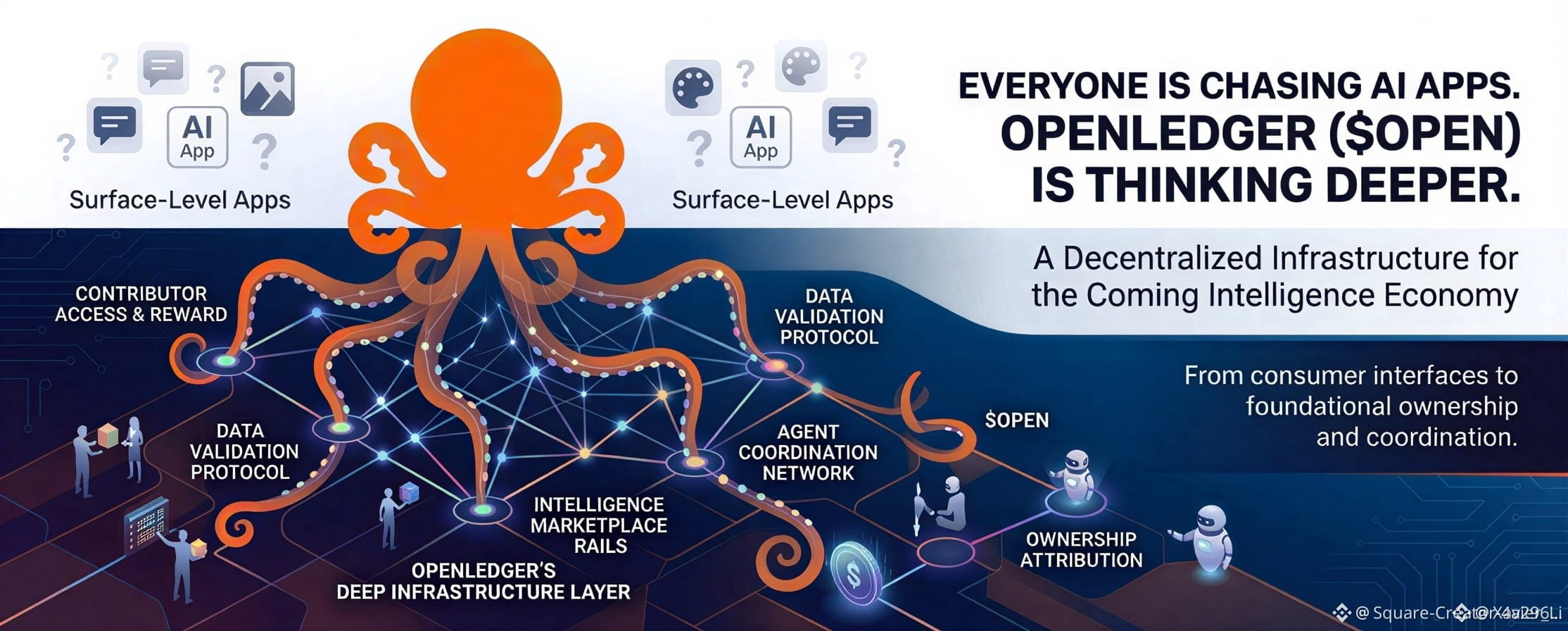
Everyone is chasing AI apps. I keep thinking about the layers nobody sees.
The polished interfaces get the attention. The viral demos get the headlines. But underneath all of it, there’s an uncomfortable question that almost nobody wants to sit with:
Who actually owns the intelligence economy being built right now?
The deeper I look into AI infrastructure, the stranger the current model feels.
Millions of people generate data every day without thinking about it. Conversations. Preferences. Corrections. Creative inputs. Behavioral signals. Entire layers of human context.
That data trains models.
Those models create products.
Those products create billion-dollar ecosystems.
And somehow, the people contributing to the intelligence loop remain mostly invisible inside it.
I don’t think this becomes sustainable forever.
Especially once AI agents become more autonomous.
Especially once machines begin coordinating with other machines.
Especially once intelligence itself becomes a tradable resource.
That’s where projects like @OpenLedger($OPEN) become interesting to me — not because they promise another AI app, but because they’re thinking about the infrastructure underneath the coming AI economy.
And honestly, that distinction matters more than most people realize.
Right now, AI feels consumer-facing.
People debate chatbots.
Image generation.
AI assistants.
Productivity tools.
But infrastructure cycles usually outlast application cycles.
Most apps change fast.
Infrastructure tends to compound quietly.
The internet itself followed that pattern.
In the early days, people obsessed over websites. Few paid attention to the protocols, data coordination layers, or backend systems that eventually became foundational.
AI may be entering a similar phase now.
Because eventually the conversation stops being:
“Which AI tool is best?”
And starts becoming:
“Who supplies the intelligence?”
“Who coordinates the data?”
“Who verifies outputs?”
“Who gets rewarded?”
Those are infrastructure questions.
@OpenLedgerseems positioned around that exact shift.
Not in a loud way.
More like an acknowledgment that AI systems will eventually need decentralized coordination layers if they’re going to scale beyond closed corporate ecosystems.
That idea stayed in my head longer than I expected.
Because the current AI landscape feels increasingly concentrated.
The largest models are expensive.
Training requires enormous compute.
Data pipelines are controlled by a small number of entities.
Even access layers are becoming centralized bottlenecks.
Meanwhile, users contribute value constantly without visibility into where that value flows.