
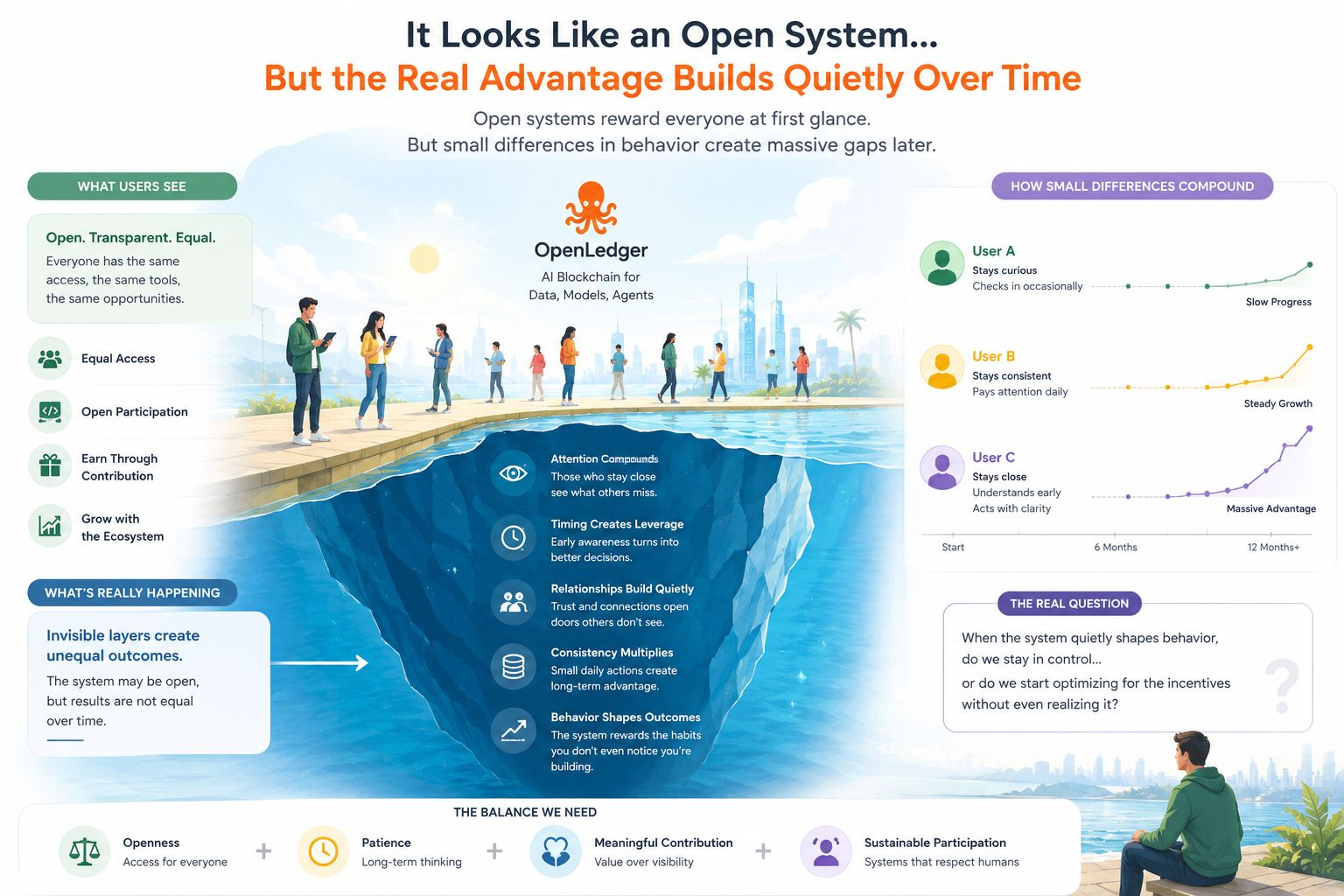
My first real time experience with OpenLedger, I got the idea almost instantaneously. At first, it seemed like a simple enough thing to do. AI models, data, agents, token incentives, decentralized participation. The architecture was neat and orderly, much like many modern crypto systems do. Individuals add value, networks expand, incentives flow and early users are in a good place. That's my initial reaction and I didn't really think much about it until first.
However, I began to see something more difficult to explain upfront and personal after watching these ecosystems more closely over time. The biggest change within systems like these often takes place in places you would never expect. Long-term outcomes are not always a result of announced partnerships, launches or even the attention that's clearly visible. Those moments grab peoples attention because they are easily recognisable and easy to react to. The changes that tip the scales within the system typically occur much earlier and much more quietly.
I believe that's what's the part that people don't realize.
Initially, the users imagine that all the people are using the same environment in the same way. The same dashboard, token, opportunities are everyone's. Over time, however, minor disparities start to crop up among those who are outwardly similar. One user is only loosely connected and logs in from time to time. Another one is with the ecosystem every day, not necessarily doing much more, but watching more carefully. They are more sensitive to changes in focus. They know what discussions become more important. They start to feel movement before it's noticeable to others.
That gap becomes even greater over time.
The distance between those two users can be quite a bit larger when it happens after months, although neither might really know exactly what took place. I don't believe it's just a matter of intelligence or effort. It's all about being close. Some just acknowledge individuals for being around for a while, if they are not doing anything at all, but just listening.
That was a life-changing realization for me when I started thinking about projects such as @OpenLedger .
Most people associate tokens with money, but I believe they affect attitude more than money. They affect the distribution of user's attention, the frequency of return, the urgency of response and ultimately the way the users organize their lives around the system. The network doesn't actually instruct users about behaviors. Rather, the building gently encourages some behaviors to be comfortable until they become natural.
It's hard to see that process in action.
One is initially not involved, the participation is casual. You learn about it because the technology is interesting. You are interested in developments because you want to see where the ecosystem will go. However, as time passes, things change. From this point on, Presence is the valuable thing. Users start to experience that connection is important almost as much as is contribution itself. The situation of a few days of missing information suddenly feels awkward because movement in the system is constant, and those who maintain synchronization with the movement acquire invisible benefits over the others.
I believe this has a much greater impact in ecosystems where AI and blockchain are interdependent, given that both spheres function at an already high speed. AI speeds up information and capability, token speeds up incentives and participation. The combination of those forces, though, creates an environment that is more than about making individual choices, it's about continual tuning into the rhythm of the network.
And that beat moulds people more than they know.
What I'm interested in is how subtle this shift is. No one goes into things like this expecting to change their behavior psychologically. Most users feel they are taking part in rational manner. However, engagement eventually turns into a game of strategy. Individuals start to become more conscious about the timing. They consider their visibility, positioning, relationships and relevance. Authenticity becomes even more difficult to distinguish from optimization, as incentives creep into the environment of all interactions.
Of course, I don't necessarily believe this is manipulation. It's quite structural, in many respects, rather than intentional. All systems generate pressures, either seen and felt, or unseen and felt. The difference lies in tokenized ecosystems – they allow for quantifiable pressures. So, users gravitate towards the behavior that the network is rewarding most regularly over time.
When efficiency begins to compete with balance, the tension is there.
Constant activity equals momentum, and a system that provides a reward for that will grow rapidly. The same structure can lead to fatigue over time, though. Individuals start to pick up the message that they are losing position with a leave. Responsiveness now has more value and becomes more difficult to achieve through reflection. The network tends to gravitate towards the people who are always there, even if that's more of a performance than engagement.
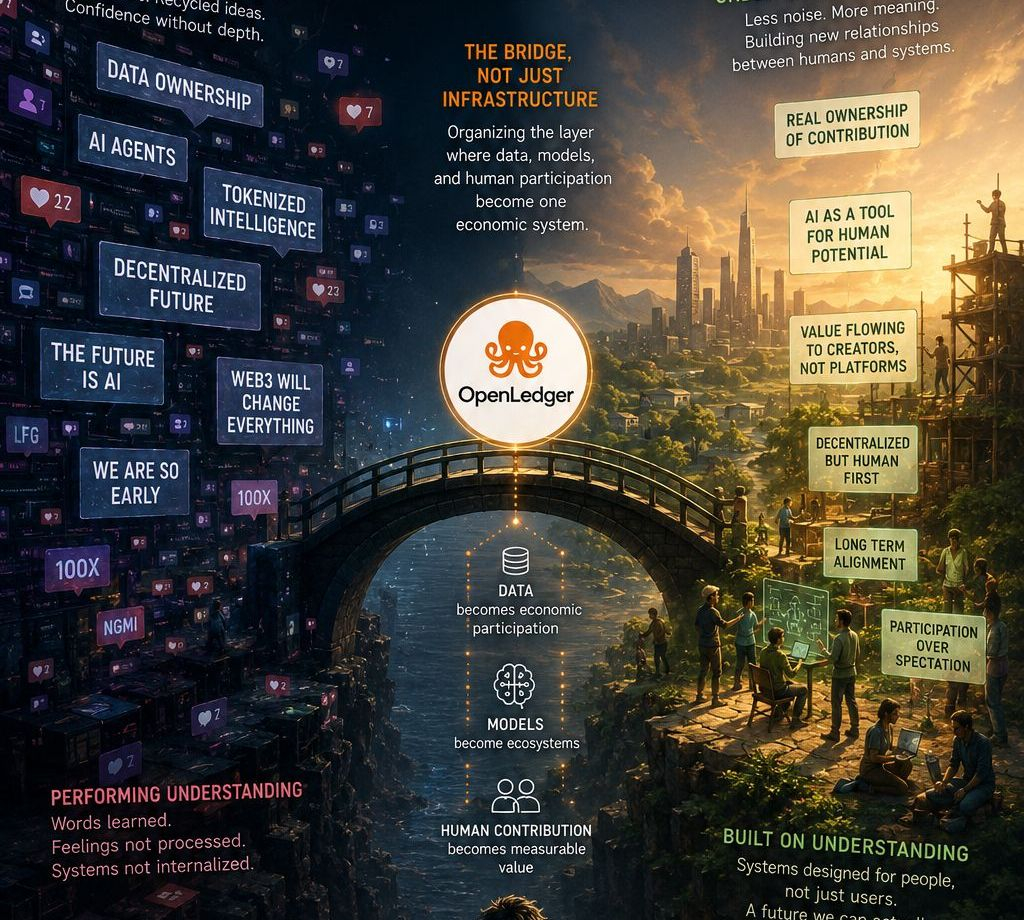
I believe uncertainty is more important than a lot of discussions would suggest.
Projects such as OPEN are usually assessed by technology, tokenomics or market potential, and I am not entirely sure if it is not a behavioral question, as well. After years of staying within the system, what kind of habits do they form? Is participation truly sustained over time – does it become a form of maintenance whereby users remain active but without being obviously rewarded for doing so?
I'm not sure there's any simple solution to that one.
Perhaps all digital systems eventually develop their own internal hierarchy based on timing, attention and response adaptation. Perhaps the openness of a competition when there is a lot of people inside the same setting is always uneven. Maybe it's just that something that is already there, but rarely discussed in terms of community and innovation.Or perhaps it's that projects such as @OpenLedger are revealing what's already there, just not always in the terms of community or innovation.
I can't help but think about how gentle this process is as it is happening. Most people only realise when there's a gap when they see the results. But by that time, a few users have found themselves inherently ahead, whether through the gradual accrual of their presence, familiarity and nearness to the system itself.
And, in a sense, I keep asking myself whether the success of something like this in the future is going to be judged by how effectively they monetize their data or AI infrastructure, or rather by whether or not people can end up feeling comfortable living in the shadow of the behavioral patterns that those systems are subtly building around themselves.
