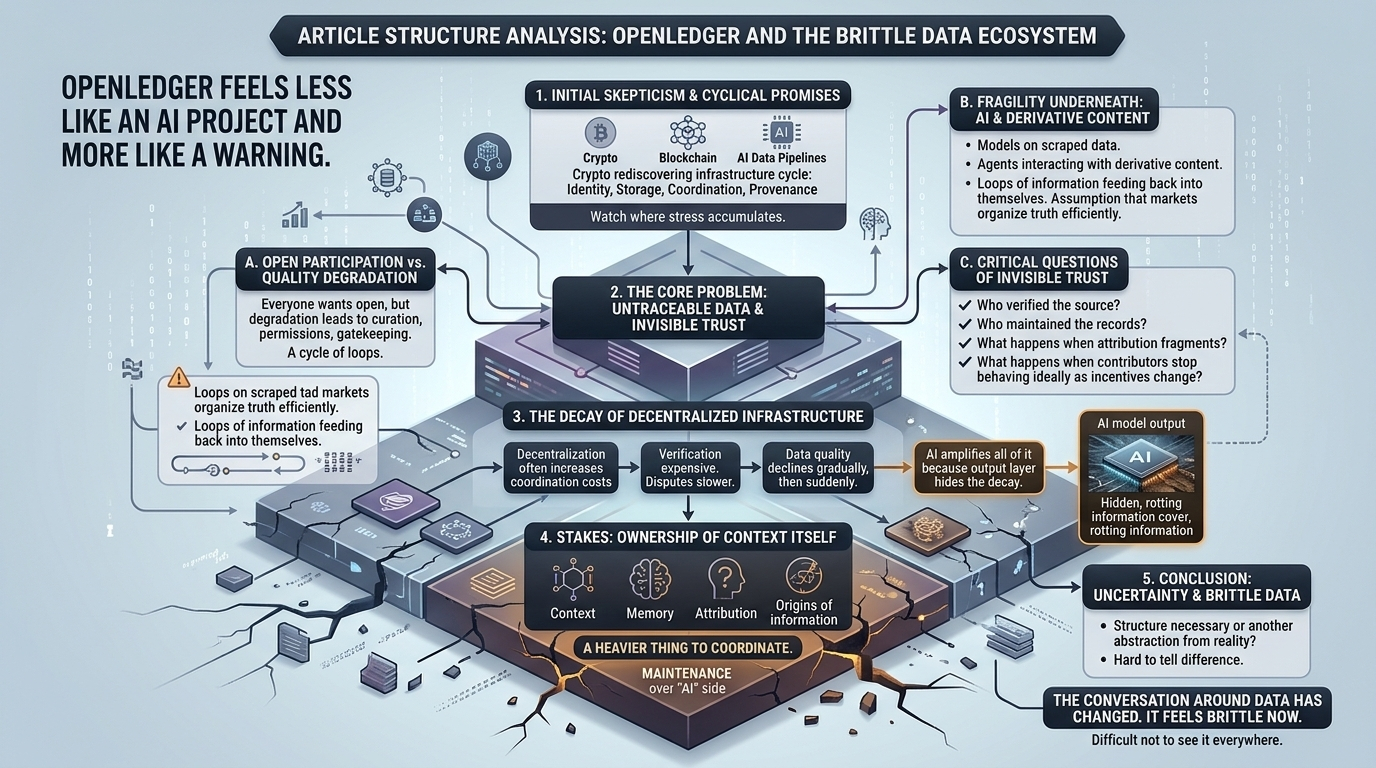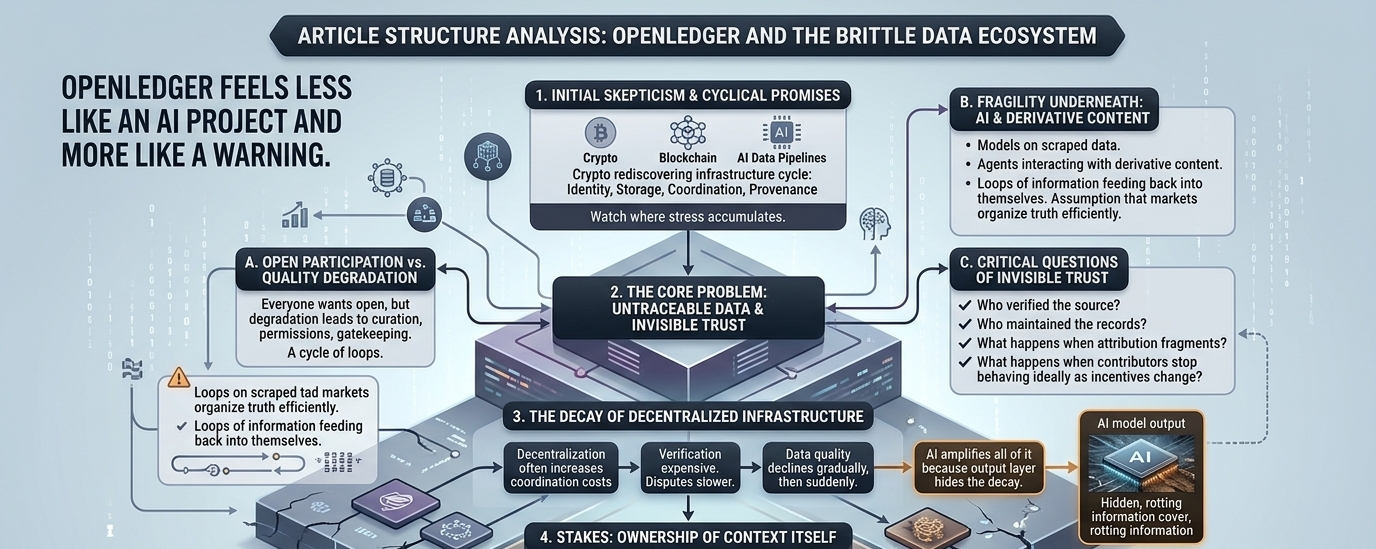
I didn't take it seriously at first. Maybe because I’ve heard too many versions of the same promise over the years. Crypto has this habit of rediscovering infrastructure every cycle and pretending it's a new frontier. Identity one year. Storage the next. Coordination. Provenance. Now AI data pipelines.
After a while you stop reacting to the language and start watching where the stress accumulates instead.
That’s partly why OpenLedger stayed in my mind longer than I expected. Not because I suddenly became convinced by the idea of an AI blockchain honestly that phrase alone still makes me hesitate but because it kept circling around a problem that feels increasingly difficult to ignore.
Nobody really knows what’s feeding these systems anymore.
And maybe people think that’s temporary. A scaling issue. Something tooling eventually fixes. But I'm not sure. The deeper problem feels cultural as much as technical. Everyone wants open participation until openness starts degrading the quality of the network itself. Then the conversation quietly shifts toward curation, permissions, gatekeeping. The cycle repeats.
AI is making that contradiction harder to hide.
You can already feel the fragility underneath everything. Models trained on datasets that were scraped from places nobody can fully trace. Agents interacting with generated content that may itself be derivative of earlier synthetic outputs. Entire loops of information feeding back into themselves. And layered on top of that is the assumption that markets can somehow organize truth efficiently.
Maybe that’s too harsh. But I keep coming back to how dependent all of this is on invisible trust.
Not trust in the emotional sense. Operational trust. The boring kind.
Who verified the source? Who maintained the records? What happens when attribution fragments over time? What happens when contributors stop behaving ideally because incentives changed six months later?
These systems always look durable in controlled environments. Pressure is what reveals whether infrastructure actually matters.
That's where things start to feel uncomfortable.
Because OpenLedger intentionally or not points toward something crypto people don’t always like admitting decentralization often increases coordination costs at the exact moment systems become more economically important. Verification becomes expensive. Disputes become slower. Data quality declines gradually then suddenly.
And AI amplifies all of it because the output layer hides the decay underneath. A model can appear functional long after the underlying information ecosystem has started rotting.
I think that's why I find myself thinking less about the AI side of OpenLedger and more about maintenance. Preservation. Continuity. The unglamorous layers no one tweets about during bull markets.
Most projects fail there.
Not because the idea was impossible, but because reality introduces messy conditions nobody wanted to model. Incentives drift. Users optimize for extraction instead of contribution. Networks centralize quietly around whoever can absorb operational complexity the longest.
Crypto has never fully solved that problem. It mostly postpones it.
And with AI, the stakes feel stranger somehow. Because now we aren’t just talking about ownership of assets or transactions. We’re talking about ownership of context itself. Memory. Attribution. The origins of information.
That's a heavier thing to coordinate than most whitepapers admit.
I still don’t know if OpenLedger is the right structure for that. Some days it feels necessary. Other days it feels like another layer built on top of systems already too abstracted from reality. Hard to tell the difference anymore.
I just know the conversation around data has changed. It used to sound theoretical. Now it feels brittle. And once you notice that brittleness, it's difficult not to see it everywhere.