
OpenLedger (OPEN): Why AI Blockchains Are Starting to Look Less Like Narratives and More Like Necessary Infrastructure
If you’ve been in crypto long enough, you start noticing a pattern. Every cycle introduces a new idea that initially sounds oversized, overpromised, and difficult to separate from speculation. In 2017 it was ICOs reinventing fundraising. In 2020 it was DeFi rebuilding financial primitives. Then NFTs attempted to redefine digital ownership.
Now the market is circling around AI.
The difference this time, at least from my perspective, is that AI is not arriving as a purely crypto-native experiment. It’s already reshaping real industries outside of crypto at an aggressive pace. The demand is tangible. Companies are spending billions on compute, data pipelines, and model deployment. Developers are automating workflows that used to require entire teams. Even small businesses are quietly integrating AI agents into operations without making a public announcement about it.
That changes the conversation entirely.
Crypto is no longer trying to invent demand for a concept. Instead, it’s trying to position itself inside an existing technological shift that is already happening at global scale.
And this is where projects like OpenLedger (OPEN) become interesting — not because of short-term market excitement, but because they’re attempting to solve a structural problem that keeps growing as AI infrastructure expands.
The biggest misconception people still have about AI is that models alone create value.
They don’t.
Models are only one layer. Behind every useful AI system sits an enormous network of contributors: datasets, inference providers, storage systems, fine-tuning pipelines, distributed compute, APIs, automation layers, and increasingly, autonomous agents interacting with one another.
The current AI economy is heavily concentrated. A handful of companies control most of the valuable infrastructure, most of the monetization channels, and most of the data feedback loops. That model works at scale, but it also creates bottlenecks around ownership, access, and incentives.
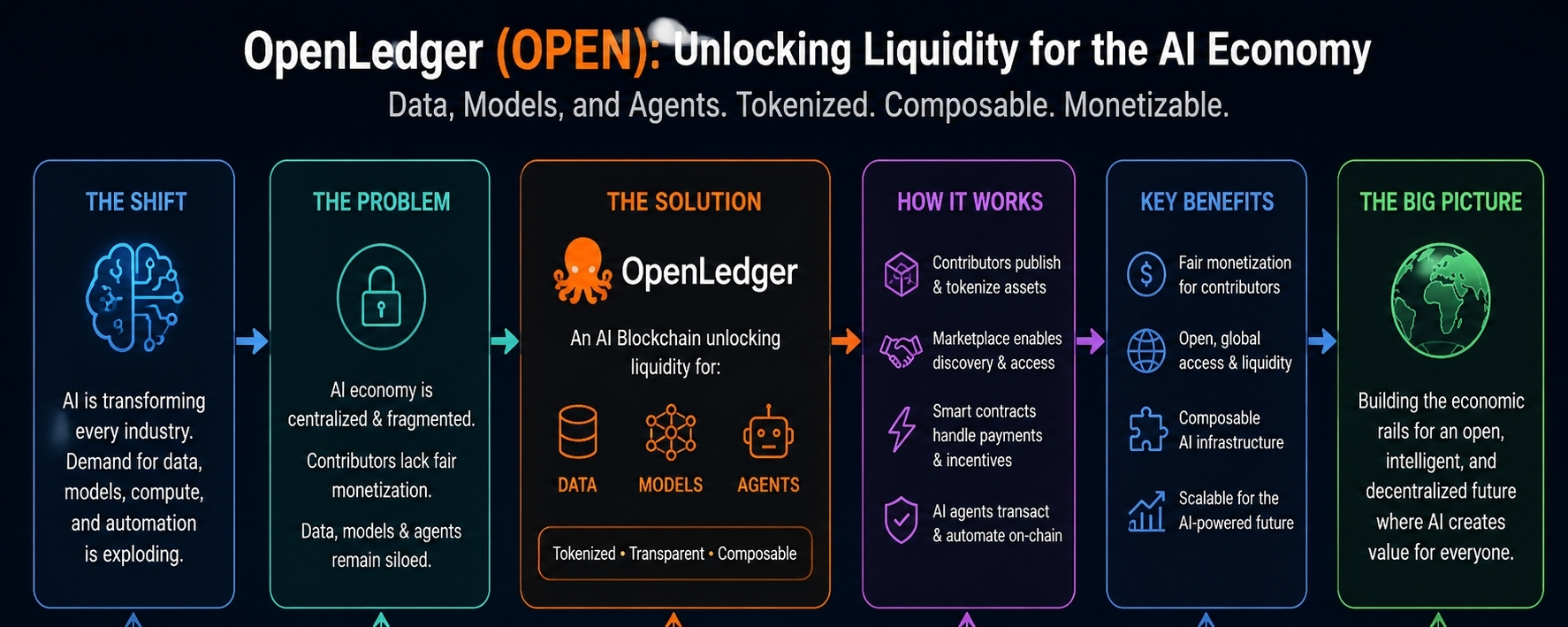
What OpenLedger appears to be exploring is a more open economic layer for AI itself — one where data, models, and agents become liquid and monetizable on-chain instead of remaining trapped inside closed ecosystems.
That matters more than many people realize.
Because if AI becomes the operating system of the internet over the next decade, then the infrastructure governing how intelligence is created, distributed, and rewarded becomes just as important as the models themselves.
In earlier crypto cycles, most users focused almost entirely on tokens. Today, experienced developers and long-term builders think differently. They look at coordination systems, deployment efficiency, interoperability, and incentive design. They ask whether a protocol can actually support usage under pressure rather than simply attracting speculation during a bull market.
That shift in thinking is healthy.
The market learned difficult lessons over the years. We saw what happens when applications scale without sustainable infrastructure beneath them. We saw how expensive and inefficient on-chain activity could become during peak demand. We also learned that decentralization alone is not enough if usability suffers.
People no longer care only about whether something is technically decentralized. They care whether it works smoothly enough to compete with centralized alternatives.
That’s an important lens for evaluating AI-focused blockchain infrastructure.
From what stands out to me, OpenLedger is attempting to position itself closer to the infrastructure layer than the application layer. That distinction is critical. Infrastructure projects rarely feel exciting at first because their value compounds slowly. But historically, the systems that quietly power ecosystems often end up mattering more than the applications receiving immediate attention.
You can compare it to cloud computing in the early internet era.
Most people didn’t obsess over AWS when it first emerged. They focused on consumer apps. But eventually the market realized the infrastructure layer was enabling entire industries behind the scenes. AI may follow a similar trajectory. The visible products capture headlines, while the underlying coordination and liquidity systems quietly become indispensable.
One of the more interesting ideas around OpenLedger is the attempt to unlock liquidity around AI assets themselves.
That sounds abstract initially, but it becomes clearer when you think about how fragmented the AI ecosystem currently is.
A researcher may create valuable datasets but struggle to monetize them fairly. A developer may build an effective specialized model but lack distribution. An AI agent may perform useful automated tasks but exist inside isolated environments with no native economic layer connecting it to broader markets.
Blockchain introduces programmable ownership and programmable incentives into that equation.
If done correctly, it allows contributors across the AI stack to participate economically without depending entirely on centralized gatekeepers. That doesn’t automatically guarantee success, but it creates a framework where collaboration and monetization become more transparent and composable.
And composability has always been one of crypto’s strongest characteristics.
DeFi exploded because protocols could interact with one another like building blocks. The same principle could eventually apply to AI agents, models, and automation systems.
Imagine autonomous systems negotiating services, accessing datasets, verifying outputs, and handling payments without manual coordination. That sounds futuristic, but pieces of that infrastructure are already being developed.
The challenge is scalability.
This is where many ambitious crypto-AI projects will struggle.
AI workloads are resource intensive. Inference costs money. Data storage becomes massive over time. Real-time coordination between agents requires speed and reliability. If blockchain systems cannot handle those operational realities efficiently, adoption will remain limited to niche experimentation.
That’s why infrastructure decisions matter more now than branding.
Experienced users have become more skeptical over time, and honestly, that skepticism is deserved. The market has seen countless projects attach themselves to whatever narrative is trending. During previous cycles, adding “DeFi,” “metaverse,” or “AI” to a pitch deck was often enough to attract attention.
Today the bar is higher.
Builders are expected to demonstrate actual deployment pathways, realistic scalability approaches, and usable developer environments. The conversation is becoming less ideological and more operational.
Can developers integrate it easily?
Can applications run reliably?
Can incentives remain sustainable beyond speculation?
Can systems attract real usage outside of token farming?
Those are the questions that determine whether infrastructure survives after market momentum fades.
What I find particularly interesting about OpenLedger is that it’s entering the market during a period when AI and crypto are both maturing simultaneously. Earlier attempts to combine these sectors often felt premature. Either AI capabilities were too limited, or blockchain infrastructure was too inefficient.
Now the timing looks different.
AI agents are becoming more autonomous. Open-source models are improving rapidly. On-chain infrastructure is faster and more modular than it was a few years ago. Developers are also more pragmatic now. They’re less interested in ideological purity and more interested in systems that can actually scale in production environments.
That maturity changes the potential outcome.
Still, there are real risks here.
AI infrastructure is becoming extremely competitive, and many well-capitalized companies already dominate large portions of the stack. Decentralized alternatives must prove they can offer meaningful advantages rather than simply replicating centralized systems with additional complexity.
There’s also the question of governance and quality control.
Open systems are powerful, but they can become noisy if incentives are poorly designed. Data quality, model reliability, and malicious automation are all issues that decentralized AI ecosystems will eventually need to address seriously.
And regulation remains an unpredictable variable.
As AI becomes more influential economically and politically, governments will likely increase scrutiny around data ownership, automated decision-making, and digital identity systems. Blockchain-based AI infrastructure may eventually sit directly in the middle of those debates.
But even with those uncertainties, I think the broader direction is becoming difficult to ignore.
If you’ve watched crypto evolve through multiple cycles, you eventually realize the industry’s most important innovations usually begin quietly. They start as infrastructure conversations long before they become mainstream narratives.
That’s the feeling I get when looking at projects trying to merge AI coordination with blockchain-based economic systems.
The real opportunity may not come from speculative excitement around AI tokens. It may come from building the invisible rails that allow intelligent systems, data contributors, developers, and autonomous agents to interact economically at global scale.
OpenLedger appears to be positioning itself within that long-term infrastructure conversation.
Whether it ultimately succeeds will depend less on marketing and more on execution: developer adoption, network reliability, economic design, and the ability to solve real coordination problems better than existing systems.
But from my perspective, that’s exactly the right battlefield to focus on.
Because the next phase of crypto probably won’t be defined by who creates the loudest narrative.
It will be defined by who builds systems durable enough to support the next generation of digital intelligence.