
A few months ago, I still thought most AI
conversations were mainly about capability.
Bigger models, faster inference, smarter reasoning, cleaner outputs.
That seemed like the obvious race. Every new release felt like another step toward more powerful systems, and honestly, most
peopleincluding me
looked at progress through that lens.
But lately I keep feeling like the real problem is shifting underneath the surface.
Because capability is no longer the only thing markets are reacting to.
Trust is becoming part of the infrastructure now, whether the industry is ready for that or not.
And the strange part is that trust becomes most visible exactly when incentives get messy.
You can already see it happening across AI. Companies want benchmark dominance because benchmarks attract headlines.
Startups want performance narratives because narratives attract funding.
Platforms want adoption numbers because growth creates momentum. Everyone is optimizing toward the layer that gets rewarded fastest.
That is normal human behavior. Markets always shape behavior.
The problem starts when optimization quietly drifts away from reliability.
A model can look incredible inside controlled evaluations and still behave unpredictably in real environments.
And most ordinary users will never notice the difference until something actually breaks. That gap between presentation and operational reality feels small at first, but economically it becomes huge over time.
I think about this a lot when people talk about “AI trust.”
Most discussions still frame trust emotionally, like it is mainly about whether users feel comfortable with AI systems.
But real trust in infrastructure has never been emotional. It is usually mechanical.
Banks rely on audits. Exchanges rely on settlement systems.
Insurance relies on risk modeling. Financial markets survive because accountability
structures exist underneath the surface, even when users never directly see them.
AI is slowly entering the same territory now.
Especially once these systems start touching workflows connected to money, healthcare, legal review, enterprise operations, or public infrastructure.
At that point, performance claims stop being marketing language. They become economic assumptions.
And economic assumptions eventually need verification.
That is why I keep circling back to projects like OpenLedger from a slightly different angle than most people do
A lot of people focus on the obvious parts first: decentralized AI, attribution layers, data contribution economies, agent infrastructure, model monetization.
Those things matter, obviously. But I think the more interesting layer might be what happens when attribution starts functioning as accountability infrastructure instead of simple bookkeeping.
Because provenance sounds boring until incentives become expensive.
Who trained a model?
Which datasets influenced outputs?
What evaluation conditions were used?
Which claims were attached to adoption decisions?
Who benefits economically when those claims spread?
Those questions feel administrative right now because AI is still moving through a hype-heavy phase.
But once larger institutions rely on these systems, ambiguity becomes costly very fast.
And honestly, crypto already explored some of this logic years ago.
Not perfectly. Definitely not cleanly. But crypto understood something important about incentives: systems behave differently when accountability
becomes economically embedded instead of socially implied.
Validators get slashed. Collateral gets liquidated.
Reputation affects liquidity. Risk gets priced continuously because markets punish uncertainty aggressively.
Again, I am not saying AI should become crypto-native in culture
.That would probably create ten new problems immediately.
But some of the structural thinking around incentives feels extremely relevant.
Right now, benchmark culture in AI still feels strangely adolescent to me. Bigger score equals better model.
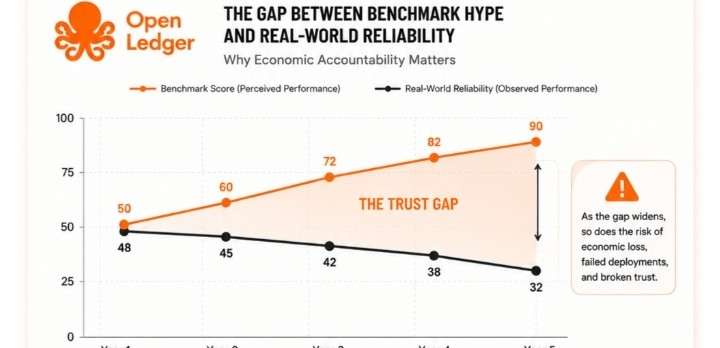
Cleaner chart equals stronger system. Most people accept those signals because they are simple and emotionally reassuring.
But operational environments do not care about aesthetic confidence.
A hospital does not care if a model looked impressive during launch week. A financial analyst does not care how polished the benchmark presentation was.
Procurement teams eventually care about failure rates, traceability, governance exposure, and reliability under pressure.
The vibe changes completely once real economic consequences enter the room.
And I think Europe’s regulatory direction is already hinting toward where this goes next.
The moment AI touches regulated workflows, the conversation becomes less philosophical and more procedural.
Audits. Documentation. Explainability requirements. Governance reviews. Liability questions.
Suddenly everyone wants to know where outputs came from.
That is where OpenLedger’s attribution model starts feeling less like optional infrastructure and more like preparation for a future market structure.
Because maybe attribution is not only about rewarding contributors.
Maybe it is also about making dishonesty harder to scale casually.
That idea keeps sitting in my head.
Not eliminating manipulation entirely. That is unrealistic.
Every system gets gamed eventually. Markets adapt. Incentives mutate. People optimize around measurement forever.
But systems can still shape behavior by increasing the cost of unreliable behavior.
Unsafe drivers pay more for insurance. Poor credit histories affect borrowing conditions. Exchanges quietly adjust trust assumptions based on operational history all the time.
Most mature systems do not remove bad actors completely. They just make certain forms of behavior less economically attractive over time.
AI could evolve in a similar direction.
And honestly, that may end up being more important than raw intelligence itself.
Because the next stage of AI competition probably is not only about who builds the smartest systems.
It may also become about who builds systems that markets can actually trust under pressure.
That feels like a very different race entirely.