
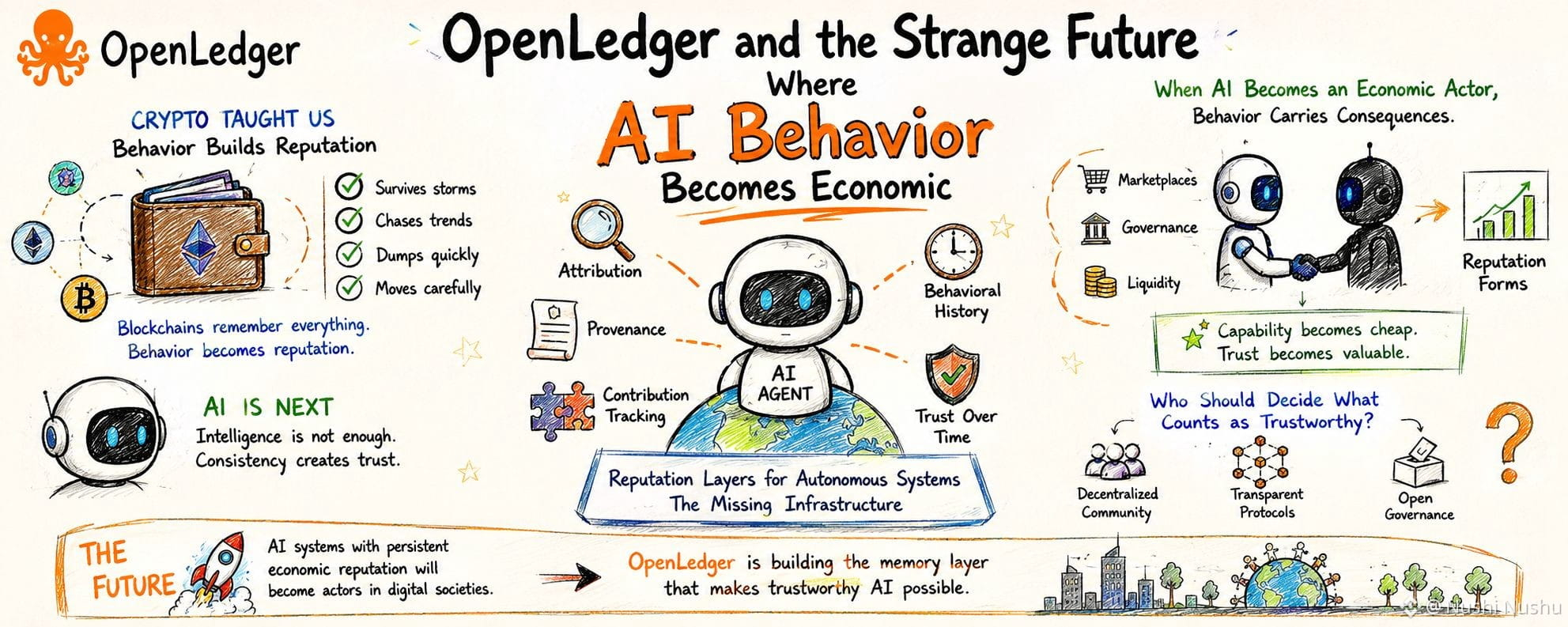
In crypto wallets stopped feeling like random addresses a long time ago.
Now when you look at a wallet you instinctively read behavior from it. You notice which wallets survive bad markets quietly. Which ones chase every trend. Which ones dump liquidity the second momentum slows down. Which ones move carefully during volatility.
Nobody officially taught you to think that way.
It just happened naturally because blockchains remember everything.
Over time behavior turned into reputation.
And lately I keep wondering if the same thing is about to happen with AI systems themselves.
That thought is honestly why OpenLedger started standing out to me differently from most AI infrastructure projects.
Most AI projects still compete like it is a pure capability race.
Smarter agents. Faster outputs. Better automation. More autonomous coordination.
You hear the same promises everywhere now.
But once AI systems begin interacting continuously with financial systems, marketplaces, governance layers and economic infrastructure something changes.
You stop caring only about intelligence.
You start caring about behavior.
That shift feels much bigger than people realize.
Because intelligence alone does not create trust.
Consistency does.
I noticed this while using automated systems myself. At first performance looks like the only thing that matters. Fast execution feels impressive for a while. Smooth automation feels efficient. Intelligent outputs feel exciting.
Then eventually another question starts forming underneath all of it:
How does this system behave repeatedly over time?
That question changes everything.
Because once autonomous systems begin operating inside open economies, every interaction leaves behind history.
And history slowly becomes economic reputation.
You start noticing which systems preserve context under stress. Which systems degrade quietly during volatility. Which systems optimize aggressively in dangerous ways. Which systems stay reliable even when conditions become unstable.
At that point, the conversation stops being about raw intelligence.
It becomes about whether the system deserves trust inside coordination layers at all.
That is where OpenLedger feels interesting to me.
Not because it promises another AI breakthrough.
But because it seems focused on attribution, provenance, contribution tracking, and persistent behavioral history.
Those things sound abstract at first until you realize autonomous systems without attribution become impossible to evaluate at scale.
Without provenance, outputs lose context. Without contribution tracking, incentives break. Without behavioral history, every autonomous interaction starts looking interchangeable.
And honestly, that becomes dangerous once AI systems begin coordinating financially with each other.
Most people still imagine AI as tools.
But what happens when AI agents become participants instead?
That is a very different environment.
The moment autonomous systems begin making decisions continuously across networks, marketplaces and liquidity systems, machine behavior itself starts carrying economic consequences.
And once behavior carries consequences, reputation inevitably forms around it.
Crypto already proved this once.
Nobody planned for wallet history to become social credibility infrastructure. It emerged naturally because transparent systems preserve memory over time.
AI systems may follow the same path.
You may eventually care less about whether an AI is smart and more about whether it behaves reliably across thousands of interactions.
That distinction matters more than it sounds.
Because capability eventually becomes cheap.
Trust usually does not.
The same pattern repeats in almost every technology cycle. At first, markets obsess over visible power. Faster systems. Bigger models. Better performance.
Then eventually the real value shifts toward coordination.
Who can be trusted? Who preserves context? Who behaves consistently under pressure? Who deserves access to larger systems?
I think OpenLedger may already be preparing for that future quietly.
And if that future actually arrives, the most important infrastructure may not be the systems generating intelligence.
It may be the systems preserving memory around intelligence itself.
That possibility keeps staying in my head lately.
Because once AI systems inherit persistent economic reputation they stop behaving like isolated software.
They start behaving more like actors inside digital societies.
And honestly I do not think most people are fully prepared for what that changes.
Do you think autonomous systems eventually need reputation layers the same way wallets already developed them in crypto?
And if machine behavior becomes economically visible over time, who should control the systems deciding what counts as trustworthy?$OPEN #OpenLedger @OpenLedger $PRL $XLM