@OpenLedger #OpenLedger $OPEN Ikeep coming back to OpenLedger because it feels like it’s trying to solve a quieter problem than most AI projects are willing to admit exists.
Not intelligence.
Not model quality.
Not benchmark performance.
Value capture.
That’s the part of the AI stack people keep talking around.
A lot of AI conversation still lives on the surface layer. Bigger models. Faster inference. More capable agents. Better outputs. But underneath all of that, there’s a structural question sitting unresolved: who actually gets paid when intelligence becomes modular, distributed, and reusable across the internet?
That’s where OpenLedger starts to feel more interesting.
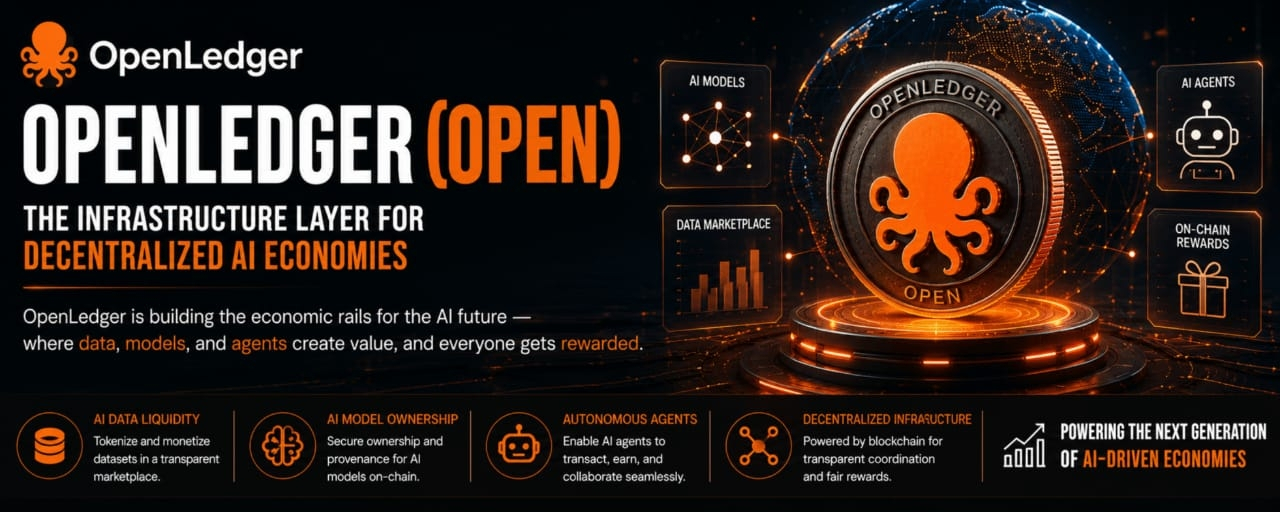
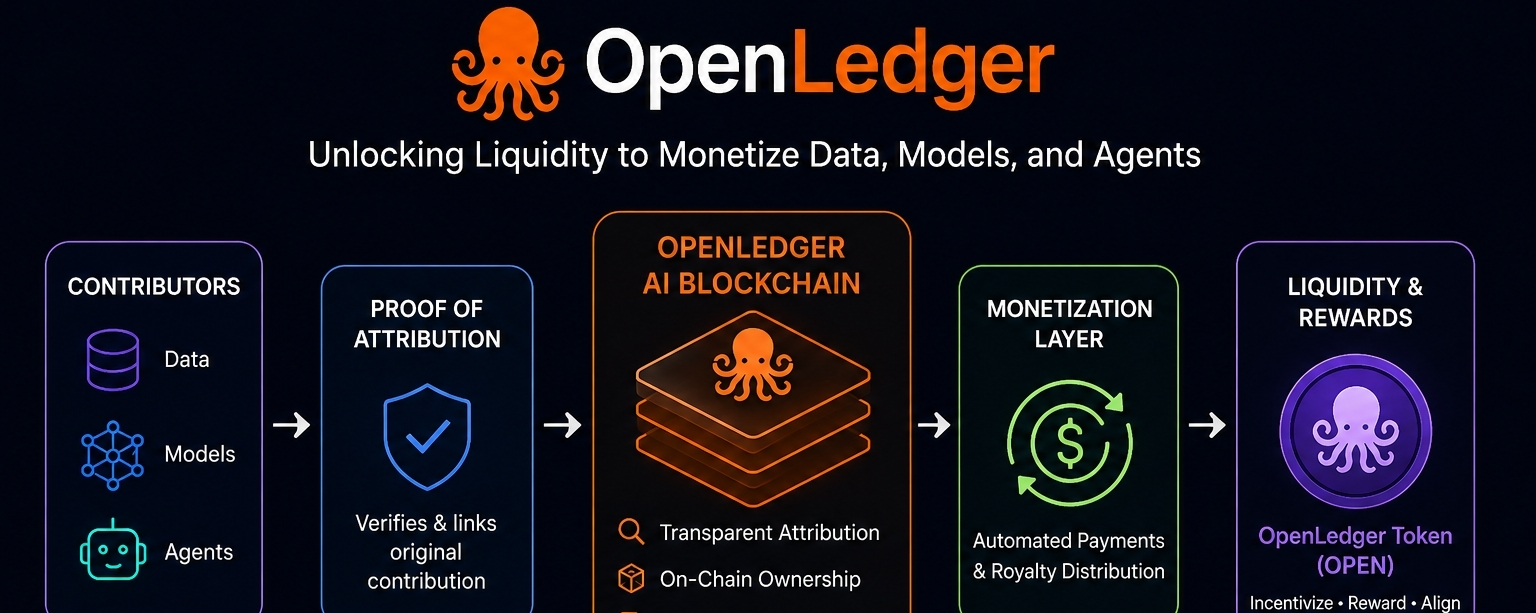
OpenLedger doesn’t really read like another AI blockchain project chasing narrative momentum. It feels more like an attempt to build accounting infrastructure around AI itself. A settlement layer for data, models, and agents where contribution can be tracked, attributed, and monetized without relying entirely on centralized platforms to decide where the value flows.
That distinction matters more than it first appears.
Most AI today still has a monetization bottleneck.
Data gets scraped or licensed once. Models get trained. End products capture revenue. But the people contributing useful datasets, fine-tuning knowledge, domain expertise, model improvements, or agent behavior often disappear economically after the contribution is made. The value compounds higher up the stack while the source layer becomes invisible.
Crypto has seen this pattern before.
Liquidity providers build markets. Protocols scale. Interfaces win attention. Then value migrates upward until incentives break and participation starts fading.
AI may be moving through the same cycle right now.
OpenLedger seems built around that pressure point.
Its framing around AI data monetization and Proof of Attribution feels less like branding and more like infrastructure responding to a real imbalance already forming inside decentralized AI.
Proof of Attribution is the piece I keep thinking about most.
Because attribution in AI isn’t just a technical issue.
It’s economic.
If a model improves because of a dataset, or an agent becomes useful because of repeated user interaction, or a workflow becomes monetizable because someone contributed a niche intelligence layer, then attribution becomes payment infrastructure. And payment infrastructure eventually becomes market structure.
Once money is involved, attribution stops being metadata.
It becomes contested territory.
That’s where OpenLedger feels ambitious.
It’s trying to create a system where contribution remains economically visible across the lifecycle of AI output. Which sounds simple in theory. But in practice it runs directly into the hardest parts of crypto coordination: incentives, verification, ownership ambiguity, sybil resistance, and human behavior.
And human behavior usually breaks elegant systems faster than code does.
People optimize for rewards.
They game incentives.
They extract.
They farm.
Then they leave if emissions disappear.
That’s always the test.
Not whether the mechanism works technically.
Whether it survives contact with users.
That’s why I’m more interested in OpenLedger’s economic design than the AI narrative around it.
Because decentralized AI only works if contributors remain motivated long after the narrative cools down.
And motivation in crypto is rarely ideological for long.
It becomes financial.
The OpenLedger token eventually sits inside that equation too.
OPEN isn’t just a network asset in that context. It becomes incentive routing. Payment logic. Coordination fuel. A way to keep data suppliers, model builders, validators, and downstream application participants economically aligned inside one expanding network.
That sounds powerful.
But also fragile.
Token systems are good at bootstrapping participation. Less good at sustaining it once speculative velocity fades.
So the long-term question isn’t whether OpenLedger can attract attention during the AI infrastructure cycle.
It probably can.
The harder question is whether it can create durable economic loops where usage keeps happening without needing narrative reinforcement every quarter.
Can data contributors keep earning?
Can builders keep deploying?
Can AI agents crypto ecosystems transact repeatedly inside the network because the economics remain useful?
Can attribution itself become a revenue primitive instead of just a record?
That’s a much harder challenge than launching an AI blockchain.
And honestly, more interesting.
Because if OpenLedger works, the outcome isn’t just another decentralized AI network.
It changes how AI ownership gets priced.
It changes who participates.
It changes who captures upside when intelligence becomes composable.
That’s bigger than infrastructure.
That starts touching internet labor itself.
And there’s cultural timing behind it too.
The internet is shifting from user-generated content toward machine-generated output, but machine-generated output still depends on human inputs somewhere underneath. Data labeling. Fine-tuning. contextual correction. niche expertise. behavior loops. reinforcement signals. domain knowledge.
AI looks automated at the surface.
But economically it’s still deeply human underneath.
OpenLedger seems built around making that hidden human layer economically legible again.
That’s why I keep watching it.
Not because it promises decentralized AI.
A lot of projects promise that.
But because it’s asking where the money moves once AI becomes infrastructure instead of product.
That’s a better question.
And usually the better investment frameworks in crypto start with better questions rather than louder answers.
I don’t think the market fully prices that distinction yet.
Most people still evaluate AI infrastructure blockchain projects through model hype, partnerships, or narrative positioning.
But the deeper layer may end up being attribution economics.
Who contributed.
Who gets paid.
Who keeps earning as value compounds.
And who gets forgotten once the system scales.
That’s not just a technical architecture problem.
That’s a market design problem.
And market design tends to outlive narratives.
Years from now, people may care less about which AI model looked impressive in a given cycle.
They may care much more about which networks built durable rails for intelligence to become ownable, monetizable, and economically traceable across the open internet.
If that becomes the frame, OpenLedger starts looking less like an AI blockchain and more like early financial infrastructure for machine-native economies.
And that’s a very different lens to look through