
A few months ago, I watched a friend shut down an AI side project that had real potential. He wasn’t a bad developer. Actually, the model worked surprisingly well for a tiny team. The problem was simpler and more brutal: GPU costs kept climbing faster than user growth.
At first, he thought scaling the product meant training a larger model. That’s the mindset most of the industry still pushes. Bigger parameter counts. Bigger clusters. Bigger fundraising rounds. But after three months of running inference costs day and night, he realized something uncomfortable. The smartest AI company in the next cycle may not be the one building the largest model. It may be the one squeezing the most efficiency from every GPU cycle.
That changed the way I started looking at projects like OpenLedger and the newer conversations around shared compute systems, LoRA optimization, and modular training layers.
The AI race used to feel simple. Whoever had more GPUs won.
Now it feels more like power-grid economics.
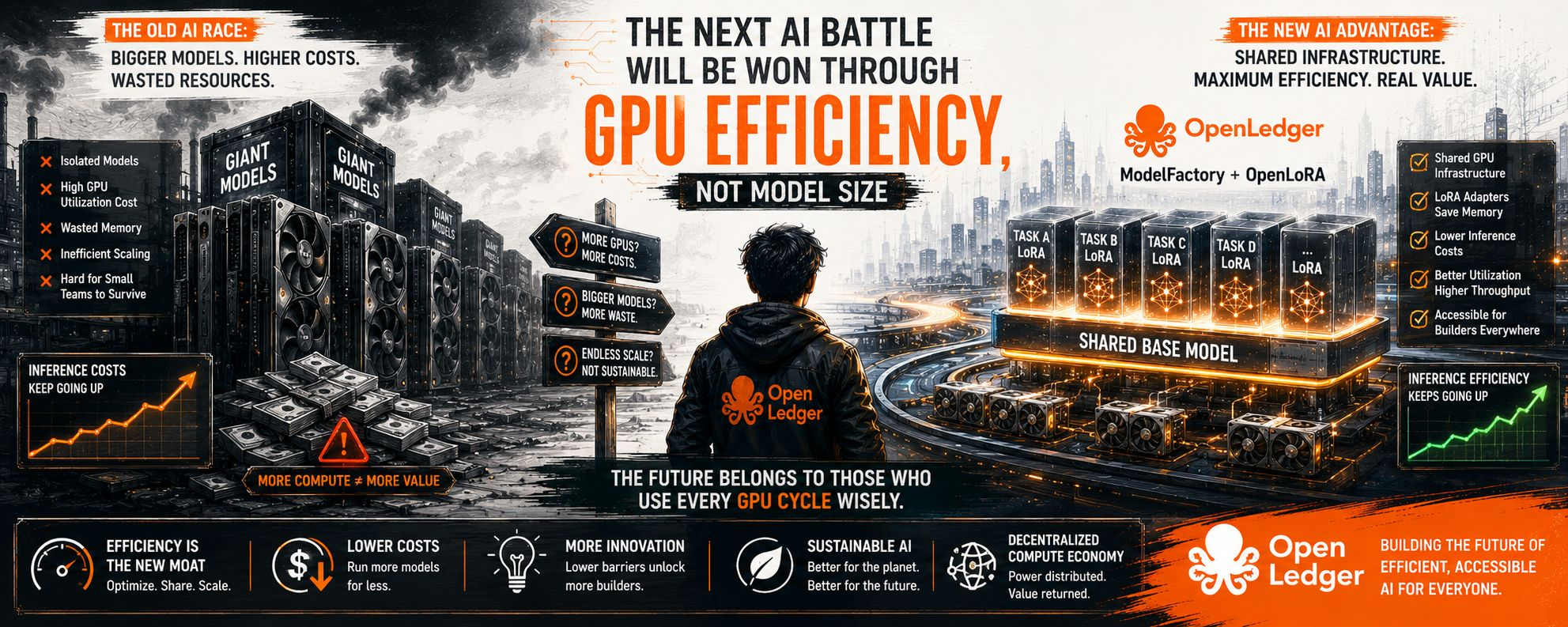
I noticed this while comparing how different AI teams handle fine-tuning workloads. Some projects still train isolated models for every use case, almost like giving every employee in a company their own private office building. Others are moving toward shared infrastructure where multiple lightweight models operate together on the same hardware stack.
That difference matters more than people think.
The easiest metaphor I can give is transportation. For years, AI development resembled everybody driving separate trucks across a city. Massive fuel consumption. Half-empty capacity. Expensive maintenance. GPU efficiency changes the system into something closer to a coordinated railway network where multiple workloads share the same infrastructure without constantly rebuilding everything from scratch.
That’s why OpenLoRA caught my attention recently.
The idea behind shared LoRA architecture sounds technical at first, but the core concept is surprisingly practical. Instead of loading entirely separate large models into memory every time a new task appears, smaller adapters can sit on top of a shared base model. Multiple fine-tuned behaviors can operate together while consuming far less GPU memory.
That changes economics immediately.
And honestly, I think many investors still underestimate how important this shift could become.
People love talking about model intelligence, but very few discuss operational survival.
A startup burning millions on compute is not automatically stronger than a leaner competitor running efficient inference pipelines. In fact, during difficult market conditions, efficiency usually wins. We already saw versions of this during cloud computing expansion years ago. Companies that optimized infrastructure survived longer than companies obsessed with scale for appearance alone.
This reminded me of a trade I made earlier this year.
I opened a small long position on an AI infrastructure token after noticing rising discussion around decentralized compute coordination. The market barely reacted at first because everyone was focused on flashy chatbot demos from larger companies. But over the following weeks, GPU supply constraints started appearing again across smaller builders. Suddenly the narrative shifted from “Who has the smartest AI?” to “Who can afford to keep AI running profitably?”
That trade ended up performing better than I expected, not because hype exploded, but because infrastructure problems became impossible to ignore.
The same pattern is happening now across decentralized AI systems.
Projects are quietly moving toward efficiency-focused architecture instead of brute-force expansion. OpenLedger’s ModelFactory approach is interesting for exactly this reason. Lowering technical barriers matters, but reducing compute waste may matter even more. A GUI-based fine-tuning environment is helpful. Shared GPU utilization is strategic.
There’s also a deeper economic layer here that people rarely mention.
If AI eventually becomes embedded into search, finance, gaming, healthcare, and autonomous systems simultaneously, the world simply cannot rely forever on endlessly scaling raw compute consumption. Hardware growth has limits. Energy costs have limits. Even data center expansion has geopolitical limits now.
That means software efficiency becomes a competitive weapon.
I think many people still underestimate how close this pressure already is. NVIDIA demand remains enormous, inference costs continue squeezing smaller developers, and governments are starting to treat AI infrastructure almost like national strategic assets. The conversation is no longer theoretical.
And yet, skepticism is still necessary.
Not every “efficient AI” project actually solves the underlying economics. Some merely repackage existing infrastructure ideas with new branding. I’ve tested enough platforms to notice that many promise decentralization while quietly depending on centralized bottlenecks underneath. Others advertise community-owned AI while governance remains concentrated among early insiders.
That’s why I’ve stopped looking only at whitepapers.
Now I pay attention to practical signals:
How much memory reduction is actually achieved?
Can multiple models truly share GPU resources effectively?
Does inference latency remain stable under load?
Can smaller developers realistically deploy without massive upfront cost?
Those questions matter more to me than marketing slogans now.
Another thing I noticed is that GPU efficiency changes accessibility itself.
When compute becomes cheaper, experimentation increases. Smaller teams can iterate faster. Independent researchers can compete again. That may ultimately become more important than any single flagship model release.
Because innovation usually comes from unexpected places when barriers fall.
Right now, the industry still celebrates size. Bigger training runs still dominate headlines. But beneath the surface, the real infrastructure war is shifting toward optimization, coordination, and sustainability.
I think the next generation of AI winners will look less like giant factories endlessly consuming power and more like highly optimized logistics systems moving intelligence efficiently across networks.
That’s a very different future from what most people imagined two years ago.
And honestly, I’m curious how others see it.
Do you think GPU efficiency will eventually matter more than raw model scale? Or will centralized labs with massive hardware advantages still dominate no matter how optimized smaller systems become?
$OPEN @OpenLedger #OpenLedger $ESPORTS $XLM
