
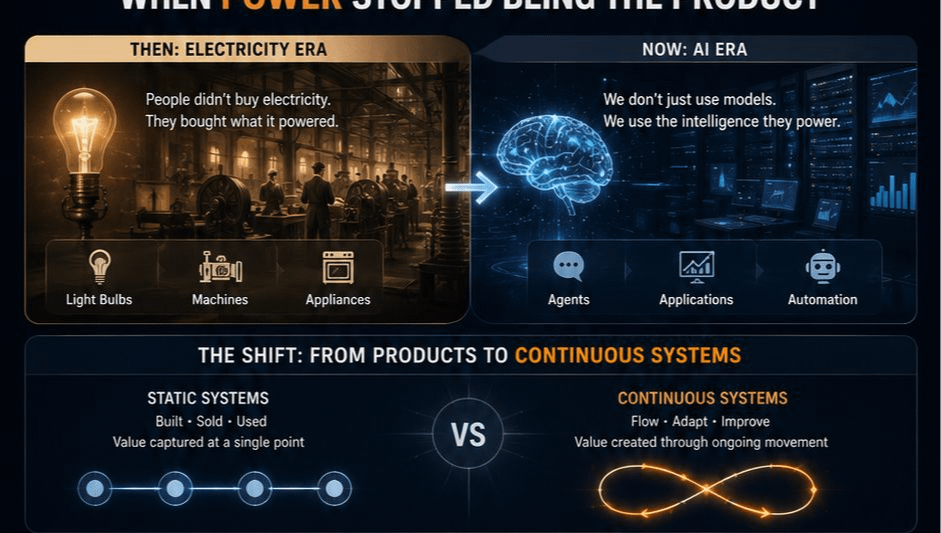
As electricity began to spread, people didn't really purchase electricity.
They purchased the light bulbs. Factories bought machines. Homes bought appliances.
The visible always garnered attention, as the people always paid attention to what they can touch. However, over time things changed. Gradually, electricity ceased to be a consumer good. Little by little, electricity became something that people started to care no more about. Access was what mattered. Reliability. Distribution. Continuous availability. Eventually, whole industries realized that the hard problems were not about generating power. The tough challenge lay in moving power around in systems that never turned off.
When it comes to the subject of AI, I often find myself thinking about this.
Most discussions continue to be product based. Which model is larger? Which model is the better choice? What company did something new. Analyze which of the following benchmarks increased this week.
But what if intelligence itself is undergoing the same evolution?
When intelligence is all around, intelligence ceases to be of interest.
Movement becomes interesting.
Like with most other software, the weird thing about intelligence is that it isn't just there after you deploy it. It always feeds information, it produces outputs, provides feedback, affects decisions, produces information, and feeds again.
It's not like software. More like infrastructure. This is another type of problem.
These systems are traditionally rewarders of ownership. Coordinated systems are rewarded in continuous systems.
Factories had to have supply lines. Recommendation engines were required for streaming platforms. World trade required logistic chains. The same might be necessary for Continuous intelligence. Not necessarily larger models. Not necessarily improved interfaces. Something underneath.
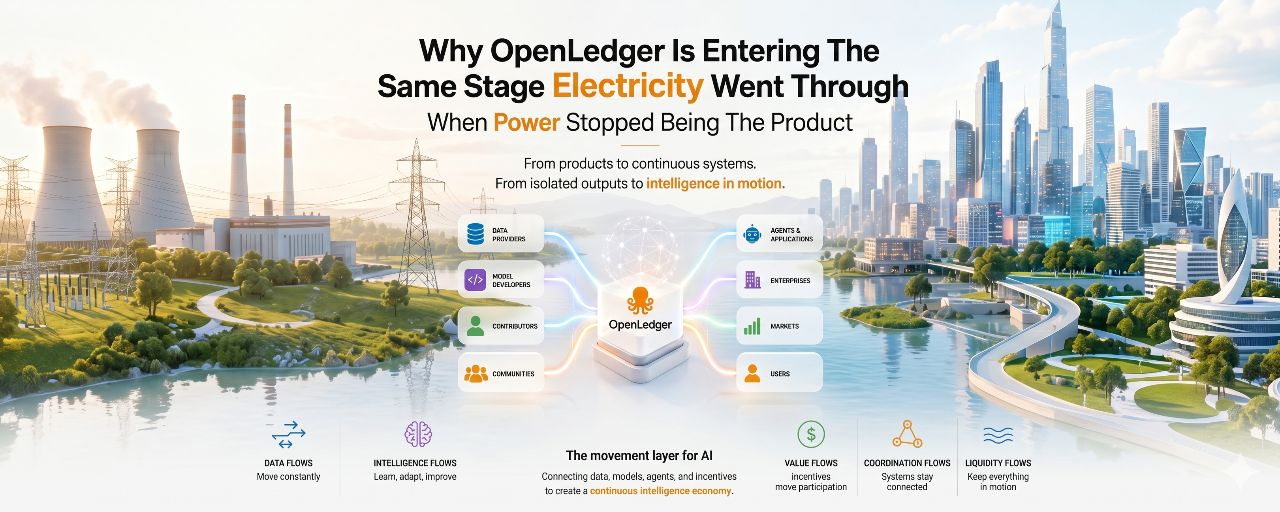
I've been thinking about projects such as @OpenLedger and the more I think about them the more interesting they seem as far as this is concerned. Not because any other infrastructure project necessarily matters. Most do not.
However, it is more common for projects that are about flows and not products to be attempting to address a different type of problem altogether.
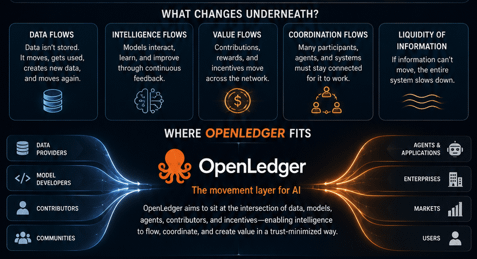
What occurs when data is not only stored information but also moves as an infrastructure?
What occurs when models are continually interacting rather than being isolated tools?
What happens if agents, contributors, datasets, outputs and incentives are all interdependent and must stay linked?
These questions may seem abstract, but they are raised by almost every modern system.
Movement creates dependency.
The lack of independence leads to coordination issues.
Coordinating difficulties produce infrastructure.
Eventually, infrastructure becomes more significant than the thing people originally paid attention to.
That's where liquidity begins to get different.
When they hear liquidity, people think about markets.
Continuous systems, however, generate another type of liquidity.
Information liquidity.
Intelligence liquidity.
Participation liquidity.
Contribution liquidity.
Without efficient information flow, systems slow.
Without efficient contribution, there is no participation.
When incentives do not move efficiently, coordination fails.
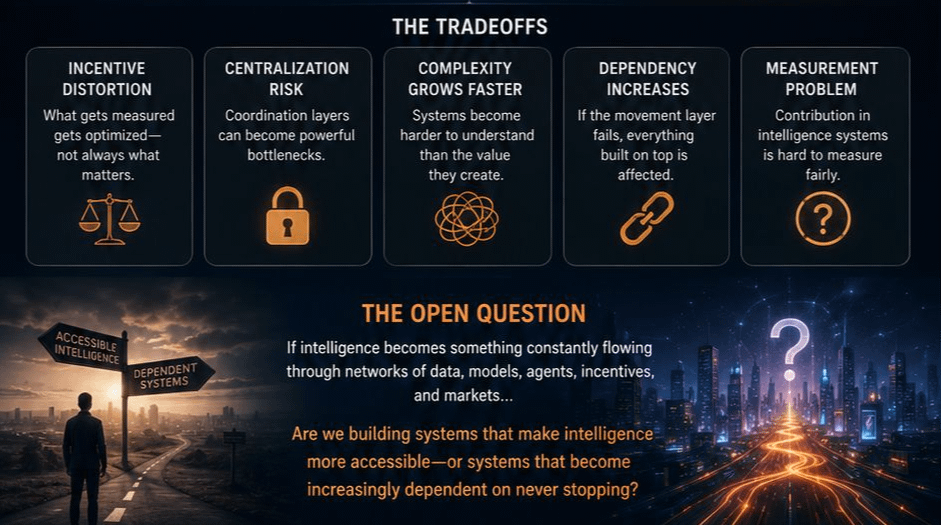
The difficulty is that moving the solution to the problem also introduces a new problem.
Systems that fail are usually not catastrophic.
They are typically slowly lost.
Participants choose to maximize what they're gaining and not what they're winning.
Networks rely on layers that most people are not familiar with.
Co-ordination focuses on infrastructure providers.
The more complex, the less visible.
People learn that they are using systems on which they cannot now make observations.
This is important because sometimes, AI conversations seem to equate with scaling, which means value is assumed.
History is typically a more nuanced narrative.
Bottlenecks are typically the first to occur when scaling.
Then new coordination layers are introduced to address those 'bottlenecks'.
Those coordination layers become systems in turn.
OpenLedger is like it's in the middle of that movement.
Not at its hub.
Most likely not as the part that you see.
More like a second is done at piping construction, while the others are busy with water flowing through pipes.
Perhaps it's the more intriguing question.
But what if intelligence one day becomes a perpetual flow of data, models, contributors, agents, incentives, and markets – are we creating systems to make intelligence more accessible?
Or are we slowly developing systems that only become intelligent as more and more complex networks are able to run without interference?
