
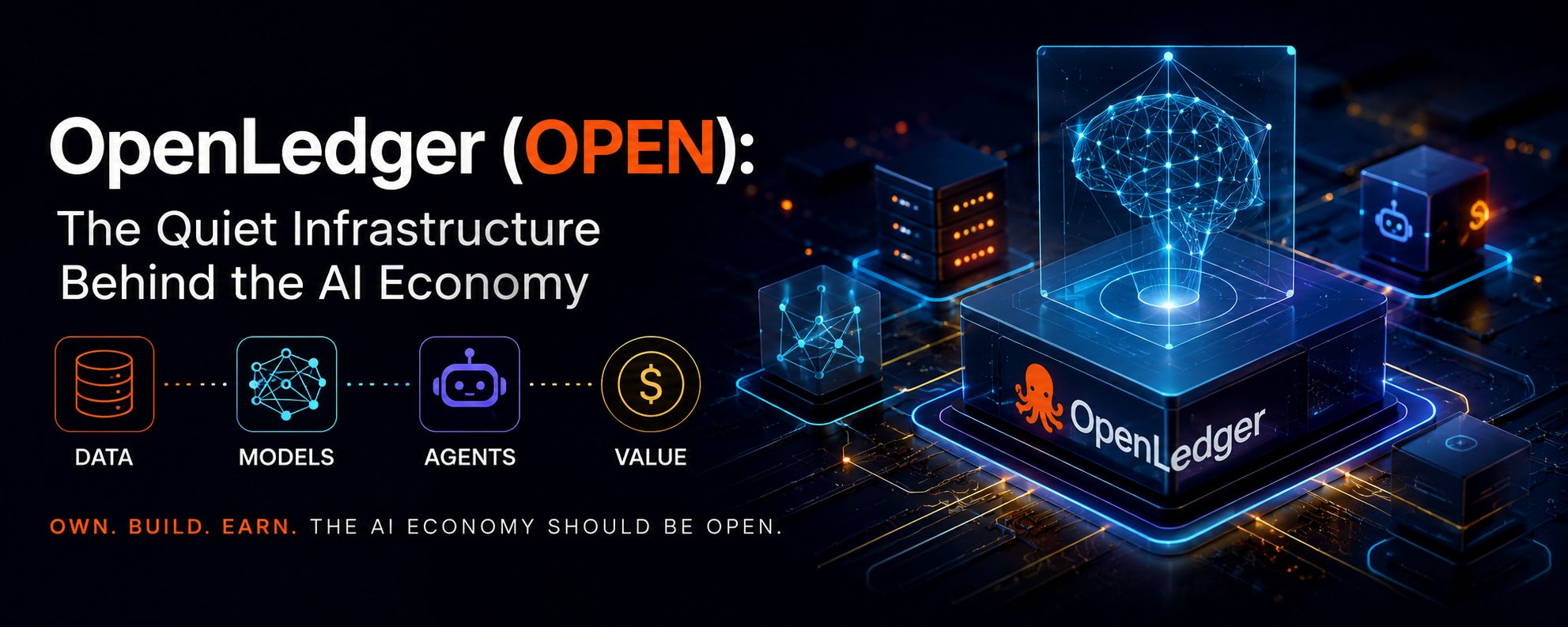
OpenLedger (OPEN) is one of those projects that made me pause for a second and think, “Okay, this is actually touching a real problem.”
Because if we are being honest, AI has been moving fast, but the value around it still feels uneven. A lot of data is being used. A lot of models are being trained. A lot of agents are starting to act on their own. Yet the people, builders, and communities behind that data usually do not get much back from the system they help create.
That is the part that stands out to me.
OpenLedger is trying to bring liquidity into that world of data, models, and agents. On paper, that sounds technical. In practice, it means giving AI-related assets a way to be owned, used, and exchanged more openly. And in today’s market, that idea feels more important than it might sound at first.
I keep noticing how often people talk about AI like it is just software. But it is becoming something much bigger than that. AI is starting to behave like infrastructure. It is not just answering questions anymore. It is helping create content, automate decisions, analyze behavior, and even act like a digital worker in some cases.
That shift changes the conversation.
If AI is becoming part of the economy, then ownership matters. Who controls the data? Who benefits from the model? Who earns from the work an agent performs? These are not small questions anymore. They are the kind of questions that usually show up later, after the market has already moved.
OpenLedger seems built around that exact gap.
What I like about the idea is that it is not trying to sell a fantasy. It is looking at the real structure behind AI and asking how value can be moved more fairly. That may sound simple, but in crypto, simple ideas are often the hardest ones to build properly.
A lot of projects rush to sound futuristic. This one feels more grounded in the actual mechanics of how AI systems grow. Data is collected. Models are trained. Agents act. Value is created. But the flow of reward is still messy. OpenLedger is trying to connect those pieces into something more open and usable.
I think that is why the project gets attention.
Not because it is loud, but because it sits inside a conversation that is only getting bigger. AI is not slowing down. In fact, it feels like we are still early in understanding how deeply it will change digital work, ownership, and online economies.
And when I look at OpenLedger through that lens, it starts to feel less like a random crypto narrative and more like a response to a future that is already forming.
The part about data is especially interesting. Data has become one of the most valuable resources in the digital world, but most users never really feel that value directly. They contribute every day through their activity, their content, their habits, and their interactions. Then large systems turn that into intelligence and profit.
That imbalance has been sitting in the background for years.
Blockchain has always promised better ownership models, but not every project actually connects that promise to something useful. OpenLedger’s angle makes more sense to me because it is tied to an industry that genuinely needs better structure.
Then there is the model side of things.
AI models are no longer just experimental tools. They are becoming assets. Some are specialized, some are trained for specific jobs, and some are powerful enough to support entire products. If those models can be connected to a transparent economic layer, that opens up new ways for builders to collaborate and earn.
That is where the “liquidity” part starts to matter.
It is not just about tokens moving around for the sake of trading. It is about making AI components easier to value, share, and use inside a system where ownership is clearer. At least, that is the idea I get from it. And honestly, that idea feels more useful than a lot of empty buzz we see in crypto.
Agents may be the most interesting part for the future.
Right now, AI agents are still a bit new for many people. But the direction is obvious. More tasks will be handled automatically. More digital actions will be delegated to systems that can think, decide, and execute with less human input. That may sound exciting, but it also raises questions about trust and control.
Who verifies what an agent is doing?
Who gets paid when it completes work?
How do you track value across a network of machine-driven actions?
Those are the kinds of problems OpenLedger is pointing toward.
I also think there is something quietly smart about building for the background layer instead of chasing attention. Most of the time, the projects that survive long enough to matter are the ones that solve a deeper problem while everybody else is busy looking at short-term narratives.
That does not guarantee success. Nothing does in crypto.
But it does make the project feel more believable.
From my experience, people usually notice infrastructure too late. At first it looks unexciting. Then developers start building on it. Then the ecosystem starts to form. Then the same people who ignored it begin calling it obvious. That cycle happens again and again.
OpenLedger could fit that pattern if adoption grows in the right way.
Of course, there are still real challenges. Any project in this space has to prove it can scale, attract builders, and make the user experience simple enough for ordinary people. A good concept is not enough. The execution has to be clean, and the ecosystem has to feel natural instead of forced.
That is usually where the difference gets made.
For me, the most interesting thing about OpenLedger is not the headline. It is the broader message behind it. AI is becoming a value-producing system, and the way that value gets shared is still wide open. Projects like this are trying to define that layer before the market fully settles.
That feels important.
Maybe not flashy. Maybe not the loudest story on the timeline. But important in the way infrastructure usually is.
And when I step back, that is what stands out the most. OpenLedger is not just about AI or blockchain by themselves. It is about the space where those two worlds meet, and the bigger question of who gets to own what in the digital economy that is coming next.
I might be early on the idea, and that is fine. Sometimes the strongest projects do not look like much at first. They just quietly point toward a problem that more people will notice later.
