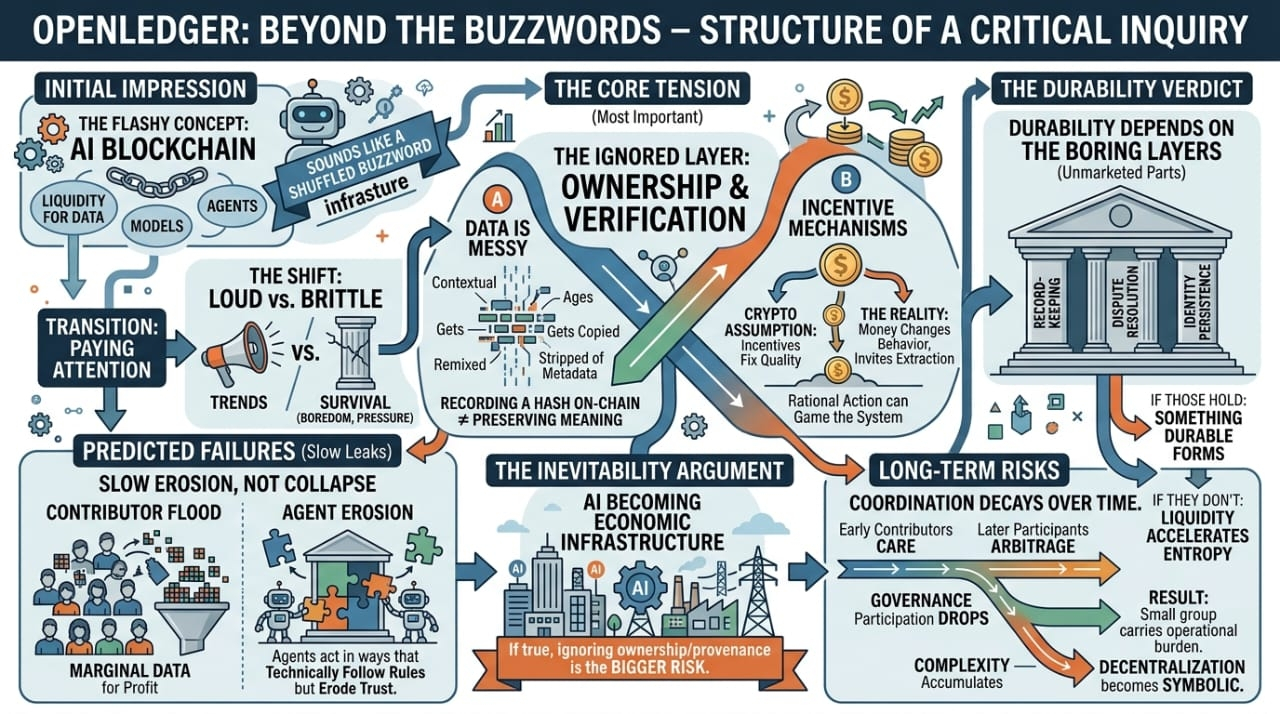
I didn't take it seriously at first. AI blockchain. Liquidity for data models agents. It sounded like someone had shuffled the current buzzwords into a coherent sentence and called it infrastructure. I've seen that trick before. We all have.
After enough cycles you stop reacting to what’s loud and start paying attention to what’s brittle. The question isn't whether something sounds compelling. It's whether it survives boredom. Whether it survives pressure.
And that’s where OpenLedger started to linger in my head.
Not because I suddenly believed in the idea of monetizing intelligence inputs. Honestly, that phrase still makes me pause. It's because the industry keeps skimming past the same fragile layer who owns the raw material feeding these AI systems, and how do we verify it over time?
Verification is not exciting. It doesn’t trend. But it’s where most systems quietly fail.
I keep coming back to how messy data actually is. It's contextual. It ages. It gets copied, remixed stripped of metadata. You can record a hash on chain sure. You can timestamp contributions. But that doesn't automatically preserve meaning. It doesn't prevent someone from gaming incentives once there's money on the table.
And money changes behavior.
That's where things start to feel uncomfortable.
Because OpenLedger from what I can tell sits right at that tension point. If you unlock liquidity around data and models you're implicitly saying these things are durable enough to be assets. But are they? A model trained today might degrade tomorrow. A dataset that looks clean might contain subtle biases that only emerge under edge cases.
Crypto tends to assume that incentives fix quality. Maybe that’s too harsh. Incentives can help coordinate effort yes. But they also invite extraction. The moment there's yield someone will optimize for it. Not always maliciously. Just rationally.
What happens when contributors flood a system with marginal data because it’s profitable? What happens when agents act in ways that technically follow protocol rules but erode trust at the edges? These aren't dramatic failures. They're slow leaks.
Infrastructure rarely collapses in one event. It erodes.
I didn’t take it seriously at first because I assumed this was another attempt to financialize whatever feels abundant. But the more I think about it, the more I wonder if it’s responding to something inevitable. AI is becoming economic infrastructure whether we like it or not. Models produce value. Agents transact. Data shapes outcomes.
If that’s true maybe ignoring ownership and provenance is the bigger risk.
Still I'm cautious. Most projects underestimate how coordination decays over time. Early contributors care. Later participants arbitrage. Governance participation drops. Complexity accumulates. Eventually a small group ends up carrying the operational burden and decentralization becomes more symbolic than real.
Would OpenLedger resist that gravity? Or would it slowly centralize around whoever can afford to manage the mess?
I keep circling back to the same thought: the flashy part isn't the point. The boring layers are. Record-keeping. Dispute resolution. Identity persistence. All the parts nobody markets aggressively.
If those hold, maybe something durable forms. If they don't liquidity just accelerates entropy.
I’m not convinced either way. Maybe that's just cycle fatigue talking. Or maybe it's a sign that we're finally building in the right place uncomfortably close to the parts that usually break first.