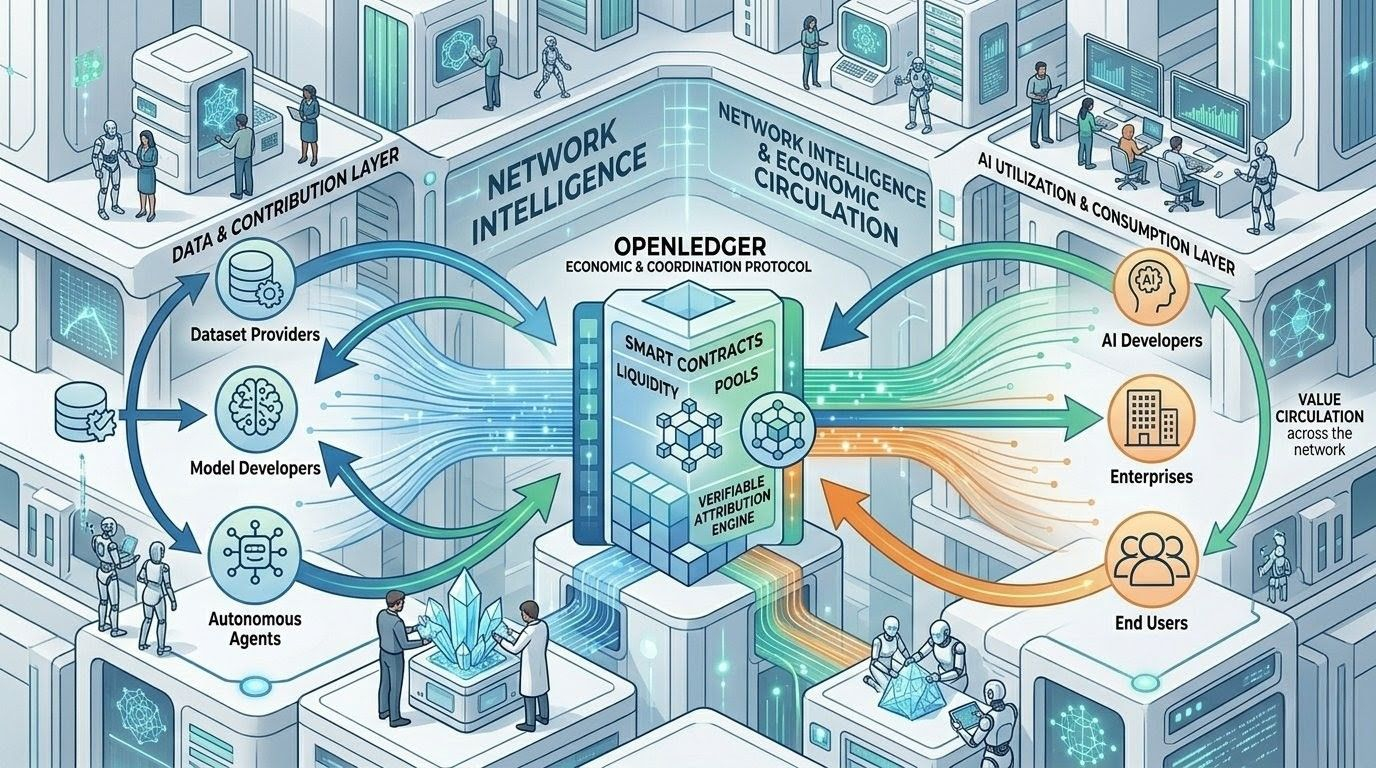

There’s been this strange shift in crypto lately where people are no longer just chasing chains they’re chasing flow. Flow of attention, flow of data, flow of models, flow of incentives. You can feel it in the way AI projects suddenly stopped sounding like science experiments and started competing for actual market positioning. Somewhere between the collapse of easy liquidity and the rise of AI everywhere, the market began asking a more uncomfortable question: who actually owns the intelligence being built online?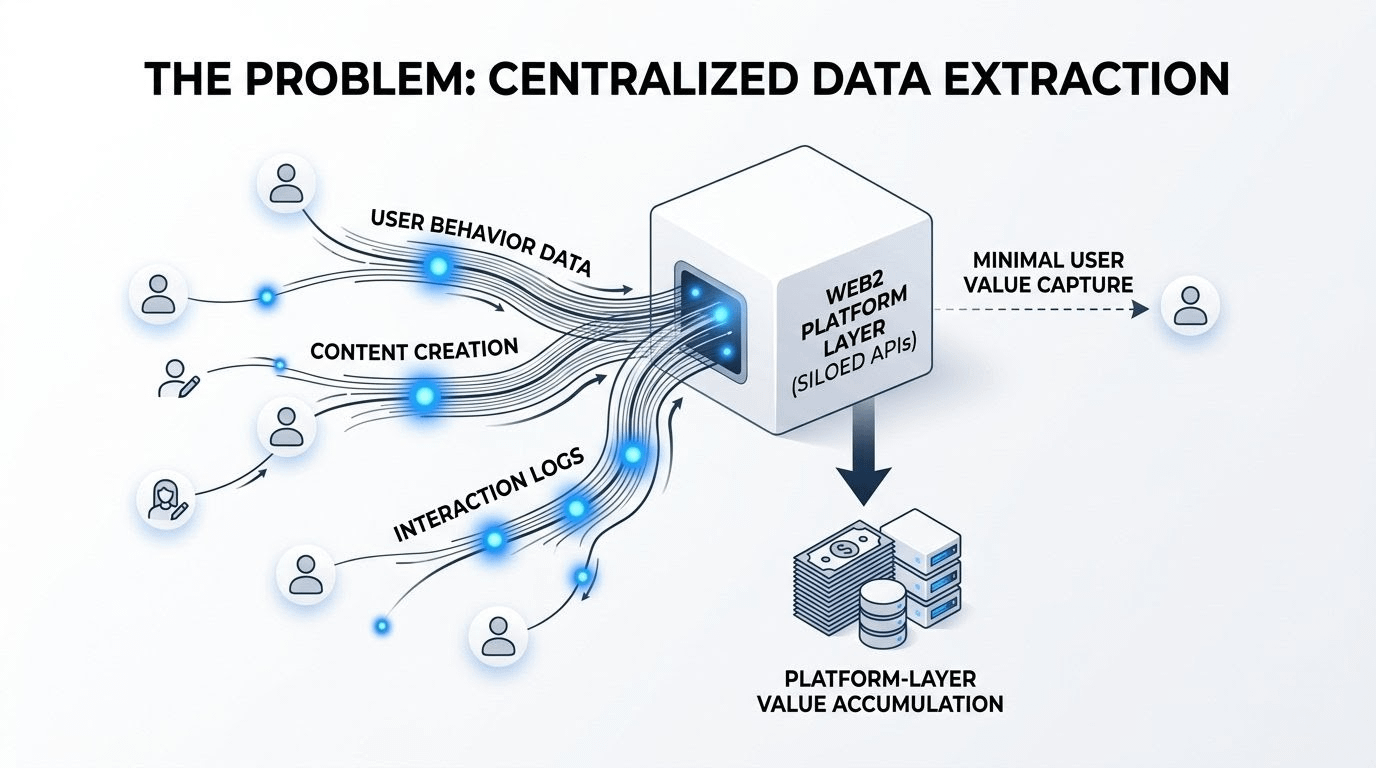
I ended up looking into OpenLedger almost by accident while reading through discussions around decentralized AI infrastructure. Most projects in this category blur together after a while. Same language about democratizing AI. Same diagrams. Same promises about agents talking to agents. But OpenLedger felt like it was trying to attack something more specific the fact that data itself has become one of the most extractive businesses on earth, while the people generating it rarely capture any value.
That part matters more than people realize.
Everyone talks about compute. Nvidia chips. Inference costs. Training clusters. But the real war underneath AI is access to useful data and the ability to coordinate incentives around it. Web2 figured this out years ago. Every platform quietly monetizes user behavior at scale while users themselves remain outside the value loop. Crypto keeps claiming it can fix ownership, but most chains still revolve around speculative capital more than productive networks.
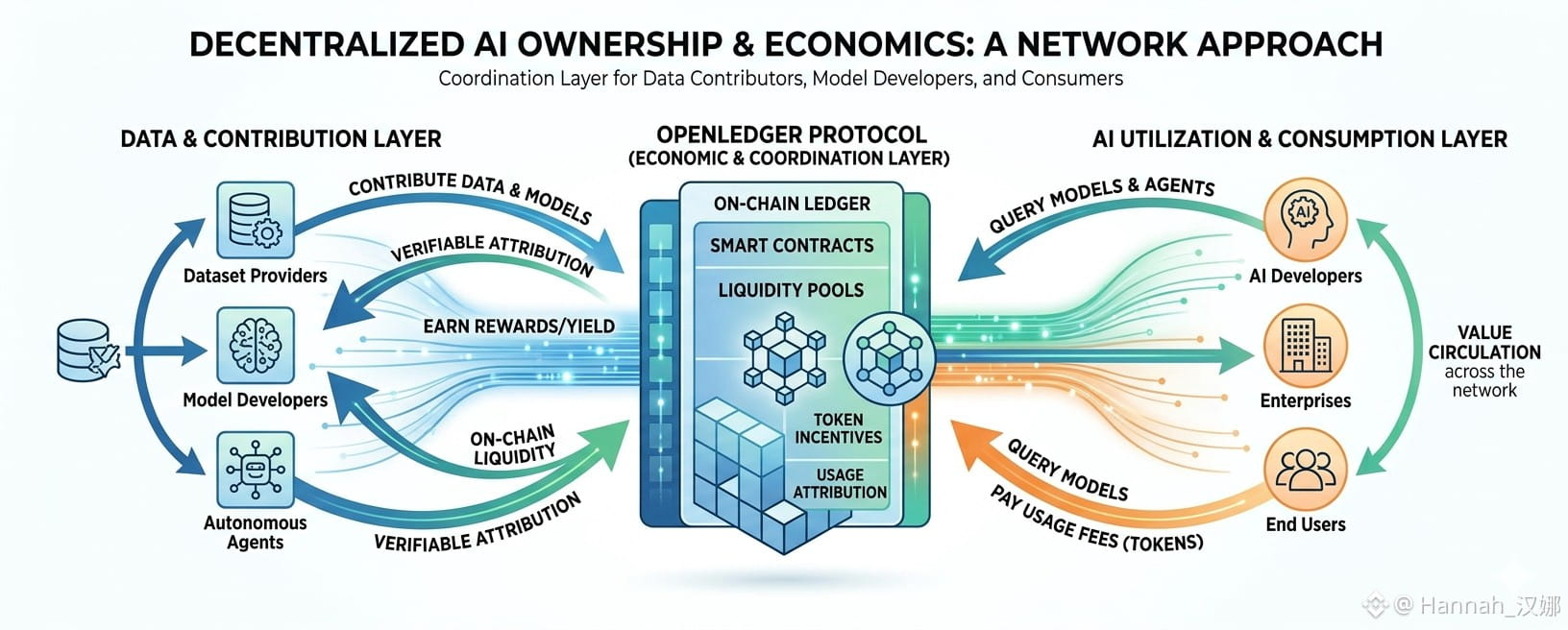
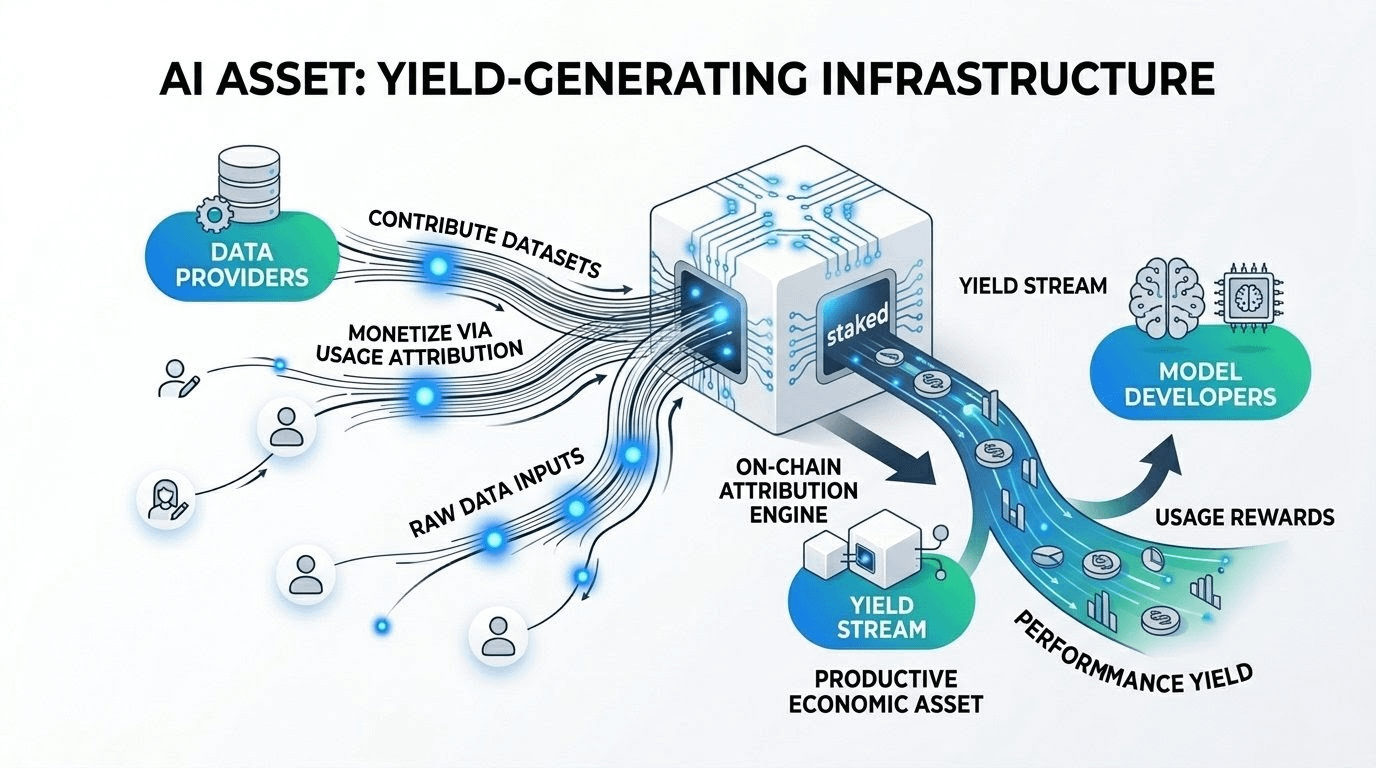
OpenLedger seems to be betting that AI networks eventually need an economic layer where contributors whether they provide datasets, models, or autonomous agents can actually earn from usage in a transparent way. Not through vague reputation systems, but through on-chain liquidity and attribution.
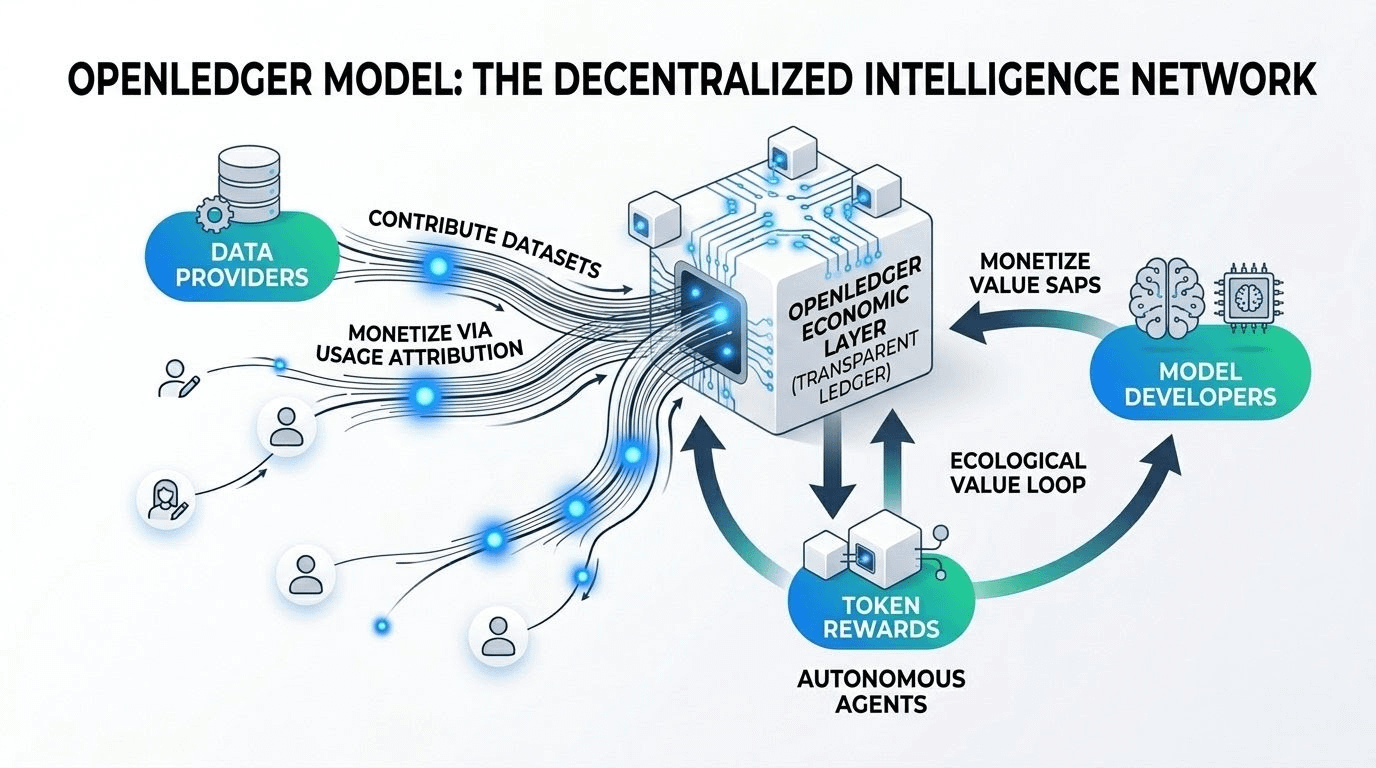
The idea sounds simple when stripped down. Imagine AI models behaving less like isolated APIs owned by giant companies and more like open economic primitives. Data providers contribute information. Developers build models. Agents consume services. Everything leaves a verifiable economic trail. Instead of value accumulating only at the platform layer, it circulates across participants.
That’s the theory anyway.
What caught my attention wasn’t just the concept itself, but the timing. AI narratives inside crypto have mostly lived in extremes so far. Either fully centralized products with real adoption but no crypto alignment, or highly speculative token ecosystems with almost no meaningful AI usage underneath. OpenLedger feels like it’s trying to sit somewhere in the middle close enough to blockchain coordination to benefit from decentralized incentives, but focused enough on AI monetization that the chain itself isn’t the entire story.
And honestly, that balance is hard.
A lot of AI crypto projects end up becoming wrappers around existing infrastructure. Fancy branding over APIs. OpenLedger at least appears aware of that risk. Their emphasis on liquidity for data and models is more interesting than just another “AI Layer 1” slogan because liquidity is ultimately what determines whether networks survive. If contributors can’t monetize effectively, ecosystems dry up. If consumers don’t see clear utility, the token becomes dead weight
From what I’ve seen, OpenLedger’s architecture tries to treat datasets and models almost like productive assets instead of static uploads. Contributors aren’t simply donating information into a black box. There’s an attempt to create ongoing economic participation tied to usage and performance. That changes the psychology a bit. It turns AI contribution from passive sharing into something closer to yield-generating infrastructure.
But this is also where the risks start appearing.
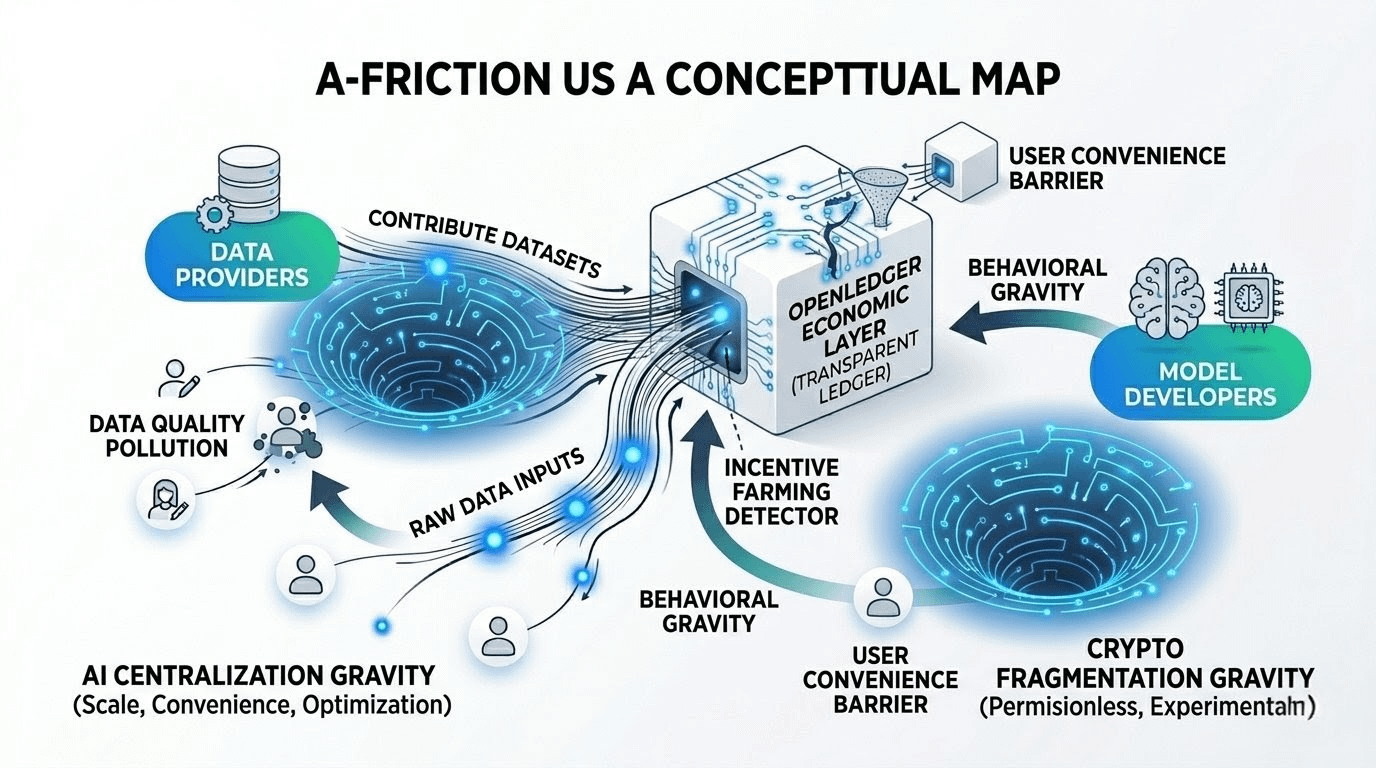
The biggest challenge for projects like this isn’t technology. It’s behavioral gravity.
Developers still overwhelmingly build where tooling is easiest and where users already exist. Enterprises still trust centralized AI providers because reliability matters more than ideology. Most users don’t care whether their AI response came from a decentralized network unless the experience is clearly better or cheaper. Crypto people sometimes underestimate how difficult it is to compete against convenience.
There’s also the issue of data quality. Decentralized contribution sounds great until networks become flooded with low-quality or manipulated inputs chasing token rewards. Incentive systems can attract participation, but they can also attract farming. And AI systems are extremely vulnerable to polluted data environments. If OpenLedger can’t solve that balancing act properly, the entire economic model weakens.
Still, I think the broader direction makes sense.
What crypto has always done well is turning previously invisible coordination into markets. Bitcoin monetized distributed trust. Ethereum monetized blockspace and computation. DeFi monetized liquidity itself. Maybe AI networks eventually need something similar a way to price intelligence inputs transparently instead of relying on closed corporate ecosystems.
And that’s probably the deeper reason OpenLedger exists.
Not because decentralization automatically makes AI better, but because AI is becoming too economically important to remain fully vertically controlled.
The token side of the equation will matter more than people admit too. In these systems, tokens aren’t just speculative assets; they become coordination tools. Rewards, access, governance, contribution incentives it all feeds back into whether the network feels alive or artificially inflated. Right now, the crypto market is ruthless at exposing fake activity. You can usually tell within months whether usage is organic or whether incentives are simply recycling capital between insiders.
That’s another reason I’m watching OpenLedger carefully instead of blindly embracing it. Some of the early momentum feels real. The conversations around decentralized AI ownership are becoming more serious, especially as concerns grow around closed-source model monopolies. But narratives move faster than infrastructure. They always do.
One thing I don’t hear discussed enough is how AI and crypto may actually conflict culturally in the long run. AI trends toward optimization and centralization because scale improves performance. Crypto trends toward fragmentation and permissionless experimentation. OpenLedger is trying to bridge those worlds, but there’s no guarantee they naturally fit together. Sometimes markets force incompatible ideas together simply because both are hot narratives at the same time.
And yet there’s still something compelling about the possibility that future AI systems won’t just be owned by a handful of corporations, but by networks where contributors themselves participate economically in the intelligence they help create.
Maybe that’s the real experiment here.
Not whether OpenLedger becomes the dominant AI blockchain, but whether decentralized ownership of intelligence is even possible once real money, real scale, and real incentives collide.
Because if AI eventually becomes the infrastructure layer beneath everything online, then the question quietly becomes unavoidable: who captures the value of intelligence itself?