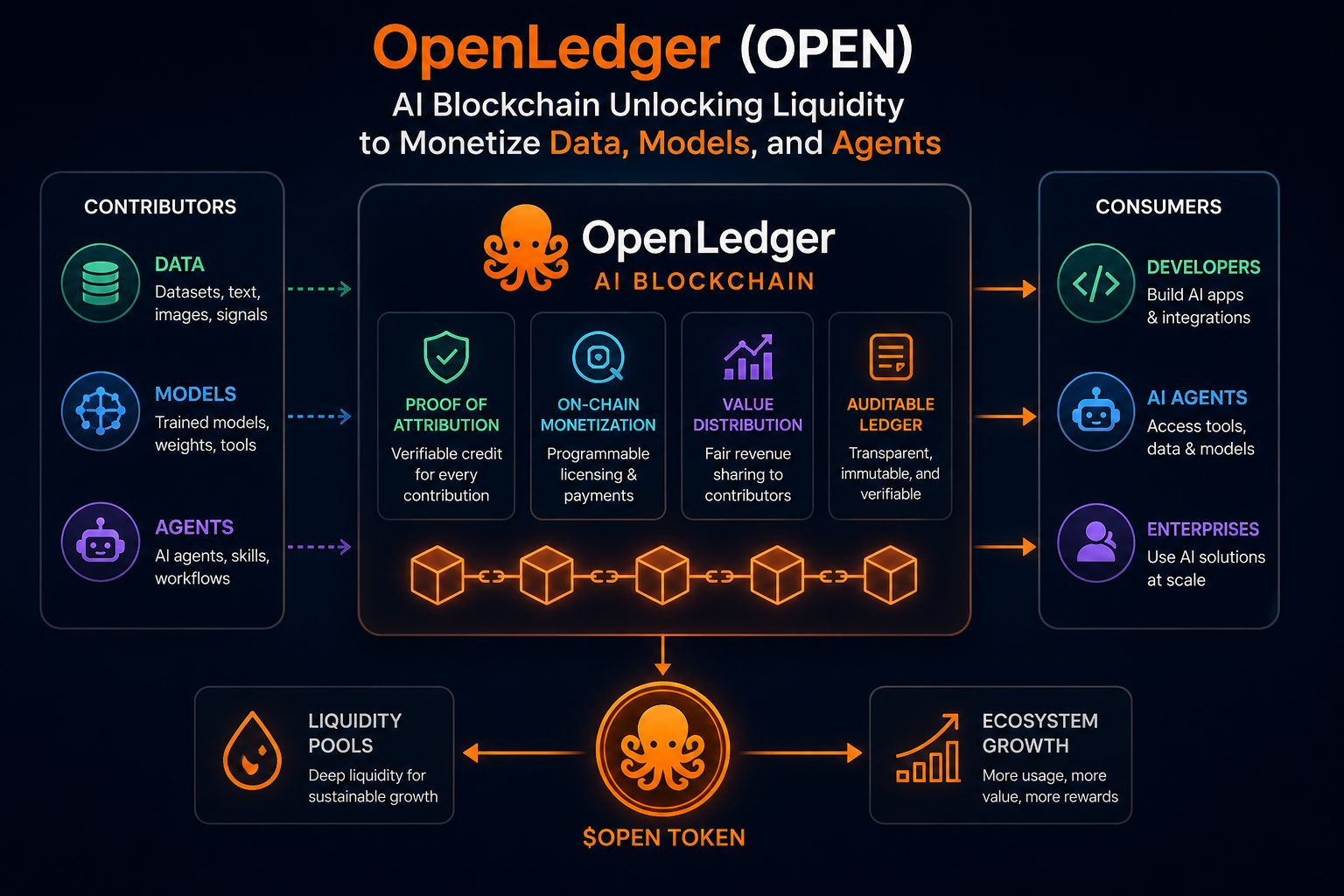
@OpenLedger #OpenLedger $OPEN I keep coming back to OpenLedger because it feels like it’s focused on a part of the AI economy most people still underestimate.
Not model intelligence.
Not benchmarks.
Not who can generate the most impressive output in ten seconds.
Value capture.
That’s where OpenLedger starts to get interesting.
Most AI conversations still orbit around performance. Faster inference. Better reasoning. Bigger models. More agents. But beneath all of that, there’s a quieter infrastructure question sitting underneath the entire market.
Who gets paid when AI creates value?
And more importantly… how?
That question sounds simple until you really follow it through the stack.
A model produces an output, but the model was trained on data. That data came from somewhere. It was labeled by someone, refined by communities, shaped by usage patterns, reinforced through feedback loops, then served through compute owned by someone else. Value gets created across multiple layers, but monetization usually collapses into one endpoint.
That imbalance becomes bigger as AI scales.
OpenLedger feels like an attempt to reorganize that imbalance.
What stands out to me about the OpenLedger AI Blockchain isn’t just that it sits inside decentralized AI. Plenty of projects say that now. It’s that the chain seems built around attribution as an economic primitive.
That changes the conversation.
If attribution becomes verifiable, monetization becomes programmable.
And once monetization becomes programmable, liquidity can move differently across the network.
That’s where Proof of Attribution becomes more than a technical feature.
It becomes market infrastructure.
Because attribution in AI isn’t really about credit. It’s about payment routing.
Who contributed data?
Which model was involved?
Which agent generated downstream value?
What gets rewarded?
What gets ignored?
What gets extracted without compensation?
These are economic coordination questions disguised as technical ones.
I think that’s why OpenLedger feels more structural than narrative-driven.
A lot of AI blockchain projects feel built around excitement. OpenLedger feels built around accounting.
That may sound less glamorous. It probably is.
But infrastructure rarely looks exciting in real time.
Settlement layers aren’t loud.
Ownership rails aren’t loud.
Liquidity plumbing usually isn’t loud until it breaks.
Then everyone notices.
OpenLedger seems to understand that future AI markets won’t just need better intelligence. They’ll need better ledgers for tracking where intelligence came from and where the value should flow afterward.
That matters because AI data monetization still feels unresolved across the industry.
Data creators want compensation.
Model builders want access.
Developers want low friction.
Users want better outputs.
Agents want execution environments.
Investors want scalable monetization.
These incentives don’t naturally align.
They collide.
And most of the pressure leaks somewhere in the middle.
That’s where decentralized AI becomes harder than it sounds.
Not because the technology is impossible.
Because incentive coordination is difficult.
Really difficult.
The OpenLedger token becomes interesting inside that context because it’s tied less to abstract network usage and more to economic participation across attribution and value exchange.
That doesn’t guarantee durable token demand, obviously. No token structure gets a free pass from market behavior.
Speculation still shows up first.
Liquidity still moves faster than utility.
Narratives still front-run adoption.
Crypto hasn’t changed that.
But over longer cycles, tokens tend to reveal whether they are actually attached to useful behavior or just circulating around attention.
That’s the harder test.
And it takes time.
For OpenLedger, adoption friction probably won’t come from whether people understand AI.
It’ll come from whether contributors trust attribution.
Whether developers integrate it.
Whether monetization feels worth the overhead.
Whether participants believe the payout logic is fair.
Because fairness in decentralized systems isn’t just mathematical.
It’s emotional.
People stay in networks where value distribution feels legitimate.
They leave when extraction feels one-sided.
That applies to blockchains.
It applies to AI.
It applies to internet communities generally.
OpenLedger sits right at that intersection.
Which is why I don’t think of it simply as an AI blockchain project.
I think of it more as economic infrastructure for machine-generated value.
A coordination layer between data, models, agents, and capital.
That framing feels more accurate.
And honestly more useful.
Because if AI agents crypto becomes real at scale, the market won’t only need intelligent agents.
It will need payment rails between those agents.
It will need ownership logic.
Licensing logic.
Attribution logic.
Revenue-sharing logic.
Liquidity routing.
Settlement.
Verification.
The invisible financial layer underneath machine interaction.
That’s where OpenLedger becomes worth watching.
Not because it promises the smartest AI.
But because it’s asking what happens after intelligence creates value.
That’s a much more durable question.
And maybe the more important one.
Crypto has spent years building systems to move money without intermediaries.
AI is now building systems that create value without human labor in the loop at every step.
OpenLedger sits where those two curves collide.
And that collision may end up defining more of the next cycle than people currently realize.
Because the next AI economy probably won’t be won purely by whoever builds the best model.
It may be shaped by whoever builds the cleanest market around the value those models produce