
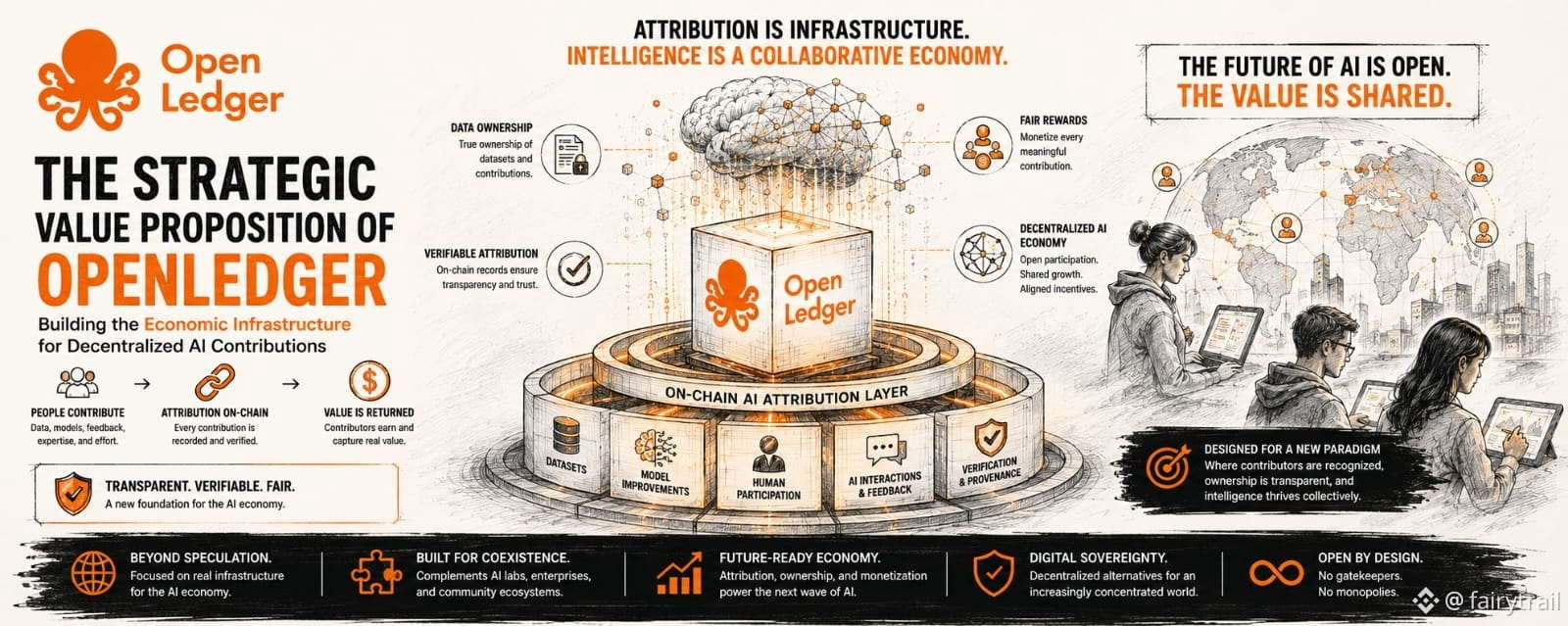
Most AI discussions in crypto still revolve around speculation, compute demand, or the race to build the next large model. Yet one of the most important questions remains surprisingly underexplored: who actually owns the intelligence layer of the future internet?
That question is precisely where OpenLedger begins to stand out.
While many blockchain-AI projects focus on marketplaces, inference networks, or token incentives alone, OpenLedger is positioning itself around a deeper infrastructure thesis — creating an economic coordination layer for decentralized AI contributions. In simple terms, the project is attempting to build a system where datasets, model improvements, and AI participation can be transparently attributed, owned, and monetized on-chain.
This may sound abstract at first, but it directly connects to one of the largest structural problems emerging in modern AI.
Today’s AI ecosystem is heavily dependent on massive datasets and continuous user interaction. However, the people contributing value — whether through data generation, labeling, fine-tuning, or behavioral feedback — rarely receive ownership or long-term economic upside. The dominant AI platforms accumulate both the models and the data network effects, while contributors remain invisible.
OpenLedger introduces an alternative framework.
Instead of treating AI as a closed corporate asset, OpenLedger appears to view intelligence as a collaborative economic system where contributors should be traceable and rewarded. This creates a potentially important shift from centralized AI platforms toward what could become an “AI contribution economy.”
The strategic significance of this idea is larger than many realize.
In traditional Web2 AI systems, attribution is weak. Data sources become blurred, model training pipelines are opaque, and economic value concentrates around a few infrastructure providers. As AI adoption accelerates globally, this imbalance may become increasingly difficult to sustain — especially as creators, developers, and communities begin demanding clearer ownership structures.
OpenLedger’s architecture is attempting to solve that coordination problem through blockchain primitives.
By anchoring attribution and participation records on-chain, the network could enable verifiable contribution histories for datasets, AI outputs, and model development. This matters because future AI systems may rely less on static datasets and more on continuous streams of human interaction and refinement.
In that environment, attribution becomes infrastructure.
One underrated narrative around OpenLedger is that the project is not simply competing within crypto. It is positioning itself within the future operational stack of AI itself. Most investors still evaluate AI projects through short-term token narratives, but OpenLedger’s relevance may ultimately depend on whether decentralized coordination becomes necessary for scalable AI ecosystems.
That distinction is important.
The AI industry is already facing growing pressure around data provenance, copyright disputes, synthetic content, and model transparency. Governments, enterprises, and users increasingly want to understand where training data originates and who benefits economically from it. OpenLedger’s focus on transparent contribution mapping directly intersects with these concerns.
In many ways, the project resembles an attempt to build “economic middleware” for AI networks.
Another underappreciated aspect is the monetization layer behind AI participation.
Most users currently interact with AI systems passively. They generate prompts, behavioral data, corrections, and contextual information that improve models over time, yet receive no measurable ownership exposure. OpenLedger introduces the possibility that AI interactions themselves could become economically recognized activities.
If successful, this could reshape how digital labor is perceived in AI economies.
The long-term implication is significant because AI development may increasingly depend on decentralized participation rather than isolated corporate training pipelines. Smaller specialized datasets, niche domain expertise, and localized AI refinement are becoming more valuable as the market matures. Large foundational models alone are no longer the entire story.
This creates room for decentralized contribution networks.
OpenLedger’s positioning also aligns with a broader infrastructure trend happening across crypto. The market is gradually moving beyond purely financial applications toward coordination systems for real-world digital activity. Stablecoins addressed internet-native money transfer. DePIN networks target physical infrastructure coordination. OpenLedger is approaching AI coordination from a similar perspective.
That narrative may prove more durable than short-lived speculative cycles.
Importantly, OpenLedger’s relevance does not depend on replacing centralized AI companies entirely. A more realistic scenario is coexistence. Large AI labs may continue dominating frontier model research, while decentralized infrastructure layers emerge around attribution, verification, monetization, and specialized community-driven datasets.
This hybrid future is where OpenLedger could become strategically valuable.
There is also a geopolitical dimension that few people are discussing yet.
AI is rapidly becoming a concentration industry controlled by a small number of corporations and cloud providers. Decentralized attribution systems could eventually become attractive not only to crypto-native communities but also to regions, developers, and enterprises seeking alternatives to centralized AI dependency.
In that sense, OpenLedger is participating in a much larger conversation about digital sovereignty.
Of course, execution risk remains substantial.
Building decentralized AI infrastructure is significantly harder than launching a conventional blockchain application. The project must solve incentive alignment, scalability, data verification, contributor quality control, and real-world adoption simultaneously. Many AI-crypto projects struggle because they prioritize narrative before utility.
OpenLedger will ultimately be judged by whether it can create sustainable participation loops that generate authentic network effects rather than temporary speculation.
Still, the strategic direction appears increasingly relevant.
As AI systems become integrated into everyday digital life, the ownership structure behind intelligence may become one of the defining questions of the next decade. Projects focused purely on compute or token mechanics may overlook the deeper economic layer emerging underneath AI itself.
OpenLedger’s core proposition is that intelligence should not only be generated collaboratively, but also owned collaboratively.
That idea may sound ambitious today, but many foundational internet infrastructures once did.
Whether OpenLedger becomes a dominant player or simply influences the broader direction of decentralized AI, its thesis touches a critical shift already beginning to unfold: the transition from centralized AI platforms toward programmable, participatory AI economies where contribution, attribution, and ownership become inseparable.
And if that transition accelerates over the coming years, OpenLedger may prove to be less of a speculative narrative and more of an early blueprint for how the economics of AI eventually evolve.
$OPEN @OpenLedger #OpenLedger $ALLO $LAB
