
A protocol launches a points campaign, wallets flood in, dashboards light up, volume explodes, and suddenly everyone starts talking about “adoption” as if incentives and utility are the same thing. But most of the time, the activity isn’t actually proving the product works. It is proving that users will optimize around rewards.
That distinction is becoming impossible to ignore as AI and Web3 start colliding.
For the longest time, crypto protocols measured success using the easiest visible metric: volume. More transactions meant more traction. More wallets meant more growth. But as farming culture matured, those numbers became increasingly distorted. Entire ecosystems learned how to manufacture activity through emissions, rebates, points systems, and speculative future airdrops. In many cases, what looked like adoption was really just temporary economic gravity created by incentives.
The more interesting question now is not “how much activity exists?”
It is:
What survives when nobody is being paid to participate?
That is where projects like OpenLedger start becoming genuinely interesting.
Not because they promise another AI narrative.
Not because “data is the new oil.”
And not because they attach tokens to every interaction.
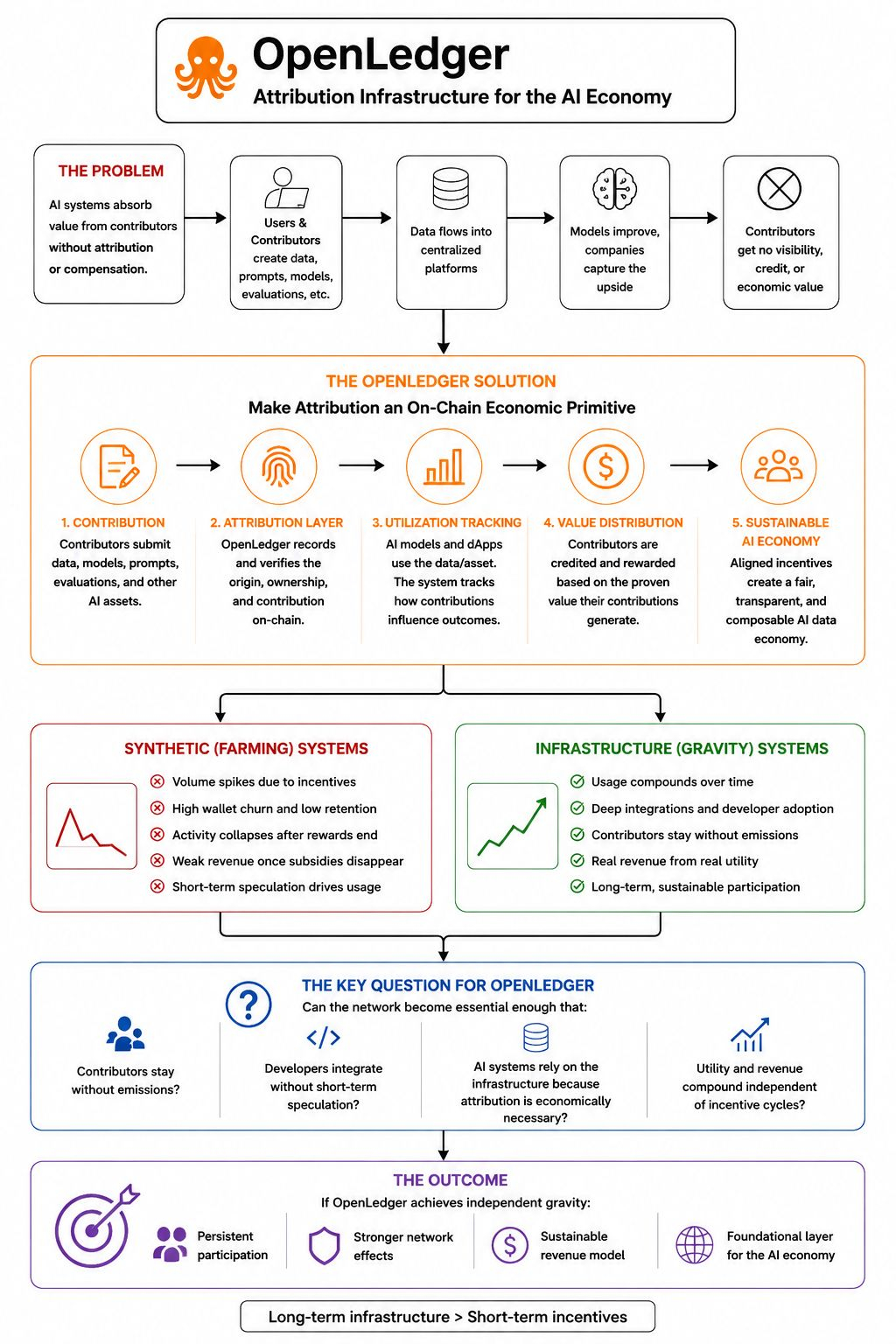
But because the project seems to be aiming at a much deeper structural problem: attribution.
Most AI systems today operate like giant black holes for value.
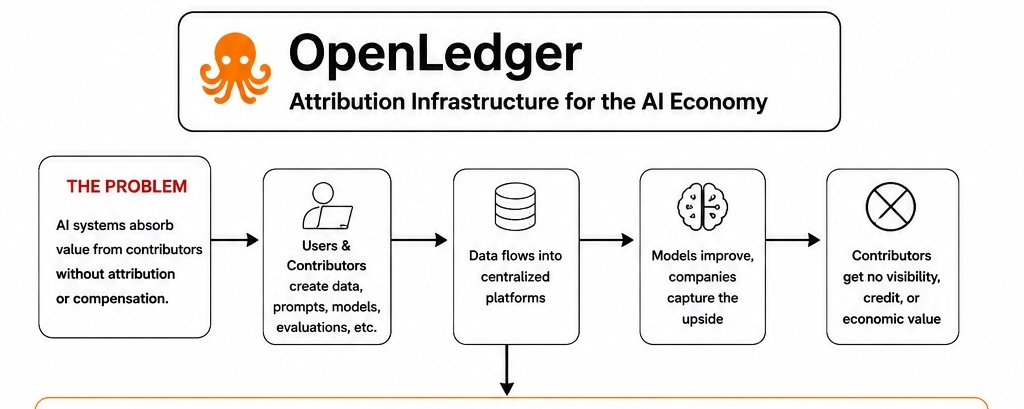
People create prompts, datasets, code, conversations, images, evaluations, rankings, and behavioral signals constantly, yet almost none of that contribution is traceable in a meaningful economic way. Data enters centralized systems, models improve, corporations capture the upside, and contributors disappear from the equation entirely.
The entire internet has effectively become unpaid training infrastructure.
OpenLedger’s thesis appears to challenge that architecture directly.
Instead of treating data as something platforms quietly absorb, the protocol frames contribution itself as an on-chain economic primitive. The important shift here is subtle but massive: attribution is no longer external to the system it becomes part of the infrastructure layer itself.
That changes how you evaluate adoption.
With most farming-heavy crypto systems, activity spikes because users are trying to maximize emissions before rewards collapse. Once incentives decay, volume evaporates because the underlying product never created independent gravity.
But attribution networks operate differently.
If a protocol can reliably prove:
who contributed data,
how valuable that contribution became,
and how downstream AI outputs were influenced,
then participation stops being pure speculation and starts becoming economically rational infrastructure.
That is the key difference.
A points campaign can manufacture temporary activity.
But attribution infrastructure can create persistent participation because contributors now have an actual reason to remain inside the system long term.
The real test is whether that participation survives without constant token emissions.
And honestly, that’s the question every AI-Web3 protocol is now being forced to answer.
Because the market is starting to separate two very different categories of projects:
The first category creates synthetic engagement loops.
The second category creates systems users genuinely depend on.
Synthetic systems usually share the same characteristics:
massive spikes during incentives,
rapid wallet churn,
low post-airdrop retention,
and weak revenue once subsidies disappear.
Infrastructure systems look different.
Usage compounds more slowly, but integrations deepen over time. Developers keep building. Data contributors remain active because economic alignment continues after hype cycles fade. The network becomes harder to replace not because rewards are large, but because utility becomes embedded into workflows.
That is the benchmark #OpenLedgar ultimately has to reach.
Right now, much of the AI x crypto sector still operates in a highly speculative phase where narratives move faster than production-grade utility. Many protocols promise decentralized AI economies, but relatively few have demonstrated sustainable data attribution markets at scale.
So the real question is not whether people are excited about AI.
The real question is whether @OpenLedger can create independent gravity.
Can the network become useful enough that:
contributors stay without emissions,
developers integrate without short-term speculation,
and AI systems rely on the infrastructure because attribution itself becomes economically necessary?
If that happens, the protocol stops behaving like a farming economy and starts behaving like foundational infrastructure.
And that distinction matters more than almost any short-term metric.
Because sustainable crypto systems are rarely the loudest during incentive cycles.
Usually, they are the ones still being used long after the rewards stop.