
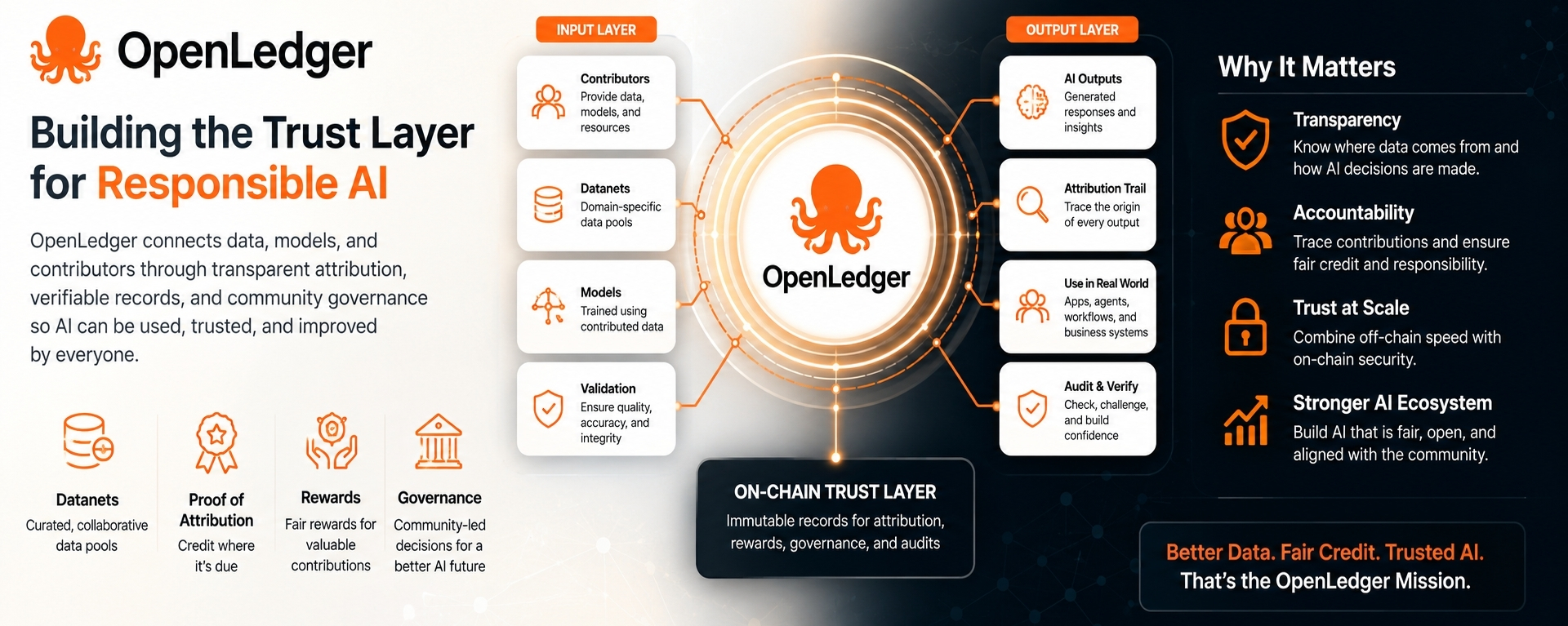

OpenLedger is one of the few AI projects I'm watching for a reason that has nothing to do with making models smarter. What interests me is whether it can make AI more accountable. We already have plenty of systems competing on speed, reasoning, and output quality. The bigger question is what happens when someone asks where an answer came from.
That's where OpenLedger stands out to me.
Most AI tools today work like a black box. You ask a question, get a response, and move on. The answer looks clean, but the path behind it is usually invisible. You rarely know what data influenced it, which model version was used, or who contributed the information that shaped the result.
OpenLedger is trying to tackle that missing layer.
Through its Datanets and Proof of Attribution system, the project is focused on tracking the journey behind AI outputs. Who supplied the data. Which datasets influenced the model. Who should receive credit. And whether that information can still be verified later.
These may not sound like exciting problems, but they become important when AI starts making decisions that affect businesses, finances, research, logistics, creator rewards, and automated systems.
A strong answer is useful. A verifiable answer is even more valuable.
What makes OpenLedger interesting is that it treats trust as infrastructure rather than an afterthought. Instead of asking users to blindly trust a platform, it aims to create records that can be reviewed, audited, and challenged when necessary.
That matters because AI mistakes rarely begin at the final output. Problems often start much earlier with weak data, outdated information, biased inputs, or poor assumptions hidden inside the training process. By the time a response reaches the user, that history is usually gone.
OpenLedger is trying to keep that history visible.
Its approach also recognizes that not everything can happen on-chain. Real-time actions need speed, while attribution, governance, rewards, and verification need permanence. The project attempts to balance both sides by keeping execution practical while giving accountability a stronger foundation.
Of course, the idea alone is not enough.
The quality of the data matters. Governance must remain effective. Rewards need to encourage valuable contributions instead of noise. Attribution has to be accurate. And the system cannot become so complex that builders and users avoid it.
Those are difficult challenges, and execution will ultimately decide whether the vision succeeds.
But the reason I keep watching OpenLedger is simple.
The AI industry spends a lot of time talking about intelligence. OpenLedger is spending time on accountability.
As AI becomes part of real-world workflows, the question won't only be whether an answer is correct. People will want to know why it was generated, what influenced it, and whether the process can be trusted.
That's the layer OpenLedger is trying to build.
Not the answer itself, but the record behind it.
And if AI continues moving deeper into everyday systems, that record may end up being just as important as the intelligence that produced it.