
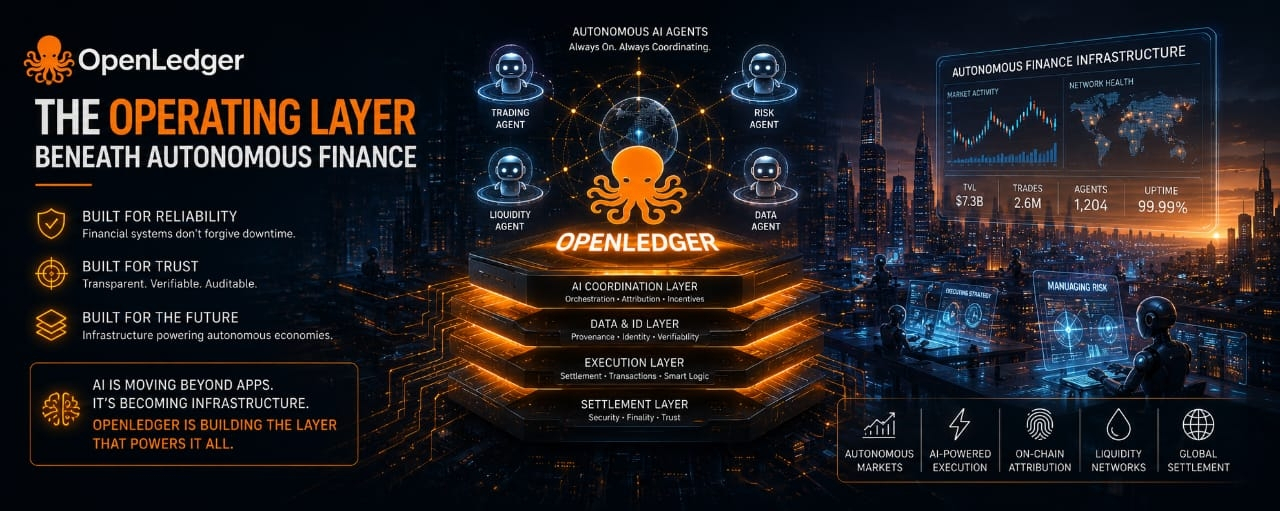
The more I watch the AI sector evolve, the more it feels like most people are still analyzing it from the wrong angle.
Everyone is focused on the visible side of AI right now — chat interfaces, content generation, assistants, automation tools, image models, productivity upgrades. The entire discussion still revolves around what AI can do for users directly in front of a screen.
But what keeps standing out to me about OpenLedger is that the project feels pointed toward something much heavier operating underneath the surface.
The infrastructure direction around it doesn’t really resemble social technology anymore. It looks closer to financial infrastructure mixed with autonomous operational systems.
That distinction matters more than people realize.
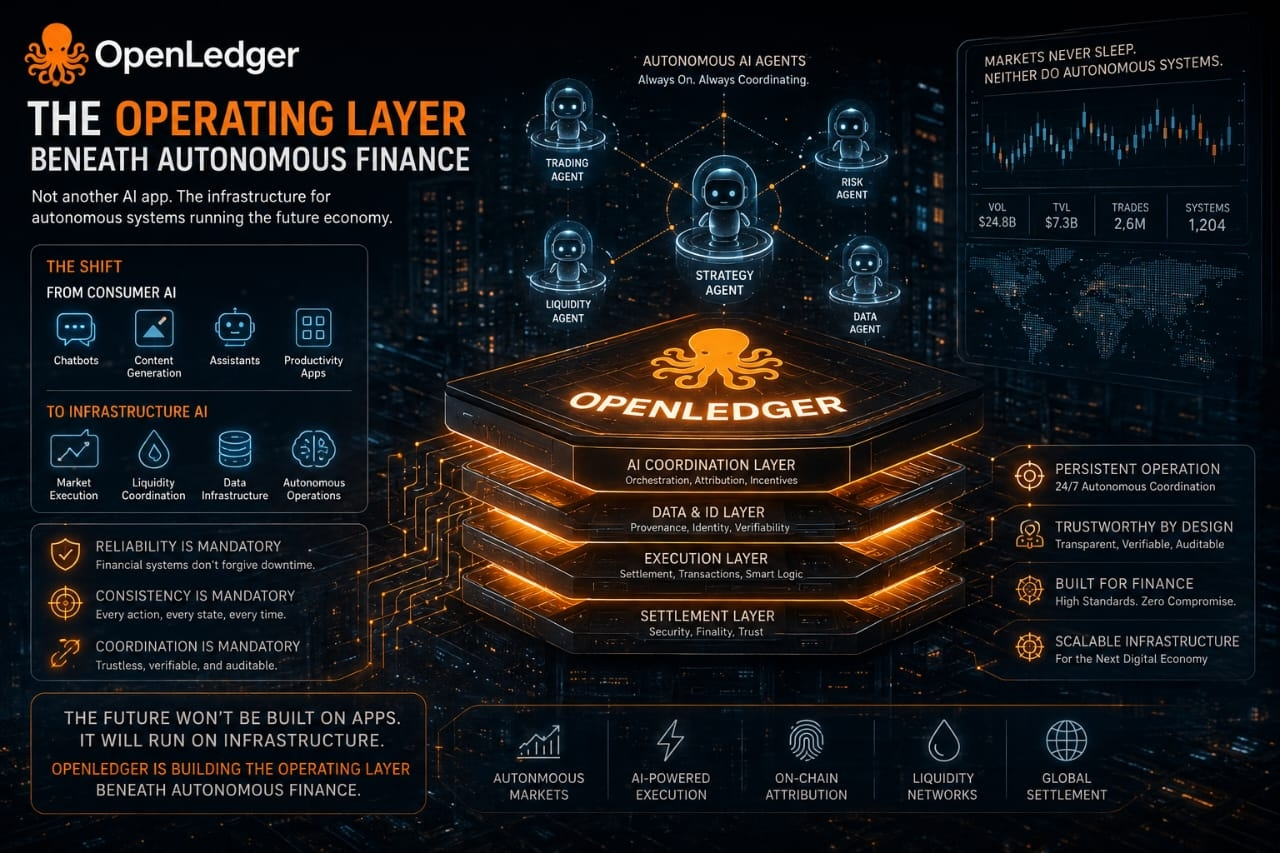
Consumer applications can survive instability. A social app glitches for ten minutes, timelines freeze, notifications stop working, and everyone forgets about it by next week. The standards inside financial environments are completely different. Systems handling execution, liquidity movement, trading coordination, attribution tracking, or autonomous AI operations do not get judged casually. Reliability becomes mandatory. Consistency becomes mandatory. Coordination quality becomes mandatory.
And once AI starts entering those environments, the expectations around it change completely too.
At that point AI is no longer just acting like a feature layered on top of an app. It starts becoming part of the operational framework underneath entire digital economies.
That’s the direction I keep seeing when I look deeper into OpenLedger.
The project seems aligned with a future where autonomous systems continuously interact with markets, data flows, infrastructure layers, and execution environments in real time without depending on constant human supervision. Not temporary interaction. Persistent operation.
That creates a completely different requirement set compared to the current AI narrative dominating social media.
People still debate which chatbot sounds smartest or generates the best replies. Meanwhile the more important race may quietly be shifting toward which networks can support trustworthy AI coordination at infrastructure scale.
And honestly, I don’t think the broader market fully understands how big that transition could become yet.
Because once AI starts integrating directly into financial and operational systems instead of just consumer-facing tools, the conversation stops being about convenience and starts becoming about infrastructure resilience itself.
That’s why projects like OPEN keep becoming more interesting to me over time.
The shift already feels like it started quietly in the background while most people are still focused on the surface layer of AI adoption.