
I’m watching OpenLedger the way I watch most things in crypto now, slowly, without rushing to decide what it is. Maybe that comes from seeing too many projects arrive looking polished and complete, only to fall apart once real usage exposed the parts nobody wanted to talk about. At some point you stop listening to the confident language and start paying attention to where the friction still lives underneath. That’s usually where the truth is hiding.
What keeps my attention here isn’t really the AI angle by itself or even the blockchain side of it. It’s the quieter problem sitting underneath both of them. Data moves everywhere now. Models borrow from other models. Agents interact with systems that are already interacting with other systems. Information keeps passing through layers until nobody can clearly say where something started, who shaped it, or who should benefit from it. Everything becomes blurred together. And somehow we’re expected to trust that the infrastructure will sort it out later.
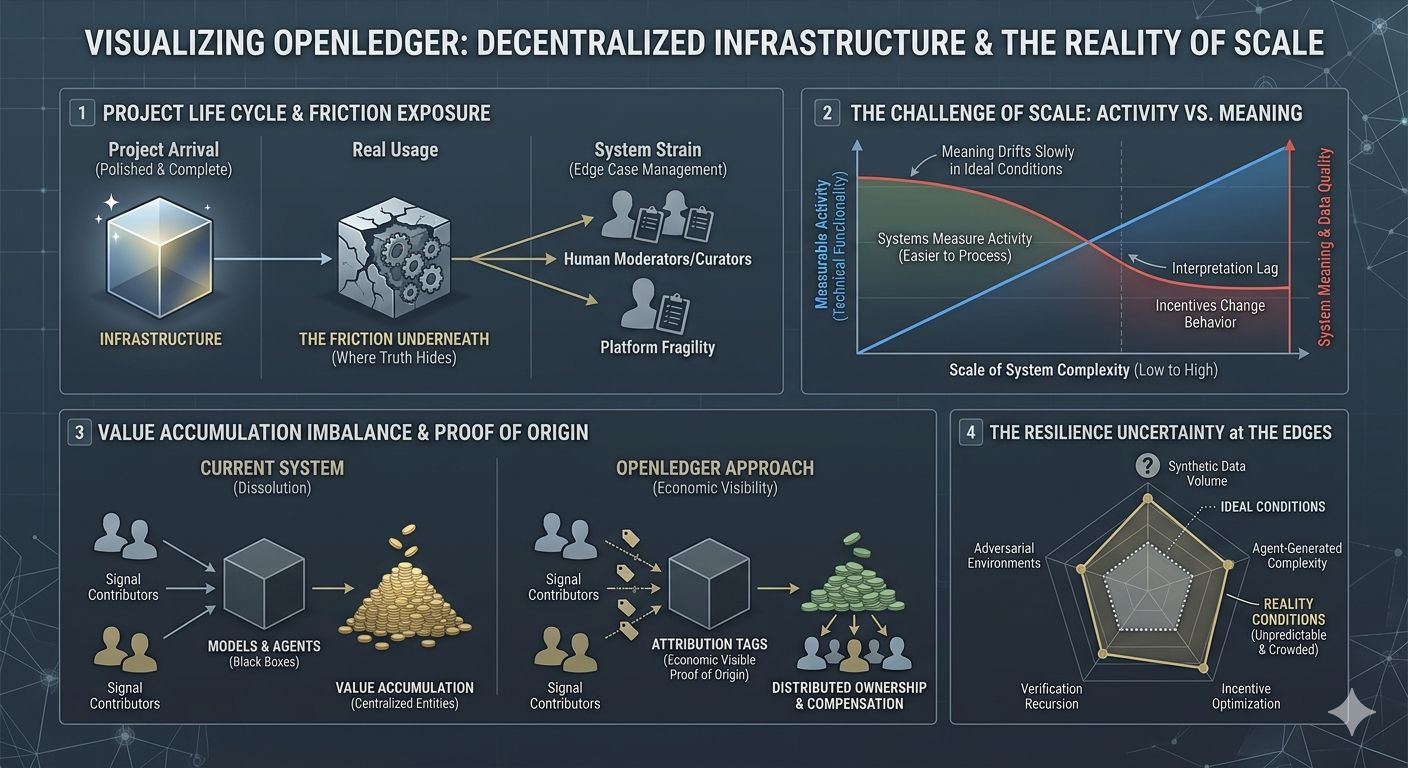
I’ve seen how fragile that trust becomes once money enters the picture. On paper most systems look clean. Contribution gets tracked. Activity gets verified. Rewards get distributed. But real environments are never that neat. The moment scale increases, meaning starts slipping between layers. People step back into processes that were supposed to be automated. Someone has to interpret edge cases. Someone decides what counts as valuable. Someone decides which proof matters and which proof gets ignored. That human layer never really disappears no matter how decentralized a system claims to be.
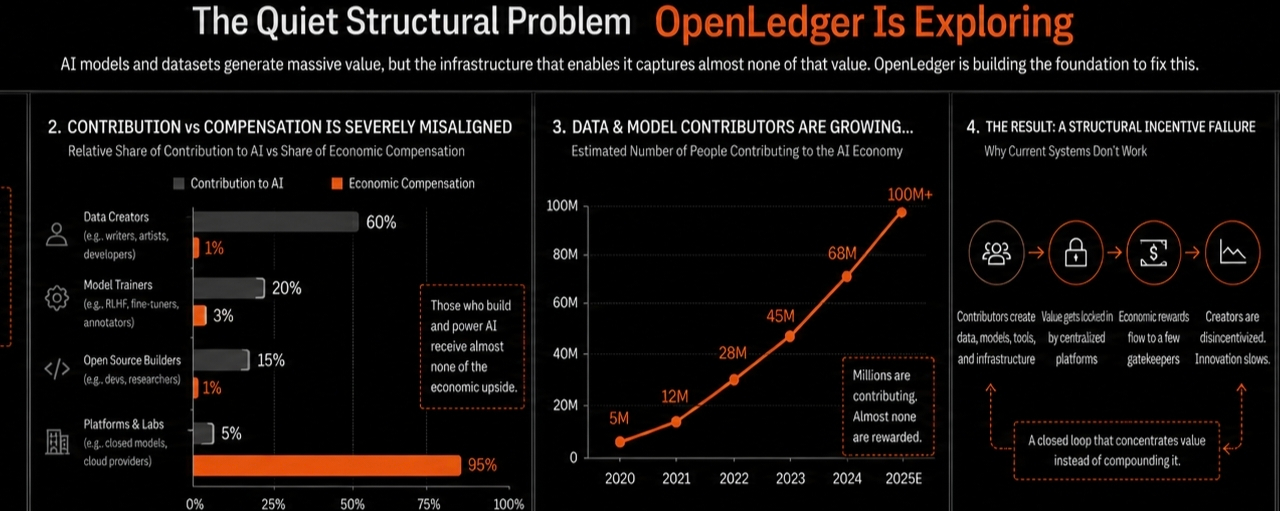
OpenLedger feels like it’s trying to solve part of that problem by keeping proof attached to origin, by making data, models, and agents economically visible instead of letting them disappear into black boxes. I understand why that matters. Right now most people contributing useful signal into AI systems barely see any ownership from what gets built on top of their work. Their input dissolves into infrastructure and the value accumulates somewhere else entirely. That imbalance keeps growing while everyone pretends it’s temporary.
Still, I can’t fully tell whether systems like this can stay stable once conditions stop being ideal. That’s the part I keep thinking about. Crypto has a long history of building structures that function beautifully in controlled conditions and then slowly strain once complexity arrives for real. Not because the ideas are bad, but because incentives change behavior faster than architecture can adapt to it. People optimize around reward systems. Agents optimize around reward systems too. Eventually platforms start measuring activity instead of meaning because activity is easier to process at scale.
That’s where things usually begin feeling hollow even when the numbers still look strong. Data quality drifts slowly. Attribution becomes recursive. Verification layers depend on other verification layers. Systems keep functioning technically while trust quietly becomes social again behind the scenes. You see moderators appear. Curators appear. Unofficial authorities emerge even inside systems designed to remove them. It happens over and over because interpretation can’t be fully automated out of existence.
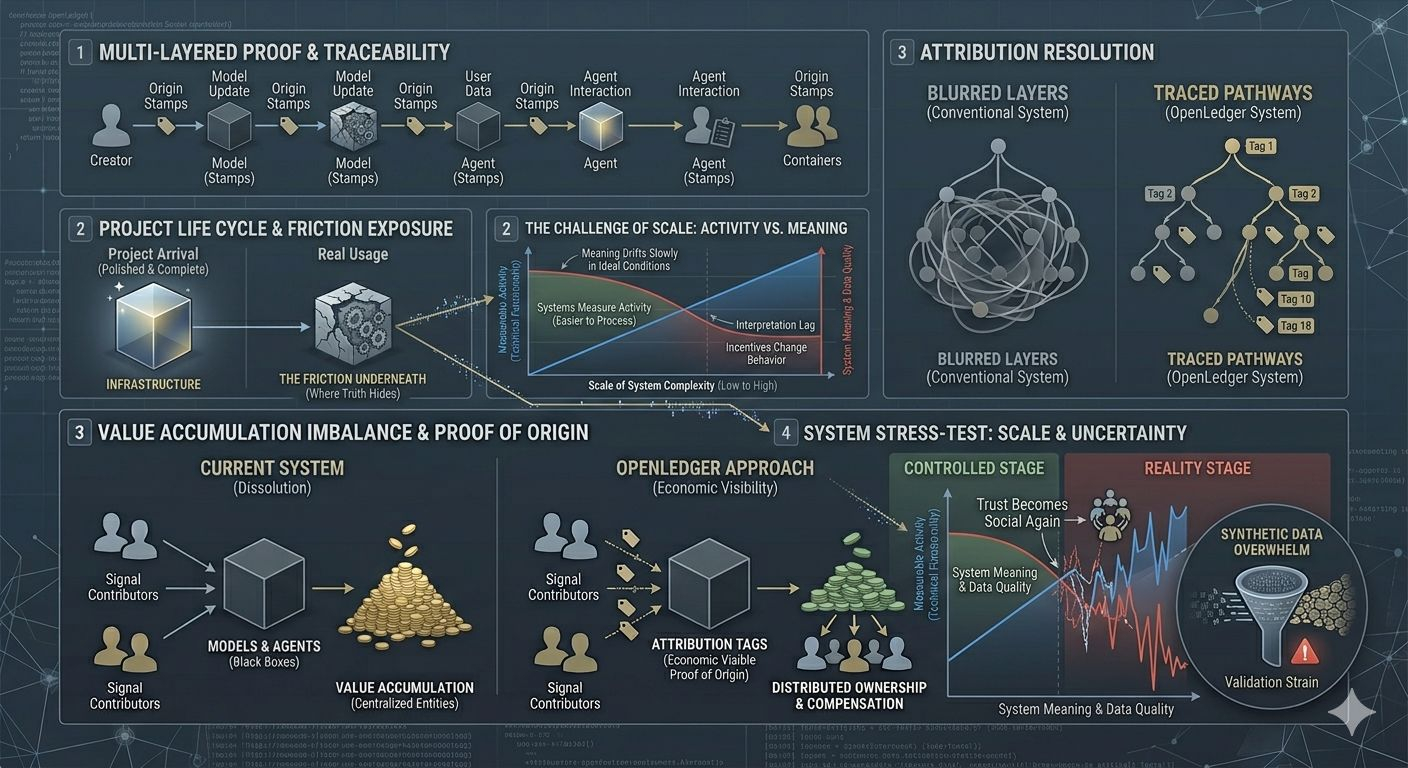
And maybe that’s why I keep approaching OpenLedger carefully instead of dismissing it or believing in it too quickly. It feels aware of a real fracture forming between AI infrastructure and ownership, between contribution and compensation, between machine output and accountability. That alone makes it more interesting than projects chasing speed or attention without understanding what’s actually breaking underneath modern systems. But awareness is different from resilience. A project can understand the problem deeply and still struggle once the environment around it becomes crowded, adversarial, and unpredictable.
I keep wondering what happens at the edges of all this. What happens when synthetic data overwhelms systems faster than validation can keep up. What happens when agents start generating layers of interaction nobody fully traces anymore. What happens when attribution itself becomes manipulated because proving origin carries economic weight. Those questions don’t disappear just because the infrastructure becomes more advanced. Sometimes advanced infrastructure simply hides the strain longer before it surfaces.
So for now I’m still watching OpenLedger in that quiet way you watch something that might either grow into necessary infrastructure or slowly collapse under the same complexity it was trying to organize. It’s hard to tell yet. The surface still looks controlled. Most systems do before reality fully reaches them. And maybe that uncertainty is the only honest place to stand right now while everything around AI, ownership, and decentralized coordination keeps moving faster than anyone can confidently explain.