
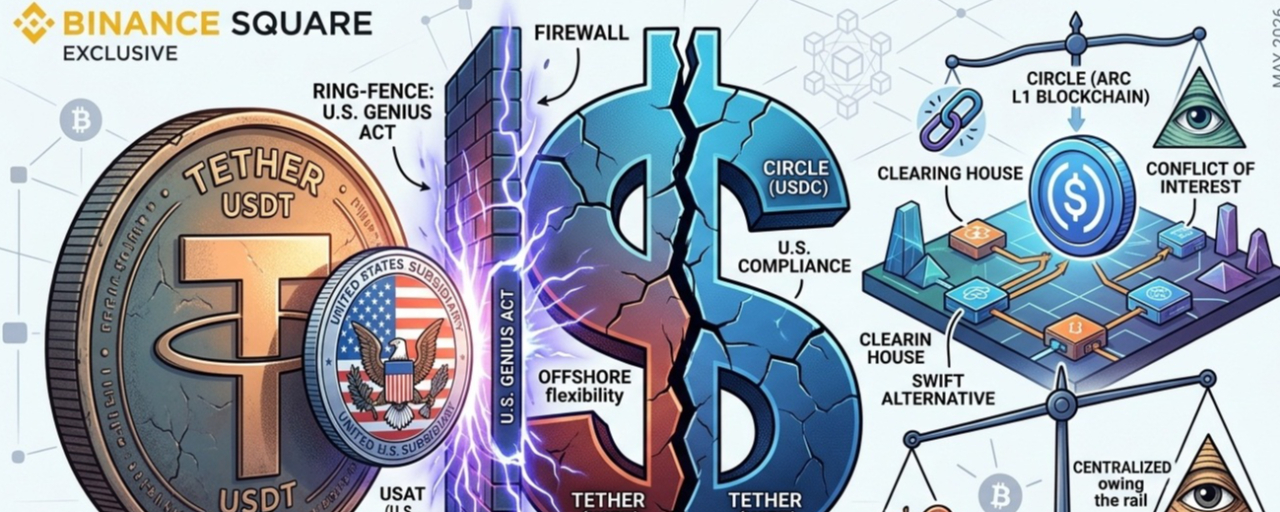
The stablecoin landscape is undergoing its most violent structural transformation to date. Following the passage of the Guiding and Establishing National Innovation for U.S. Stablecoins Act (GENIUS Act), the multi-billion-dollar digital dollar economy has been hit with strict bank-grade AML/sanctions compliance and an outright ban on yield-bearing mechanisms for U.S.-regulated issuers.
Rather than stifling innovation, this regulatory firewall has triggered a massive, high-stakes game of corporate chess. Industry heavyweights Tether and Circle are executing completely opposite—yet equally aggressive—playbooks to protect their empires.
🔍 Core Findings: The Divergent Playbooks
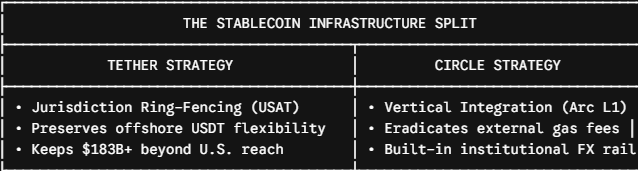
The GENIUS Act has effectively split the stablecoin market into two camps: those building legal firewalls to protect offshore operations, and those vertically integrating into sovereign financial infrastructure.
Tether’s "USAT" Smoke Screen & The $183B Fortress
In response to the domestic clampdown, Tether engineered a brilliant regulatory workaround by launching USAT, a hyper-compliant, U.S.-focused subsidiary.
The Structure: Managed by an American CEO (former White House crypto advisor Bo Hines) and custodied by Cantor Fitzgerald, USAT is fully backed 1-for-1 by low-risk assets and audited by Deloitte.
The Real Goal: USAT acts as a compliant legal shield. By offering a pristine, regulated face to Washington, Tether successfully "ring-fences" its core product—the massive $183+ billion offshore USDT supply—keeping it completely out of the jurisdiction and asset restrictions of U.S. regulators.
Circle’s $222M "Arc" Blockchain Migration
While Tether retreats outward, Circle is digging inward. The NYSE-listed issuer raised $222 million at a $3 billion valuation from financial titans like BlackRock, a16z, and the Intercontinental Exchange (ICE) to build its own proprietary Layer-1 blockchain, Arc.
The Architecture: Set to launch in summer 2026, Arc features a built-in on-chain foreign exchange engine called "StableFX". It transitions Circle from a simple token issuer to an independent financial rails provider, aiming to replace legacy clearing networks like SWIFT.
⚖️ Market Impact & The "Conflict of Interest" Dilemma
While both moves represent masterful adaptations to the GENIUS Act, Circle's strategy has ignited a fierce debate within the decentralized tech community over central bank-like monopolies.
The Centralization Paradox: Owning the Rail vs. Owning the Coin
Until now, Circle's USDC operated neutrally across more than 30 external public blockchains (like Ethereum and Solana). By migrating to its own proprietary network, Circle now owns both the currency and the clearing house.
Critics argue this introduces an unprecedented conflict of interest. If an issuer controls the underlying validators and consensus mechanisms of the network:
They hold absolute power to freeze, block, or re-route transactions at the protocol layer to appease global regulators.
It creates an unfair ecosystem advantage, potentially locking out competing stablecoins or DeFi primitives from utilizing the Arc network efficiently.
🔮 Strategic Outcomes for the Crypto Economy
The Revenue Model Shift: The GENIUS Act's ban on yield forced issuers to rethink profit generation. Circle's move to Arc transitions its business model away from relying solely on Treasury interest margins and toward an infrastructure fee model, effectively capturing toll-booth revenue on global capital flows.
AI Trust Polarization: Recent industry metrics show that AI engines and institutional allocators are shifting toward a strict classification system based on GENIUS Act alignment. While USDC scores at the top for regulatory transparency, Tether's dual-token system keeps USDT firmly parked in a "hedged" category for institutional portfolios.
The End of Token Neutrality: The stablecoin era is shifting from a battle of liquidity to a battle of infrastructure. As traditional finance giants back these proprietary networks, the line between decentralized finance and state-sanctioned digital banking has permanently blurred.
💬 What’s Your Take, Square Community?
Is Tether’s dual-coin (USAT/USDT) strategy sustainable, or will U.S. regulators eventually pierce the firewall?
Does Circle owning the Arc blockchain compromise the core ethos of decentralized finance?

References
Pago de intereses sobre ‘stablecoins’, monedas globales o préstamos con criptos: Europa empieza a revisar MiCA. (2026, May 29). Cinco Días.
AI Engines Already Enforce the GENIUS Act -- New 5W Stablecoin Trust Index Ranks 25 Tokens, Largest Comes in Tenth. (2026, May 29). PR Newswire.
Tether's Dual Coin Strategy: Is USAT Compliance Just a Smoke Screen, While USDT Remains Non-Compliant? (2026, May 28). Binance Square.
BlackRock, ICE back Circle's Arc stablecoin blockchain in $222m raise, $3bn valuation. (2026, May 11). Ledger Insights.
Circle Raises $222M for ARC Blockchain, Signals Shift in Stablecoin Infrastructure. (2026, May 14). KuCoin Pulse.
Circle Raises $222M to Build Its Own Blockchain for Stablecoins. (2026, May 12). Trending Topics.
A global dollar stablecoin issuer Circle is vertically integrating digital finance... (2026, May 27). Maeil Business Newspaper.